
Progressive Disclosure
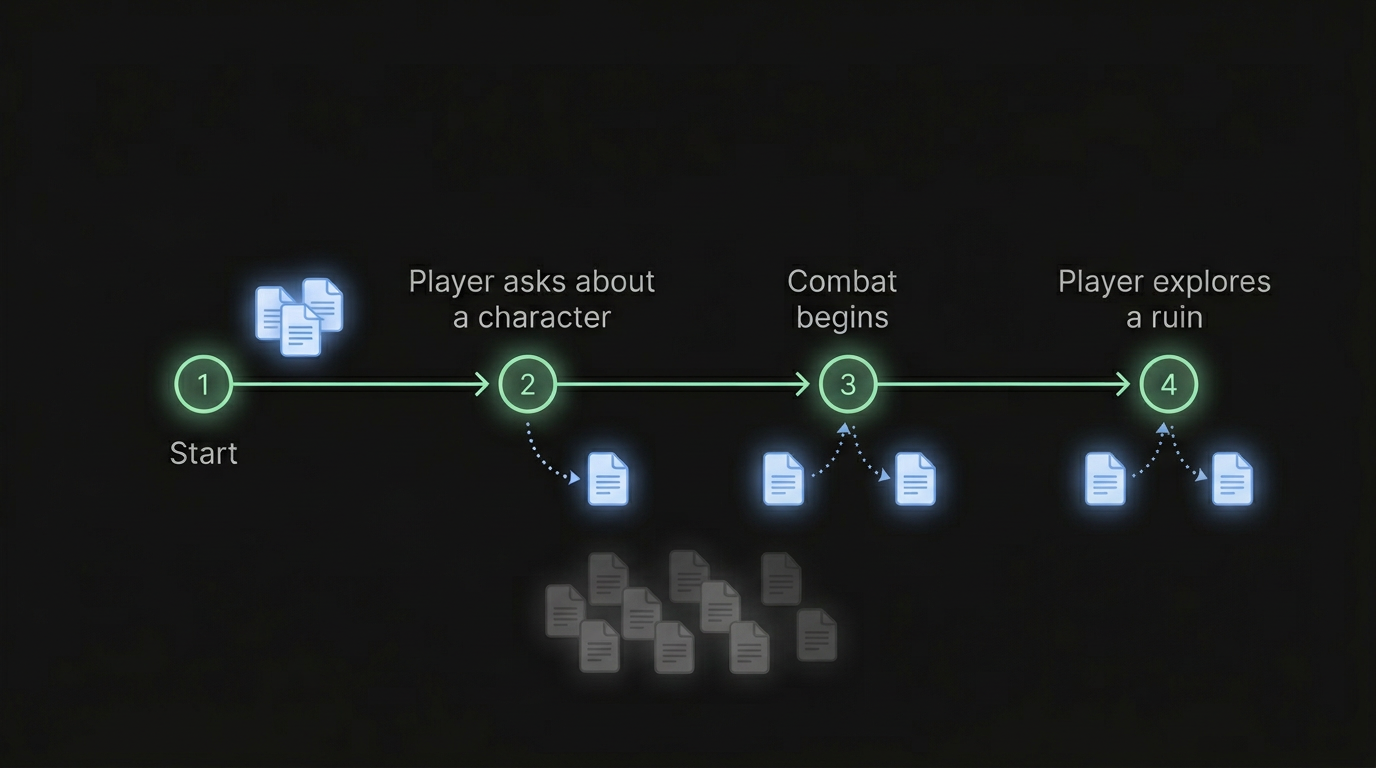
Your Game Master can only hold so much in its head at once. Progressive disclosure is the idea that the AI should start with a small, focused set of information and pull in more detail only when it needs it.
These visibility layers apply to the Game Master only. Orbit uses its own context and is not controlled by file context visibility.
This might sound like a technical concept, but you already understand it intuitively. When you prep for a tabletop session, you don't memorize every NPC's backstory, every room in the dungeon, and every rule in the book. You keep your key notes handy, skim your prep, and look things up when the moment calls for it. That's progressive disclosure.
Why It Matters
When an AI has too much information loaded at once, a few things go wrong:
- Important details get lost. Imagine reading a 50-page document and then being asked a question about page 23. The more you're holding in your head, the harder it is to focus on what matters right now.
- Responses slow down. More loaded content means longer processing time for every message.
- Instructions compete. If you've loaded 20 files of rules, some of them will inevitably contradict each other in edge cases. The AI ends up hedging instead of making confident calls.
The solution isn't to give the AI less content. It's to give it the right content at the right time.
The Three Layers
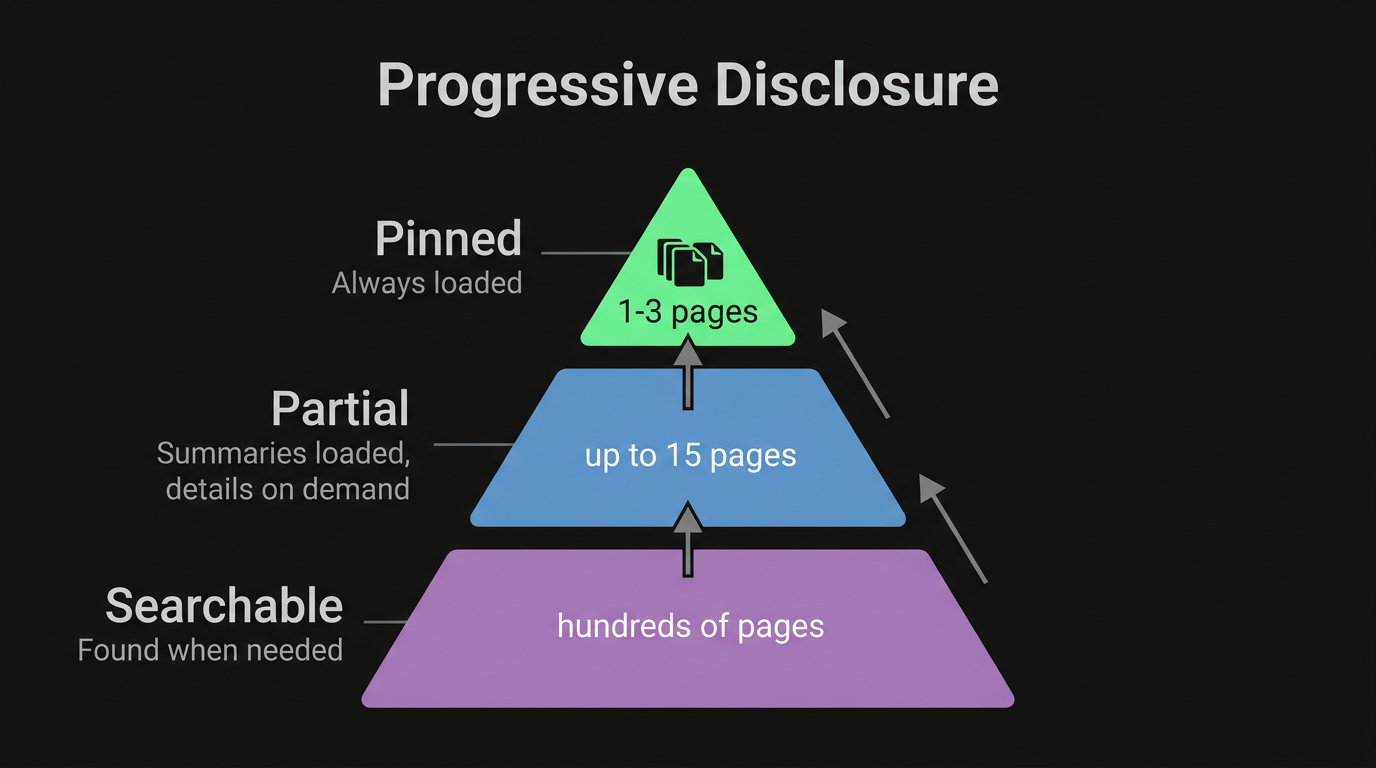
Craft's context visibility system is built around three layers of progressive disclosure.
Layer 1: The Cheat Sheet (Pinned)
This is what the GM has taped to their screen. A few critical files that apply to every single moment of the game: the GM's personality, core rules, the current situation. These are always loaded, so they need to be lightweight and high-signal.
Think of this layer as a directory. It should remind the GM who it is, what matters most, and where to look for everything else. A well-written pinned file might be only a paragraph or two, but it orients the entire session.
Layer 2: The Prep Notes (Partial)
This is the GM's session prep binder, open on the table. The GM can see the tabs and titles. They know what's there, and they can flip to any file in a moment.
In Craft, Partial files load their title and description into context. The AI knows "there's an NPC named Captain Reva who commands the harbor guard" without having her full backstory and stat block taking up space. When a player walks up to Captain Reva, the GM pulls up her full file.
This is where most of your key content should live. The AI knows your world has these elements, and it knows where to find the details.
Layer 3: The Library (Searchable)
This is everything else: the full bookshelf behind the GM's chair. Deep lore, historical records, detailed stat blocks, supplementary material. The GM doesn't know exactly what's on every shelf, but they know they can search through it all.
Searchable content isn't in the AI's working memory at all, but it's fully searchable. When a player asks "what happened during the War of Silver Thorns?" the GM searches your world's content and finds the answer.
Getting the Balance Right
The goal is a pyramid: very little at the top (Pinned), a moderate amount in the middle (Partial), and the bulk of your content at the base (Searchable).
A common mistake is pinning too much. If you pin 30 files of rules, you've basically handed the GM a novel and asked them to keep it all in mind while running a conversation. The important stuff drowns.
A better approach:
- Pin 1-3 files max. These should be short, focused instructions and the most critical rules.
- Set up to 15 key files to Partial. Characters, locations, factions, major plot points. The AI sees the summaries and fetches details on demand.
- Leave everything else Searchable. Hundreds of files of lore, encounters, items, and reference material can live here without hurting performance.
Writing for Each Layer
The way you write content should match how the AI uses it.
For Pinned files, write concisely. Every sentence should earn its place. Use bullet points, keep paragraphs short, and focus on actionable instructions. This isn't the place for flavor text or backstory.
For Partial files, invest in your titles and descriptions. These are the only parts the AI sees by default. A description like "A city" tells the GM nothing. A description like "The largest port city in the Ironcoast, known for its black market and corrupt harbor guild" gives the GM enough to reference it naturally in conversation and know when to look up more.
For Searchable files, write as much as you want. Go deep on lore, history, and detail. This content only gets loaded when the AI searches for it, so length isn't a concern. The richer your searchable content, the better the GM's answers will be when players dig into specifics.
Examples
| Content | Visibility | Why |
|---|---|---|
| GM personality and tone | Pinned | Applied to every response |
| "Write a scene log when you finish a scene" | Pinned | A short, always-on instruction |
| Core combat rules | Partial | Referenced often, but only during combat — GM can pull up the full rules when a fight starts |
| Major NPCs (key characters) | Partial | GM knows they exist, fetches details when they appear |
| Everything Else | Searchable | Most files should be searchable, so they don't bloat your context |
Notice only two files are pinned — both short, both applicable to every single response. The combat rules are important, but they're situational, so Partial is the right fit. The GM sees a summary of the combat rules and loads them in full when a fight breaks out.
The GM starts every conversation knowing its personality, its key instructions, and a light overview of the characters and places. As the session unfolds and players interact with specific parts of your world, the GM pulls in exactly what it needs.
That's progressive disclosure: the right information, at the right time, in the right amount.