
Working with AI
The Game Master and Orbit are AI models. Each one reads a context before it answers: its instructions, what it was given about the moment, and what it looked up along the way. The more that context holds, the less well it attends to any one part of it. So a good world isn't one that puts everything in front of the AI. It gives the AI a small, clear core on every turn and makes everything else easy to look up when it is needed. This guide covers how that works for the GM and in Orbit, and where each part of a world belongs.
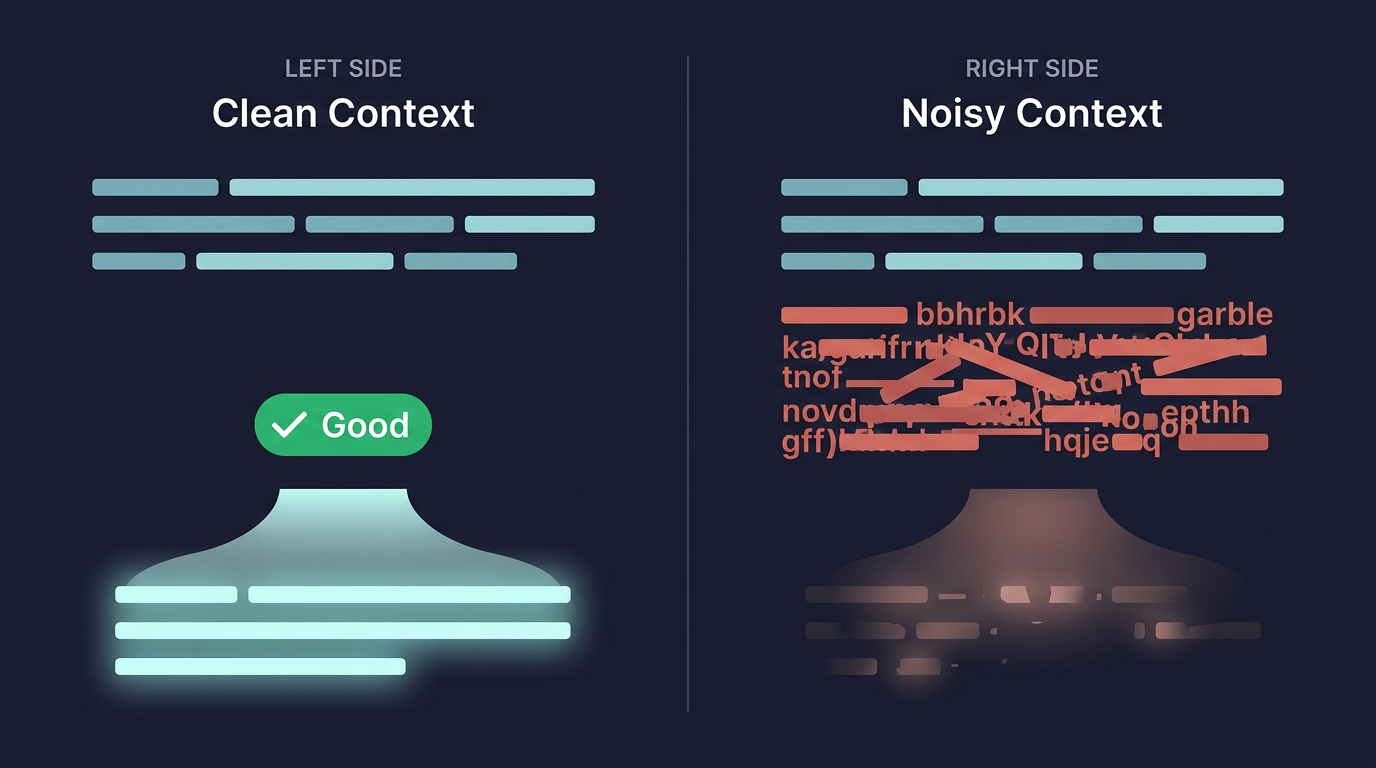
Context rot
Models get less accurate as their input grows, even on simple tasks and even when the right fact is plainly there. In play it looks like this:
- the GM forgets a rule you wrote, or follows some always-on rules and not others;
- replies turn generic or repeat themselves;
- the tone drifts from what the instructions describe;
- the GM spends the turn looking things up instead of telling the story.
What causes it:
- Too much always on. Every always-on instruction is read on every turn, including the one where someone orders a drink. Rules for one moment crowd out the rules that matter now.
- Rules said twice, or arguing. Two instructions on the same thing, or one that fights Craft's defaults, make the GM guess which one you meant. Combine them, and to change one of Craft's defaults, reword Craft's own instead of adding a rule that argues with it.
- Busywork. "Read every lore file before you reply" or "check every sheet each turn" fills the context with lookups the turn didn't need.
- Vague, wordy text. Two thousand words of atmosphere take the room of two thousand words of rules and give the GM far less to act on.
- Old drafts and duplicates the GM can find and believe.
The cure is the same every time: less, said once, in the right place.
What the GM has every turn
Every turn starts with the same short picture of the game:
- Its instructions. Craft's own, the world's always-on GM instructions, and the instructions of the player options the player picked. Craft's own name no game system: the GM knows D&D 5e and other well-known systems, but plays one only when an always-on instruction names it ("uses D&D 5e, with these changes").
- The game's memory. Once a game has grown, a summary of the story so far and the latest chapter in full (see What the GM remembers).
- The current state. The player's character, where the party is and the places that place sits inside, what is drawn on its map, who is in the scene and where they stand, and the trackers. Each person there comes with their file's key fields.
- An outline of the world. The folders and how many files each holds, and the list of procedures with their titles and when to use each. Not the files themselves.
- The recent turns, word for word, since the latest chapter, including the GM's own hidden notes.
- The rules for this moment. The few situational instructions whose moment has come, placed right beside the player's move, where the GM pays the most attention (see Triggers).
- What changed by hand. When someone edits a file or the game's settings between turns, the GM is told at the top of the next turn.
What the GM looks up
Everything else it fetches when the story calls for it:
- Find checks whether something has a file and gets its id: by name, by words in the name, or by a close spelling. Given a folder or a type, it lists what is there.
- Read opens a file by its id, whole or only the fields the turn needs, with what its computed fields work out. One read opens up to 3 files, and gives at most 12,000 characters of each; a bigger file is read in parts, and pictures are left out. Reading a place also gives its map in words: its areas, landmarks and where each exit leads. Reading a procedure gives its steps.
- Research answers an open question in plain words ("What does the Ember Crown do?", "What did the harbourmaster promise?") from the game's search index, and says which files the answer came from. See Research.
- Scripts, in a world that has them, run a rule exactly and hand the GM the result (see scripts).
When the player walks up to Captain Reva, the GM reads her file. When they ask about the War of Silver Thorns, it researches it. Neither took up room until then, so a file the GM isn't using costs nothing: write as much lore as you like.
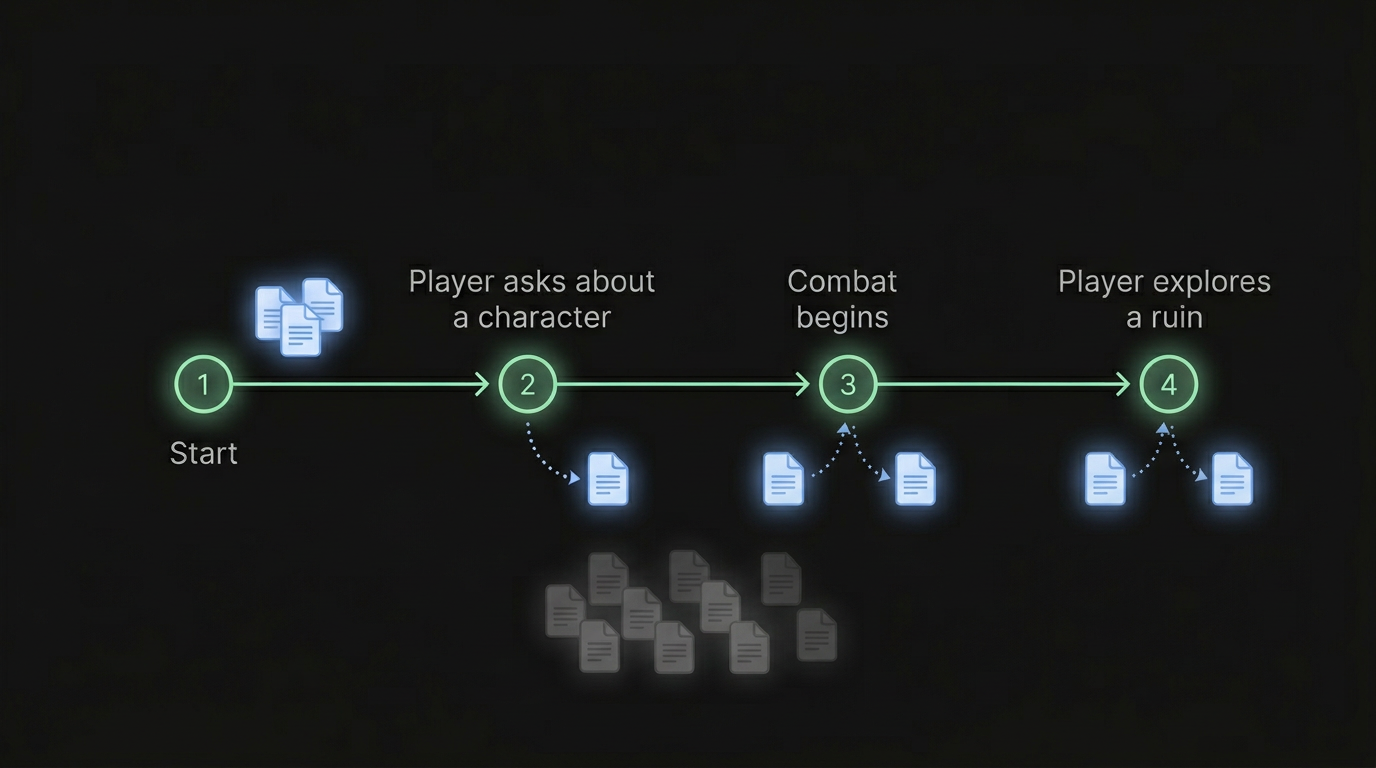
What the GM keeps
What a turn looked up is cleared from the GM's context when the turn ends; later turns see only that the lookup happened. That keeps every turn lean. A few things stay:
- Key fields. The fields of a file type marked key stay after a read or a research answer that returned them: who someone is, how they look and sound. See key fields.
- A read made again. When the GM reads the same file and fields on a later turn after the first read was cleared, that read stays whole until the game's memory next folds those turns into a chapter.
- Procedures set to stay. A procedure stays after its turn only when it is set to stay until the next chapter (see Procedures).
- Hidden notes. The GM keeps notes to itself inside its replies: a secret, what someone really plans, a ruling, a number it will need again. Notes stay with the reply, out of the story, and players can open them under a reply.
So when the GM seems to forget what a sheet says, it most often read the sheet on an earlier turn and the read was cleared. Mark the few fields the story leans on as key, and let the GM read the rest again when a turn needs it.
What the GM remembers
The GM remembers the whole game without carrying every turn. As a game grows, Craft folds older play into chapters. Each chapter has a title, a one or two sentence synopsis, and an account of what happened, point by point, with the turns each point covers. The GM's own hidden notes that still matter are kept in it as points marked hidden.
- When. A chapter is written when the GM's context reaches a set size, or sooner at a natural break: when the party moves to a new place and about half that much has built up, the scene being left becomes a chapter. Long turns fill it faster than short ones.
- What the GM reads. A summary of the whole story before the latest chapter, held to about 800 words however long the game runs, then the latest chapter in full, then every turn since, word for word. Where the latest chapter changes something the summary says, the chapter wins.
- The last exchange stays. The player's latest move and the GM's reply to it are never folded, so the GM keeps the exact words of what it just asked or set up.
- Further back. Every chapter is kept whole in the game's search index, so research finds what happened long ago, in the order it happened.
- Deleting. Deleting the game from a message onward also removes each chapter that reaches the deleted turns, and the turns before them come back word for word. Editing a message, or deleting just one, leaves the chapters as they were.
Chapters are written in the background and cost the player nothing. There is nothing to set up: memory files, session logs and "take notes" instructions aren't needed, and only add to what the GM reads. Memory is for the story. What must stay exact (hit points, money, inventory, conditions, standings) belongs on a sheet or a tracker, which the GM changes the moment it changes.
A small detail from hundreds of turns back can still slip. A player can remind the GM in their next move ("Remember, Sera owes us a favor"), and anything that must never be forgotten belongs on a sheet or a tracker. To repair a game already under way, see fixing a game.
Research
Each game has its own search index: a copy of the world's files taken when the game starts, plus every chapter of the game's memory. It changes with the game, and an edit to a file shows up in research a moment later.
- How it answers. The question is matched against the index by meaning and by its exact words; files the question names are added, with the files they link to. A fast model keeps only the pieces the answer needs, and they come back mostly as written: the files first, then earlier play in order. The answer names its files, with their key fields, so the GM can read or edit them next.
- Who someone is. When a name could mean more than one person, the answer lists each of them, so Lysa isn't mixed up with Lysandra.
- What it never returns. A file hidden from the GM (see visibility).
- Questions, not lists. For "every tavern in the city", the GM lists a folder or a type instead.
- Right after a game starts, a big world's index may still be building; answers say so, and the GM can still find and read any file.
Research only reads, and it isn't charged on its own: it counts toward its turn.
To see what the GM asked and what came back, open Inspect turn on the reply and narrow it to the research tool: each research call shows the GM's questions, and the result under it the answer. If research keeps coming back with the wrong thing, look at the files it should have found: clear names, the key facts up front and links between files help it most.
How Orbit uses context
Orbit works the same way. With each message it gets its own instructions, a list of the world's folders, files and file types, your instructions for Orbit, the chat so far and the file you have open. It reads everything else when a request needs it, and it reads hidden files too, since it is building, not running a game. In a game, it reads the game's messages, its memory and search, only when your question needs them. See Orbit.
What fills Orbit's context is the chat itself, and each message pays again for it. When a chat gets very long, Orbit summarizes its earlier part and keeps the newest part word for word (see long chats). Start a new chat when the topic changes, and let subagents do wide jobs so forty files never land in the chat (see Bulk work).
Where things go
| What | Where it goes | Why |
|---|---|---|
| The premise, voice and tone, the core roll | An always-on GM instruction | The GM needs it on nearly every turn |
| How one moment plays ("When a player barters") | A situational instruction | It arrives only on turns where it happens |
| How a longer moment runs, step by step (a fight's rounds) | A procedure | The GM sees its title every turn and reads the steps when it starts |
| Math, tables and bookkeeping that run the same way every time | A script | Code gets it right every time and spares the GM the steps |
| A rule players might want different (difficulty, lethality) | A player option | Only the picked choice reaches the GM |
| Something the story keeps count of (Heat, a clock) | A tracker | It stays in the current state, where the player sees it |
| People, places, items, factions | One file each | The GM finds and reads them when they come up |
| What the GM should always have once it has read a file | Key fields | They stay after the read |
| History, deep lore, reference tables | Files | Research finds the part a question needs |
| Design notes, drafts, old versions | Hidden files, or deleted | They are for you, not the GM |
Where each part of a rules system goes: designing a game system.
Doing it well
- Keep always on small. Only what nearly every turn needs. A long always-on block is a ceiling, not a target (see GM instructions).
- Name files what people call them. The GM finds a file by its name, words in it and close spellings: "Captain Reva" beats "NPC 14".
- One file per thing. Forty short character files are easier to find and read than one "Everyone in the city" file.
- Key facts first. Open each file with what it is and why it matters. Research reads the opening of files a question names.
- Link related files. References and mentions let research bring back a character's faction and home with them.
- Folders and types that say what's inside. The GM sees the folder outline every turn and lists a folder by its name.
- Mark few key fields. Who someone is, how they look and sound, and in a very mechanical game the handful of stats used every turn. Long lists stay unmarked: the GM reads them when a turn needs them.
- Point to files from instructions. If the GM should use a file at a moment, say so in that moment's instruction ("When someone casts a spell, the Spell List has every cost").
- Let the GM keep its own books. It already remembers the story, tracks the scene, turn order, time and objectives, and records changes as it narrates them.
Mistakes
To repair a game already under way, see fixing a game.
- Instructions for what the GM does itself: memory files, "write the new HP to the sheet", "re-read X every turn". They fight what it already does.
- One giant file for a whole city or a whole rulebook. A read gives one part at a time, and research finds less in it.
- Everything marked key. Key fields stay in the GM's context on every turn after a read, and open each person's entry in the current state; marking a spell list key costs context every turn.
- Hiding a file because it is long. The GM reads only what a turn needs. Hide what would mislead, and keep secrets visible: the GM needs the villain's plan to run it.
- Reading a forgotten detail as a broken GM. Check whether it was on a sheet, a key field or only in an old lookup.
Seeing what the GM sees
You don't have to guess. In the Game Master place, the System prompt page shows the always-on text exactly as the GM reads it, for any player picks, and the Instruction tester shows which situational instructions a player's move would bring in. In a game, Inspect turn in a reply's menu shows exactly what the GM was sent that turn: the whole system prompt, the messages the turn opened with (the scene, its memory of earlier play and the rules for the moment), and every step it took, with search. Hidden notes open from under a reply.