
Dice
When a game calls for chance, Craft rolls real dice. The GM rolls for the people it plays, the player rolls for their own character, and scripts roll for rules that must come out exactly. The dice are rolled in code, never made up by the AI, and every roll shows its dice, its total and how it went. Only the dice are: what a roll changes (a gauge, a condition) is the GM's call from the rules, unless a script applies it. What to roll, and when, is the world's design: you name the dice in the world's rules, and the GM rolls those.
How it is used
- The GM rolls for everyone it plays: enemies, allies and extras, damage, random tables and rolls the player must not see. Each call rolls one expression. The GM sets the number to beat from the world's rules and the files, then narrates the total honestly, failure included.
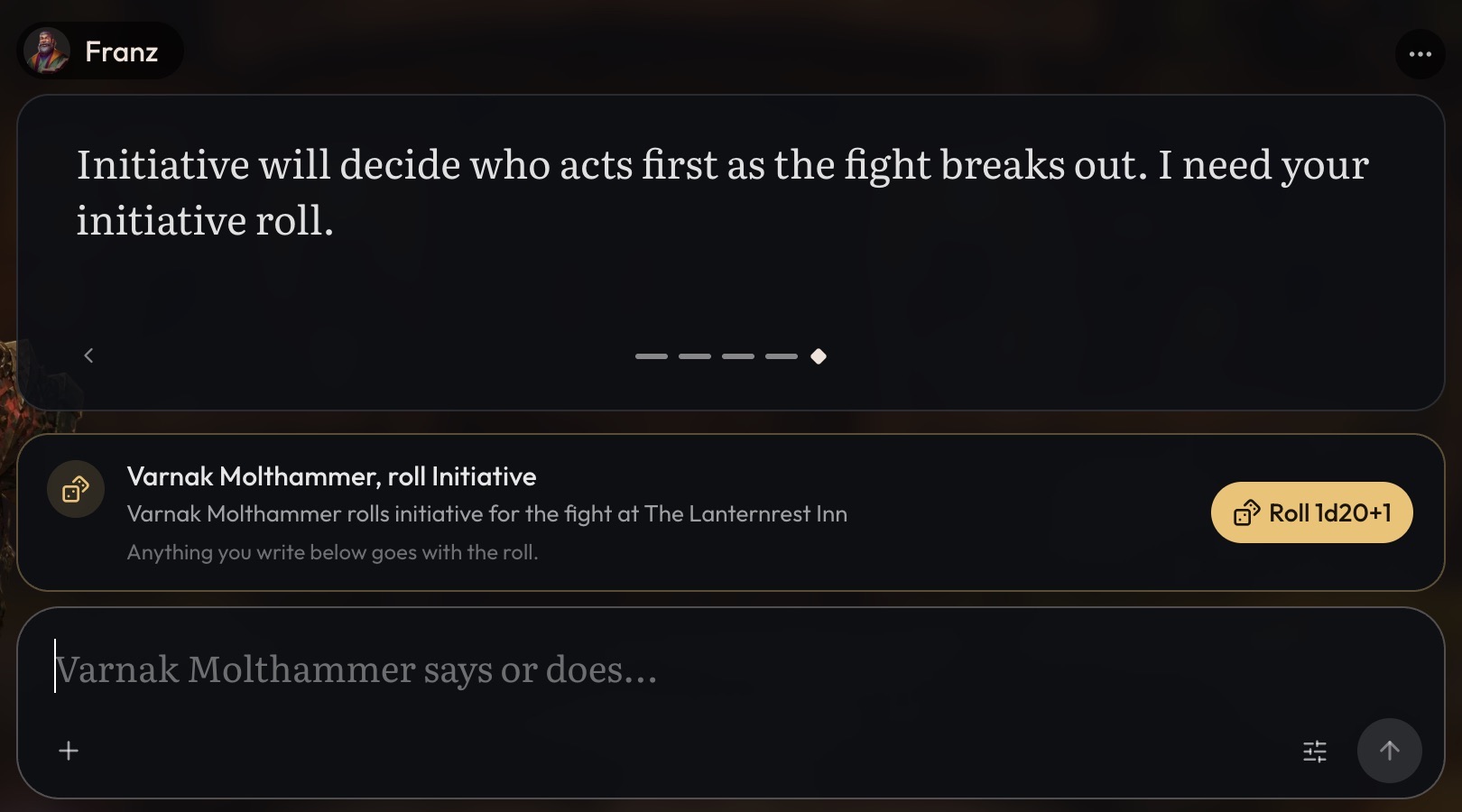
- The GM asks the player to roll for their own character's checks, attacks and saves, when player rolls are on. The GM's turn ends there. The player sees what the roll is for and a button with the dice, and the GM resolves the roll on its next turn. The request also shows the number to beat when there is one, and anything the player wrote goes with the roll. The GM still rolls the character's damage and any roll the player must not see. A check, attack or save the GM tries to roll for the player's character itself is refused while player rolls are on.
- The player rolls on their own from the turn input's menu: pick a die and a count, advantage or disadvantage, labeled modifiers and a message. The roll becomes the player's turn, and the GM reacts to it.
- Scripts roll with the same roller as the GM, and can ask the player to roll and carry on with the result. See rolls and effects.
- With player rolls off, the GM rolls for the player's character too and never asks.
What a roll shows
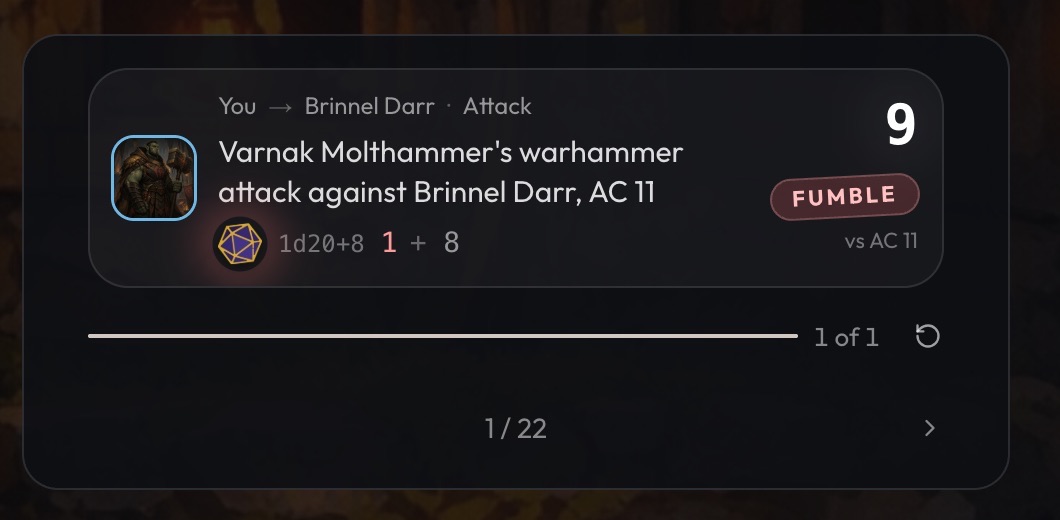
Every roll gets a dice card in the story: what it was for, each die, the modifiers and the total. Dice dropped by keep-highest or keep-lowest are set apart from the kept ones. A roll with several labeled groups shows each group's dice and subtotal, so a pool or an action against challenge dice stays readable.
The card also shows who rolled, at whom and the number it was against, and stamps how it went: Hit or Miss for an attack, Resisted or Failed for a save, Won or Lost for a contest, Pass or Fail for anything else. A single kept d20 that lands on 20 and succeeds is a Crit, and one that lands on 1 and fails is a Fumble. A roll for how much (damage, healing) or a plain chance roll gets no stamp. The same roll plays on the scene's map: the dice tumble over the roller, and the verdict shows over the target. How each kind of roll looks there is in rolls and effects.
The total is always the plain sum of the kept dice and the modifiers. In a system where the sum doesn't matter (counting successes, comparing action dice to challenge dice), the GM reads each die from the labeled groups instead, as your rules tell it.
The player's own rolls throw physically simulated 3D dice. Fate dice, dice with no 3D model and very large handfuls show a flat readout instead; the roll itself is the same either way. The GM's and scripts' rolls show their dice flat on the card. How the dice look is each person's own choice of dice skin, made in their account settings or from the dice builder, not part of a world.
| Limit | Value |
|---|---|
| Dice groups and modifiers in one roll the player makes | 20 |
| Dice of one size in the dice builder | 20 |
| Dice a player's roll throws in 3D (more show as a flat readout) | 14 |
| Dice with a 3D model | d4, d6, d8, d10, d12, d20, d100 |
| Dice in one roll a script makes | 100 |
| Sides on a die a script rolls | 1000 |
Number to beat
Most rules succeed at or above a number (AC 14, DC 15, 8 or more on 2d6), and meeting it is enough. Roll-under rules succeed at or below it (d100 under a skill, 3d6 under an attribute). The GM decides which side succeeds for each roll from the world's rules, so a roll-under game has to say so:
- State the direction in one plain sentence in an always-on rule: "Skill checks are roll-under: roll 1d100, and it succeeds when it is equal to or lower than the skill."
- Name the number the way the table would: "roll 1d100 under Spot Hidden". The card then shows "Spot Hidden ≤45".
- Add a worked example: "Skill 45: a 23 succeeds, a 67 fails."
- Say which rolls go the other way: "Damage and initiative roll high; every check is roll-under."
Setting up a world's dice
- Name the core roll and its dice in an always-on GM instruction: "Roll 2d6 and add the stat that fits. 10 or more: it works." Add rules for the moments that call for other dice. See GM instructions. Choosing the core roll among a system's other parts: designing a game system.
- Never mention a d20 you don't use. When the always-on rules name dice and never a d20, the GM's rolls with a d20 are refused and it rolls your dice instead. "Never roll a d20" names a d20 and turns that off.
- Say how to read anything that isn't a sum. For a pool, name the
group and what counts as a success: "Roll the pool as
6d6[Pool]; each 5 or 6 is a success." - Turn player rolls on or off. To change it, open the GM's profile (its name at the top of the world's Game Master place) and use the Roll tool switch under GM tools. It starts on. The world's setting is the default for new games, and each game keeps its own copy. To change one game's, use the same switch on the GM's profile in the game's Game Master place.
- Use a script for a procedure. A random table, an attack with its damage, or initiative for everyone comes out the same every time from a script, with each roll on the map. See scripts.
- Write dice on files as notation. The GM reads a weapon's
"damage": "1d8+3"and rolls those dice.
Doing it well
- Write every expression in the plain form both rollers read the
same: a count before every
d, keep counts below the dice rolled, and no spaces. - Modifiers are numbers. "1d20+5", not "1d20+DEX". Label a modifier
to say where it comes from:
1d20+2[STR]+3[PROF]. - Advantage is the rules' own. Write it as the system gives it:
2d20kh1in a d20 game,3d6kh2where advantage keeps two of three. - Label groups the rules read apart, and only those:
1d12[Hope]+1d12[Fear]. - Keep the rules about rolling consistent. A leftover "beat the target number" can win over the rule that says roll under.
Mistakes
- A space before a flat modifier. The GM and scripts drop it:
1d20 + 5rolls1d20. Write1d20+5. - A word or
?for a modifier. The player's dice refuse it, and the GM's roller silently drops it. - A die with no count. The player's dice read
d20, but the GM and scripts refuse it. Write1d20. - Keeping as many dice as are rolled.
2d6kh2is refused by the player's dice and keeps both for the GM. Keep fewer than you roll. - Keep on Fate dice. The player's dice refuse
4dFkh2. - A roll-under game that never says so. The GM reads its successes as fails, and the card stamps them so. If a roll still lands on the wrong side, tell the GM in the next turn ("that was a success, it's roll-under") and fix the rule. See fixing a game.
Reference
Each table below runs its examples through both rollers: the player's dice (the dice builder and the roll the GM asks for) and the roller the GM and scripts use. "Refused" means the roll doesn't happen and the roller says why.
Dice notation
NdS
A number of dice of one size, added up: 3d6 rolls three six-sided dice. The count before the d can be left out for one die.
| Expression | Rolls | Player's dice | GM and scripts |
|---|---|---|---|
1d20 |
1 × d20 | yes | yes |
3d6 |
3 × d6 | yes | yes |
1d100 |
1 × d100 | yes | yes |
d20 |
1 × d20 | yes | refused |
NdF
How many sides each die has, or F for Fate (Fudge) dice, which land on -1, 0 or +1.
| Expression | Rolls | Player's dice | GM and scripts |
|---|---|---|---|
4dF |
4 × Fate dice | yes | yes |
4dF+2 |
4 × Fate dice; +2 | yes | yes |
4dFkh2 |
4 × Fate dice, keep the highest 2 | refused | yes |
khN and klN
Keeps only the highest (kh) or lowest (kl) few dice of the group and drops the rest: 2d20kh1 is advantage, 4d6kh3 keeps the best three. It keeps at least one die and fewer than the group rolls.
| Expression | Rolls | Player's dice | GM and scripts |
|---|---|---|---|
2d20kh1 |
2 × d20, keep the highest 1 | yes | yes |
2d20kl1+4 |
2 × d20, keep the lowest 1; +4 | yes | yes |
4d6kh3 |
4 × d6, keep the highest 3 | yes | yes |
3d6kh2+1 |
3 × d6, keep the highest 2; +1 | yes | yes |
2d6kh2 |
2 × d6, keep the highest 2 | refused | yes |
[Label]
A name for the group in square brackets, so the roll can be read group by group: a pool counted for successes, action dice against challenge dice.
| Expression | Rolls | Player's dice | GM and scripts |
|---|---|---|---|
6d6[Pool] |
6 × d6 (Pool) | yes | yes |
1d12[Hope]+1d12[Fear] |
1 × d12 (Hope); 1 × d12 (Fear) | yes | yes |
+NdS and -NdS
Several groups in one roll are joined with + or -; a group after a - is taken away from the total.
| Expression | Rolls | Player's dice | GM and scripts |
|---|---|---|---|
1d6[Action]+2d10[Challenge] |
1 × d6 (Action); 2 × d10 (Challenge) | yes | yes |
1d20-1d4 |
1 × d20; minus 1 × d4 | yes | yes |
1d20 - 1d4 |
1 × d20; minus 1 × d4 | yes | yes |
+N and -N
A flat number added to or taken from the total, with an optional label in square brackets to show where it comes from.
| Expression | Rolls | Player's dice | GM and scripts |
|---|---|---|---|
1d20+5 |
1 × d20; +5 | yes | yes |
2d6-1 |
2 × d6; −1 | yes | yes |
1d20+2[STR]+3[PROF] |
1 × d20; +2 (STR); +3 (PROF) | yes | yes |
1d20 + 5 |
1 × d20; +5 | yes | reads it as 1d20 |
1d20+STR |
1 × d20 | refused | reads it as 1d20 |