
Linked locations
A pin on a map says where a place is. It doesn't say how you get there, and many places are on no map at all. A linked location says how two locations relate without drawing anything: one is part of the other (a cellar under the kitchens), both are parts of one place (two floors of an inn), they are separate places joined by a way (a road between two towns), or they relate some other way you put in words ("is the Shadowfell reflection of"). The GM uses these links to know what is inside what and how to get from one place to another, so a world with few maps can still be travelled.
How it is used
- The GM moves the party along them. The GM offers each way as a move ("stairs up to the Top Floor"), brings people in where the way comes in, and finds the same cellar again when the party goes back down. Its current state says what a place is part of ("Within: The Ring Kitchens") even when no map draws it, and lists the parts and ways of the place the party is in, with what it knows of each way: locked, hidden, how far, when it is open, what it takes. A one-way way is offered only from the end it leaves.
- The GM makes them too. When the story goes somewhere new inside the current place (a cellar, an upper floor, a back room), the GM makes the new location as a part of that place, with a way between them, and draws nothing.
- Links you change during a game reach the GM. It is told on its next turn what is now inside what and which ways are new.
- The play screen's world map puts a location under the place it is part of when no map draws it.
- In the map editor each linked location sits as a badge around the map, on the side its way points to: stairs up above the map, a door west on the left. Badges stay out of a game's player view, so a hidden way gives nothing away, and they don't show on phones.
- They belong to the world. A link is saved on a location, in its version history, and travels with copies of the world, game starts and packages.
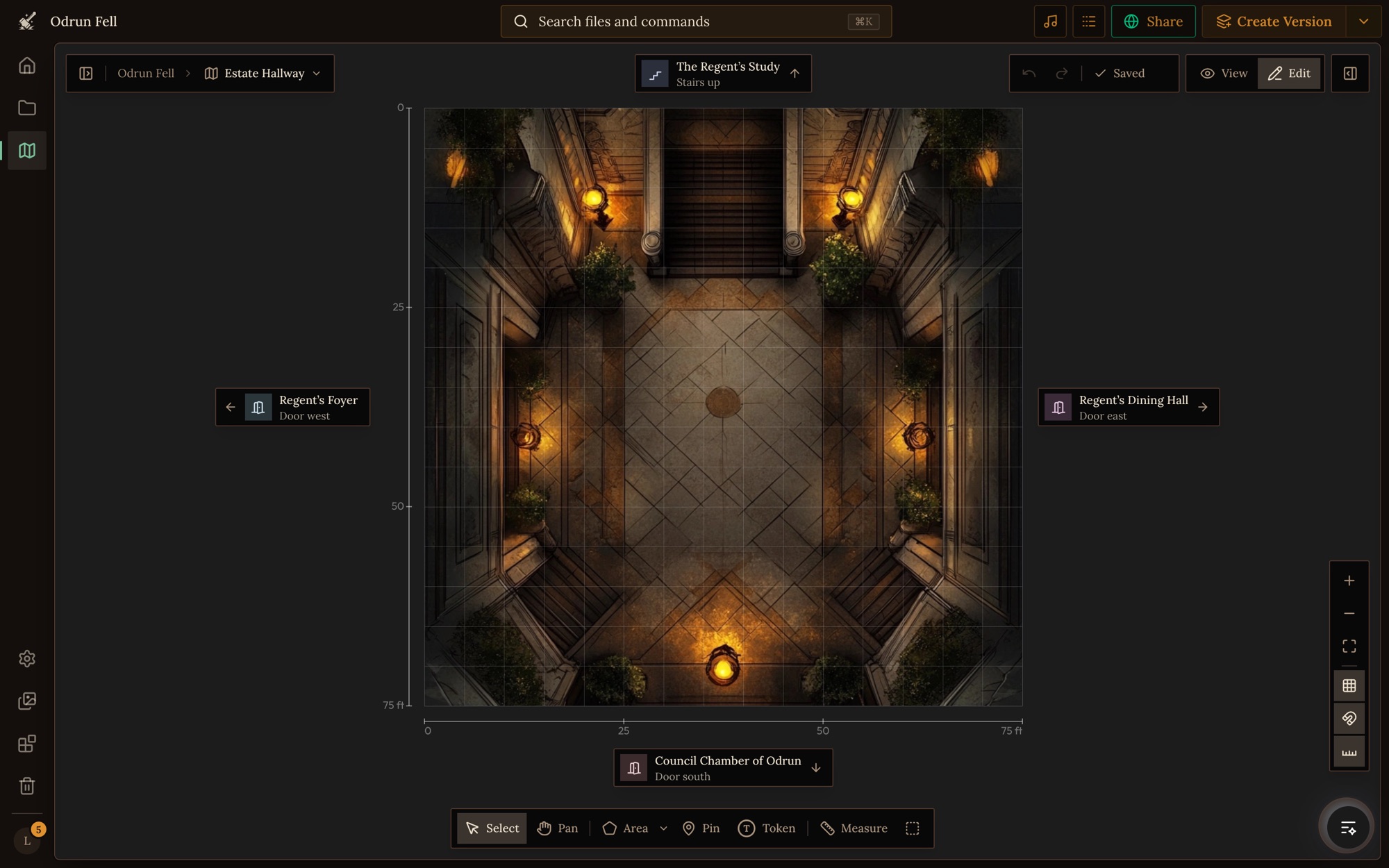
Clicking a badge opens that place's map. Hovering one shows its picture, the link as a sentence, View map and Edit link.
Linked location or map exit
Both say how to get from one place to another. Pick by whether the way has a spot on a drawn map:
- The way is at a spot on a map (the door in a floor plan, the town gate): make that pin or area an exit. See Exits.
- There's no map, or the place isn't in the picture (a cellar, the floors of a tower, a realm reached by ritual): link the two locations.
- Both is fine. The kitchens' map can draw a hatch as an exit down to the cellar while the cellar is linked as part of the kitchens.
A linked location's way has the same fields as an exit: what it is, which way it runs, locked, hidden. Don't also pin a linked place on the other place's map: the inn's upper floor is reached up the stairs, not drawn on the ground-floor plan.
How two locations can relate
A link is read from the location you start on. There are five answers:
- Both in one location. Floors, rooms or wings of one place, or two towns of a kingdom, two systems of a sector. You name the place they're both in, and give the way when one joins them (a road, a jump lane).
- The other is part of this one. A room, floor or corner inside it.
- This one is part of the other. The cellar of the kitchens.
- Separate locations. Each a place of its own, in no place they share, joined only by the way between them. They need a way. Saving it takes the other out of a place both were in, so two places in one place are both in one location, with the way. This is also the answer for a way between rooms of different places (a secret passage from the queen's chamber in one wing to the chapel in another): each room stays in its own wing.
- Something else. Your own words for how they relate: "was built on the ruins of", "is the Shadowfell reflection of". The words go between the two names, so the sentence reads the same from either end. Not for a way: a link with a way is one of the answers above.
relation |
Means |
|---|---|
same_place |
Both are parts of one place (two floors of an inn). Needs the place they are both in. |
contains |
The other location is part of this one (the kitchens and their cellar). |
part_of |
This location is part of the other (the cellar of the kitchens). |
separate |
Two places of their own, joined only by the way between them. Needs a way. |
other |
Related some other way, said in words ("is the Shadowfell reflection of"). Needs the words. |
The way between them
Any of the answers can have a way, and separate locations must. A way says:
- What it is: a door, gate, stairs, ladder, hatch, path, road, dock, portal, bridge, ferry, tunnel, ritual or other.
- Which way it runs from the location you start on: up, down, in, out, through or a compass point. Read from the other end it turns round: the cellar's stairs up are the kitchens' stairs down.
- Whether it is locked, hidden or one way. Hidden is for a secret door or a way no one looking would see: the GM sees it marked hidden and decides when the party finds it. Who in the world knows about it goes in GM instructions or the GM's notes. A one-way way (a chute, a portal into a market square) only goes from one end.
- Its words, if they help: a name ("the Deep Stair"), how far it goes ("300 ft"), how long it takes ("3 days on foot"), when it is open ("at twilight") and what it takes ("an obol").
| Field | Type | Required | What it is |
|---|---|---|---|
kind |
"door" | "gate" | "stairs" | "ladder" | "hatch" | "path" | "road" | "dock" | "portal" | "other" | "bridge" | "ferry" | "tunnel" | "ritual" |
What the way is: a door, stairs, a road, a portal. Default "door". |
|
direction |
"up" | "down" | "in" | "out" | "through" | "north" | "northeast" | "east" | "southeast" | "south" | "southwest" | "west" | "northwest" |
Which way it runs from where it starts. | |
locked |
boolean |
Locked or barred. | |
hidden |
boolean |
Not obvious to someone looking: a secret door, a hidden hatch. | |
when |
string |
When it is open: "at twilight". | |
requires |
string |
What it takes: "an obol". | |
by |
string |
What is or makes the way, by reference id: a place, a character or an item. | |
label |
string |
The way's own name, read the same from both ends: "the smugglers' tunnel". | |
distance |
string |
How far it goes, where no map can measure it: "50 mi". | |
time |
string |
How long it takes: "3 days on foot". | |
oneWay |
"there" | "back" |
Only one way: "there" (this location to the other) or "back" (the other to this one). |
The map editor sets a way's name, distance and time. When it is open, what it takes and what makes the way are set through Orbit or the CLI.
Linking two locations
To see what a location is linked to, open the location's map, then Map settings, and look at Linked locations. To link two locations, click Add Linked Location and answer its three steps: which location, how they are related, and how you get there. To take a link away, open the link from either location's Linked locations list and remove it.
The button is under This place in Map settings, and below the map. Hovering the empty space beside the left, right or top of the map shows it too, with the direction set from that side. In step 1, New location, the search's last row, drafts a new place to fit beside this one. Step 3 reads the whole link back as a sentence before Add link.
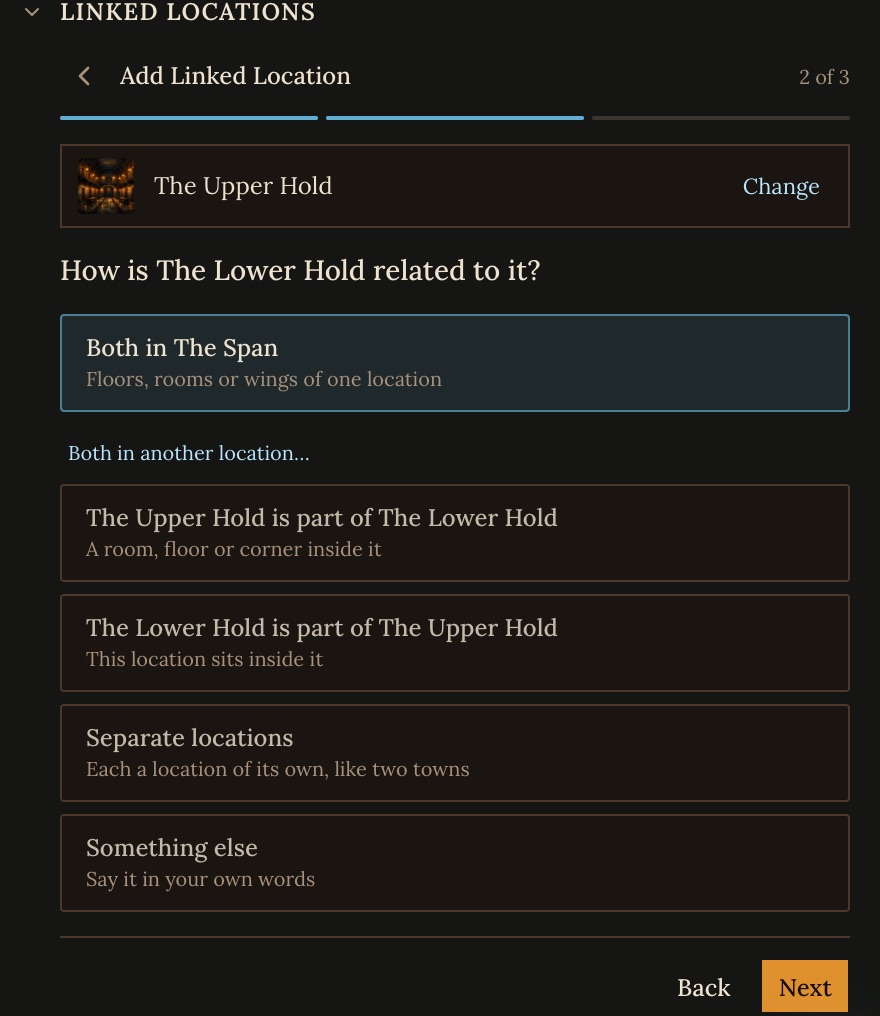
A link shows on both locations, so you can change or remove it from either end.
What saving a link moves
Each part of a link is stored once, on the location it belongs to, and read from both ends: the cellar keeps that it is part of the kitchens, and the kitchens list the cellar among their parts. Don't link the same pair again from the other side.
Saving a link can move a location in or out of another:
- Part of moves the part into the whole, out of wherever it was.
- Both in one location puts both in the place you name, the first location too.
- Separate, something else and removing the link take the two out of each other. If both were in one place, the other location leaves it.
A location is part of at most one other, never of itself, and never of a place that is part of it. A save that would break that is refused with the reason. The editor says what will move before you save.
Transports
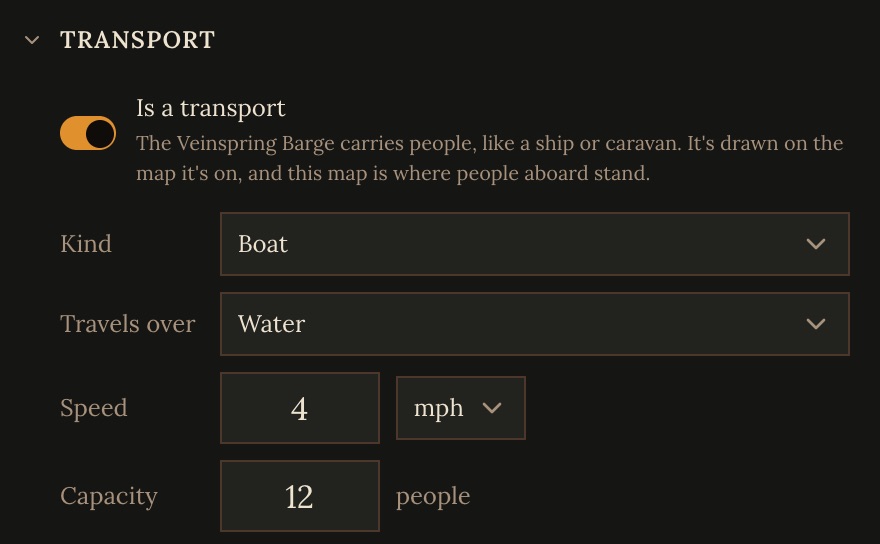
A ship, airship, caravan or train the party can board is a location that is a transport. To make one, open its Map settings, then Transport, and turn on Is a transport.
| Field | Type | Required | What it is |
|---|---|---|---|
kind |
"ship" | "boat" | "airship" | "wagon" | "caravan" | "carriage" | "train" | "car" | "bus" | "plane" | "mount" | "other" |
yes | What kind of transport it is. |
travels |
"water" | "land" | "air" | "rail" | "underground" | "space" |
What it travels over: a ship can't take a road. | |
speed |
{ value, unit } |
Its usual speed, for how long a trip takes: a value and a unit, mph, km/h or knots. | |
capacity |
number |
How many people it carries. |
Its own map is the deck plan, where the people aboard stand. Where it is now is its pin on another map. The GM moves that pin when it arrives, to a spot on the destination's map where its kind stops (a dock, harbour or quay for a ship, a gate or stables for a caravan, a station for a train), so name those spots on your maps. From then on the pin says where it is, so the GM takes the transport out of any place it was part of. Don't make a ship part of its home port.
A ship with several decks: make each deck a location, link it as part of the ship, and link the decks to each other with ladders or stairs. They go wherever the ship goes.
A transport's way out (an airlock, a gangplank) leads to wherever it is now, so it has no fixed destination: never pair it with a port's dock. A dock is where the transport's pin goes, not a door into it.
Doing it well
- The bigger place holds the smaller. A wall, ring or camp built around a place is part of the place it surrounds, or the two are something else in words ("is built around"), never the container of a whole drowned city.
- Link places that aren't on any map. Every place the party can reach should be part of something, or joined to something by a way. The GM can reach a place linked to nothing only by its name.
- Name a part for its place when the bare name could belong to any place: "The Ring Kitchens Cellar" stays clear wherever it is listed; "Cellar" doesn't. A name that is already one of a kind ("the Queen's Chamber") needs nothing added.
- Give a way a direction. It decides which side of the map the badge sits on and how the GM words the move ("stairs up", "the road north").
- Say how far, when no map can. A road between two towns needs a
distanceortimefor the GM to know how long the trip takes. Both are words in any unit ("3 jumps", "2 days"), so a jump route with a length is a way, not a list of references on each star system: only a way lets the GM move the party along it. - Use words for what isn't a way. A reflection, a rival, a sister city is something else in words, not a way with no kind.
- Floors go in one place. The floors of a tower are each part of the tower, joined to each other by stairs, rather than a chain of parts.
Mistakes
- Linking the pair from both sides. It is one link, read from both ends. Saving it again from the other side changes that same link.
- Separate locations with no way. They need one: the way is all that joins them.
- A direction from the wrong end. The direction runs from the location you start on. The cellar's way to the kitchens is up.
- Pinning a part on its place's map as well. The cellar is reached down the stairs, not drawn on the kitchens' floor.
- Expecting a part to keep its old place. Making a location part of another moves it out of where it was.
How relations are stored
Each link is saved as relations on one of the two locations, at most 100 per location. There are three kinds. Linking two locations writes them for you, so you rarely need these.
Relation kinds
inside
The place this one is inside. Always stored on the place that is inside, so a place's parent is in its own metadata; the parent reads it as "contains". One per place.
| Field | Type | Required | What it is |
|---|---|---|---|
id |
string |
yes | The relation's own id. |
to |
string |
yes | The location this one is inside, by reference id. |
level |
number |
Floor or deck order among the place's parts: 0 the ground floor, negative below it. |
Stored on the location that is inside, so the other location's list shows
it as a part. Nothing in the editor or the tools sets level yet, and a
place that moves loses it.
connects
A way to another place, with no spot on a map. With no to, out to the place this one is inside.
| Field | Type | Required | What it is |
|---|---|---|---|
kind |
"door" | "gate" | "stairs" | "ladder" | "hatch" | "path" | "road" | "dock" | "portal" | "other" | "bridge" | "ferry" | "tunnel" | "ritual" |
What the way is: a door, stairs, a road, a portal. Default "door". |
|
to |
string |
The location it leads to, by reference id. None: out to the place this one is inside. Default null. |
|
direction |
"up" | "down" | "in" | "out" | "through" | "north" | "northeast" | "east" | "southeast" | "south" | "southwest" | "west" | "northwest" |
Which way it runs from where it starts. | |
arriveAt |
string |
The pin or area on the other location's map where it comes out, by element id. | |
main |
boolean |
The main way in and out, where someone arriving comes in. | |
locked |
boolean |
Locked or barred. | |
hidden |
boolean |
Not obvious to someone looking: a secret door, a hidden hatch. | |
oneWay |
boolean |
Only from here to there: a chute, a one-way portal. | |
when |
string |
When it is open: "at twilight". | |
requires |
string |
What it takes: "an obol". | |
by |
string |
What is or makes the way, by reference id: a place, a character or an item. | |
label |
string |
The way's own name, read the same from both ends: "the smugglers' tunnel". | |
distance |
string |
How far it goes, where no map can measure it: "50 mi". | |
time |
string |
How long it takes: "3 days on foot". | |
id |
string |
yes | The relation's own id. |
A part's way out to its place has no to. A oneWay way is stored on
the location it leaves from.
other
Anything else, in the label: the words between the two places' names, so it reads the same from both ends. On Gloomwater, "is the Shadowfell reflection of" Waterdeep; on a keep, "was built on the ruins of" a fortress.
| Field | Type | Required | What it is |
|---|---|---|---|
id |
string |
yes | The relation's own id. |
to |
string |
yes | The other location, by reference id. |
label |
string |
yes | The words between the two names: "is the Shadowfell reflection of". |
{ "id": "<uuid>", "type": "other", "to": "<Waterdeep's reference id>", "label": "is the Shadowfell reflection of" }