
GM Instructions
GM instructions are the rules a world gives its Game Master: the premise, the tone, the core roll, how a moment plays out. They are one value saved with the world, and every game copies it when it starts. Player options sit beside them: questions the player answers when a game starts ("Difficulty", "House rules"), where each choice brings its own instructions.
Before writing a rule:
- Keep the creator's words: their "you", numbers and names. Anything added is an offer, named as an addition.
- A world on a known system (D&D 5e) gets one always-on rule naming it, then only what differs. Designing a system's rules: designing a game system.
- A count no sheet holds (a running house total) needs a tracker, not only a rule.
- Every stat or condition a rule names exists in the world.
How it is used
Every instruction is one of three kinds, and each reaches the GM in a different way:
- Always on. In the GM's system prompt on every turn, under its title. The strongest place, and the most crowded: the more there is, the less well the GM follows any one part. Keep it for what nearly every turn needs.
- Situational. A short reminder for one moment ("When a character drops to 0 HP"). Twice a turn, before the GM answers and after it narrates, a quick check reads the moment and hands the GM the few whose moment has come: in full the first time, by title after that. See Triggers.
- Procedure. The steps for running a longer moment: a fight's rounds, a negotiation, a heist's phases. The GM keeps a list of every procedure by title and when to use it, and reads one whole when its moment comes. See Procedures.
Around those:
- Sections group the world's own instructions ("World", "Rules"). The GM reads them in section order.
- Player options each have choices. Only the picked choice's instructions reach the GM, so three versions of a rule cost no more than one. The player picks before the game starts and can change it during play, from the next turn.
- Trackers are instructions too: an instruction with a tracker defines something the GM keeps in the current state for the player to watch (Heat, a chase, faction standing). Its text is the tracker's rules, read beside the tracker while it is in play. See Trackers.
- Craft's defaults are in every world unless it changes or removes them: "Player agency", "Only the story", "Rolls", "Each turn", "Places, not squares", "Journeys, not timetables", "Player moves" and "Running a fight", the Combat, Objectives, Party and Time trackers, and the Response length and Long-distance travel player options. Their Rolls rule says when to roll, not with what dice: a world names its dice and stats in an always-on instruction. See Craft's defaults.
- What the GM does itself needs no instruction: it keeps its own memory of the game, the scene, the map, turn order, time and objectives, looks files up as it needs them, and records changes as it narrates them.
A new game copies the world's instructions from the version it starts from, and a game in progress gets the world's changes only when its owner syncs them in. Each game's copy can be changed for that game alone (see In a game).
Changing GM instructions
A world's GM instructions live in the world's Game Master place (the crowned die on the workspace's left rail). The editor checks every save and marks what to fix. The format and every field are in the format; the limits are below.
The Game Master place (the crowned die in the world's left rail) lists the world's Instructions by section, Tracker templates and Player options. Use + Instruction or + Player option to add one, and click a card to edit it. The budget at the foot shows how much of each limit the world uses.
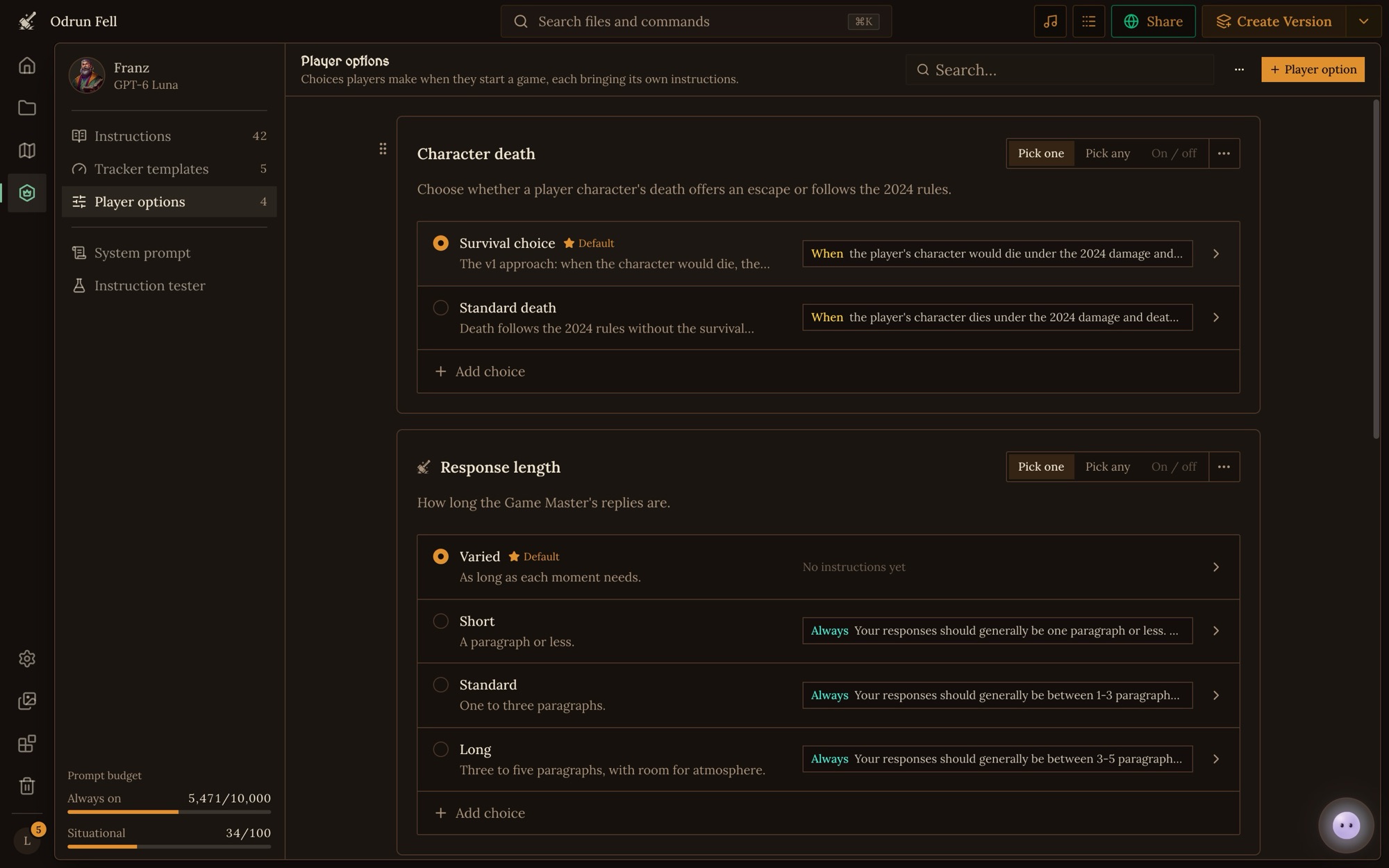
New games get a change from the next published version (a world never published starts its games from the live world). Games already running get it when their owner syncs.
Doing it well
- A trigger is a moment, not a number. The check that picks situational rules can't see sheets or trackers, so "when Corruption reaches 10" never fires. Put what happens at a threshold inside the rule that moves the number, or in a short always-on line.
- Situational first. Make an instruction always on only when the GM needs it on almost every turn: the premise, the GM's voice and tone, the core game system and its dice, the few rules no turn may break, and principles that shape every scene ("a mystery never dead-ends"), even when they're worded about one kind of moment. Anything that applies when something happens (a fight, a purchase, a secret, a journey) is situational, even when it happens often. When in doubt, situational.
- Leave room. Craft's defaults take about 2,200 of the 10,000-character always-on budget. Keep the world's own always-on text under about 3,900.
- Split mixed rules. When an always-on rule has a part for one moment (how NPCs speak, what happens at 0 HP), keep the every-turn sentence always on and move the rest into a situational instruction.
- A rule drawn from the world's data says only what the data shows. Check each claim against the files ("illegal goods cost the most in their band") and offer anything more as a change.
- Every condition a rule tests is in the game. "Closed on Wednesdays" needs a weekday the GM can read (a tracker, a rule that says day 1 is Monday); add the missing piece or say it's missing.
- The creator's rules in the creator's words. Splitting moves their sentences; it doesn't rewrite them. Keep their "you", their numbers and their names, and add nothing they didn't say: an addition you think helps is an offer. When a pasted rule keeps a count no sheet holds (a running house total), keep the wording and offer a tracker to hold it: a rule alone puts nothing on screen.
- One moment per situational instruction, with the ruling first and a trigger the story can show (see Triggers).
- Long steps are a procedure; exact steps are a script. A procedure is for a moment that needs judgment over several steps. Math, rolls and bookkeeping that run the same way every time belong in a script, which the GM calls instead of working them out.
- Player options are for choices players make. Difficulty, lethality, tone and house rules the creator wants players to pick go in an option's choices, with the world's usual way as the default. A rule the creator simply states, even one they call a variant or house rule, is one of the world's own instructions. A rule that should change with an option lives only in that option's choices, never also in the world's own instructions.
- Name your dice. Craft's defaults name no dice and no game system, so every world needs one always-on instruction with its core roll ("roll 1d20 + modifier against a DC", "2d6 + stat: 10+ clean"), even a world built on a well-known system. For a world built on one, name the system in it ("uses D&D 5e, with these changes"), then write only what differs. In a roll-under world every rule with a roll says "under". Never mention a d20 you don't use: see Dice, and read it before writing the core roll.
- Reference rules stay in files. A spell list or a gear table is a file the GM looks up. An instruction can name the file for its moment ("When someone casts a spell: the Spell List has every cost").
- Change Craft's defaults rather than argue with them. If a default doesn't fit, reword it or turn it off (see Craft's defaults); a second rule beside it makes the GM guess.
Wording
How to word a rule so the GM follows it, with weak and better examples and a short test for any rule, is in writing good instructions. How to change the GM's prose with one short instruction, and why a long style rulebook doesn't pay, is in changing how the GM writes.
Broad style here, exact rules in prose rules
Instructions and prose rules do different jobs, and each is weak at the other's:
- Instructions set the voice. They reach the GM before it writes, so they are the only place for what has to be in the writing from the start: the style, the tone, the narrator, how long a reply runs, how much detail. A named style works well here, and a long list of exact rules works badly.
- Prose rules enforce exact rules. They are a player's own list (Settings, under Experimental), turned on for a game in its Player Preferences. The GM never sees them. After the GM has written, a separate pass checks the reply against each rule and rewrites any passage that breaks one, so a rule there costs the GM no attention and is enforced rather than hoped for. This is the place for "No em dashes", "Say what something is, not what it isn't" and a list of banned phrases.
Prose rules are experimental and on GM Harness 2 only. With them on, the reply arrives all at once instead of word by word, and each turn costs a little more energy. The pass can cut and reword what the GM wrote, never add to it, so a rule that asks for a tone, a length or richer detail does nothing there: that is an instruction's job. Prose rules belong to the player, not the world, so a world can't ship them to its games.
Testing a change
- See what the GM gets. The System prompt page in the Game Master place shows the always-on text exactly as the GM reads it, for any set of player picks.
- Check every choice, not only the default. The System prompt page can show the GM's text for any picks, and an option's Compare choices marks the words its choices differ by. Play a game on each choice you changed: the tester covers situational rules, but only play shows how an always-on choice feels.
- Test triggers. The Instruction tester takes a player's move and shows which situational instructions, trackers and player options it would bring in.
- Play a fresh game. The GM copies its own recent replies, so an old habit can carry on for a few turns after a fix.
- Retry before rewriting. Retry a missed turn a couple of times, then on a stronger model. If the stronger model follows the instruction, it is fine; if it misses too, rewrite it.
- Audit the whole set now and then. To check the instructions against the handbooks and the world's files, see auditing a world.
Mistakes
- Everything always on. Rules for one moment crowd the prompt and get followed less well. Make them situational or procedures.
- Rules for what the GM does itself. Memory files, "re-read X every turn", "write the new HP to the sheet", moving tokens, "wait for the player to roll" and output formats (headings, JSON, lists of choices) all fight what the GM already does. Take them out. Naming a script the world has, or a tool the GM has, is fine.
- Read-everything rules. "Every turn, read every lore page" spends the GM's attention on lookups instead of the story.
- Context tricks and note formats. "Always keep file X in mind", pinning, out-of-character reasoning blocks and "think step by step" scaffolding do nothing useful: the GM looks files up as it needs them and keeps its own notes.
- A tracker written as a rule. "Track Heat from 0 to 6" puts nothing in the current state. Define a tracker.
- A rule that argues with a pick. "Keep replies short" fights a player who picked Long. Put it in the option's choices instead.
- A changed key. Option and choice keys are what games' picks point at. Rename the label, never the key.
- A field name the format doesn't know. It is dropped and does nothing. Copy field names from the format.
Limits
Every save is checked against these.
- Always-on text: at most 10,000 characters of names and text in the largest game a player can pick. Craft's defaults take about 2,200 of it. Trackers don't count.
- Situational instructions: at most 100 in that largest game.
- Procedures: at most 25 in that largest game, Craft's editable ones included. The four built into every game don't count.
- Instructions in all: 200, the world's own and every choice's.
- Text of one instruction: 2,000 characters always on or for a tracker's rules, 1,000 situational, 10,000 for a procedure.
- Titles and triggers: 120 characters each.
- Player options: 9 in a game, Craft's 2 included, with up to 8 choices each.
- Option and choice names: 60 characters; descriptions 200; keys 60.
- Sections: up to 30, each name up to 40 characters.
"The largest game" counts the world's own instructions, Craft's, the longest choice of each pick-one option and every choice of the others, so a long choice takes room even if nobody picks it.
Reference
- Craft's defaults: The instructions, trackers and player options Craft gives every world, and how a world rewords, removes or moves them.
- GM instructions format: The saved shape of GM instructions, with the whole value, an instruction, a player option, a choice, and changes to Craft's defaults.
- GM instructions in a game: A game's own copy of its world's GM instructions, the player's picks, what a change does in play, and how syncing merges them.
- Changing how the GM writes: How to change the GM's prose with a short always-on style instruction, why long style rulebooks and draft-and-check routines cost more without reading better, and what we measured.
- Procedures: Instructions for running a longer moment step by step, which the GM reads whole when their moment comes.
- Triggers: How a situational instruction is brought in on the turns it applies to, and how to write a trigger the check can spot.
- Writing good instructions: What makes a GM instruction one the GM follows, with weak and better examples, the words to avoid, how much is too much, and a short test for any rule.