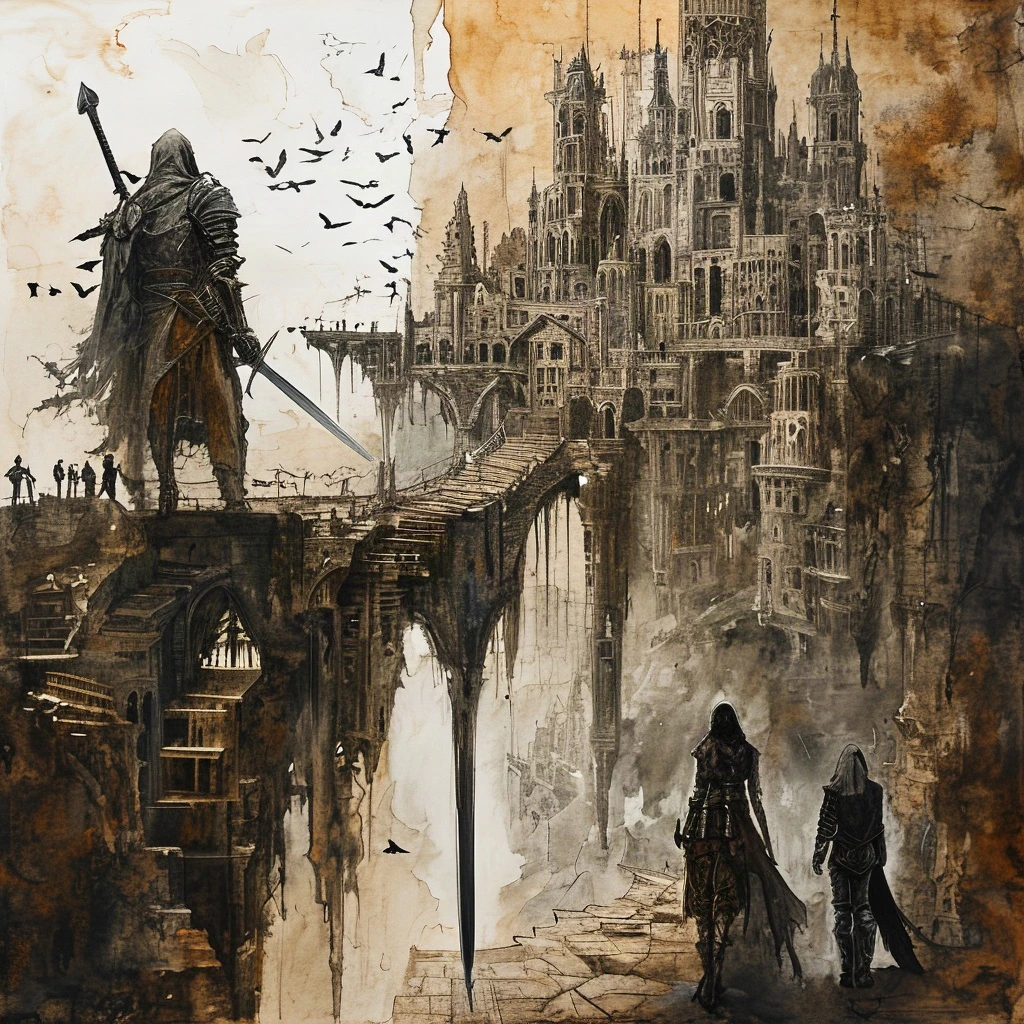
The pit does not ask what you were. It takes the body as it stands and weighs everything else later. You make a body the way the pit makes everything: sparse, flat, and honest about what it costs.
The two ways in
Every descent begins as one of two people, and the difference between them is the whole question the pit exists to ask.
The Arrival. You wake mid-journey on the road to the pit city, walking toward something you cannot name. You have a short blade, a cheap lantern, and a coat that was on a fence. Somewhere behind your eyes, a voice has already welcomed you. It does not explain itself, and it will not be answering questions.
The Sentence. You are what the city could not forgive. The sentence stripped you of everything — boots, coat, card — and at dawn, at the lip, they stopped holding your arms. You stand somewhere in the dark with nothing, and the way out is up: the shaft wall, the cables, and your own two hands. Climb back to the top and the crime is forgiven — all of it, absolutely, by law. The pit has heard every apology ever offered at that lip. It keeps the ones it believes.
Pick the one you want to play. The Arrival starts armed and dressed; the Sentence starts with nothing but the climb. Neither is the easy way — one owes the dark, the other owes the city.
The body
Four numbers describe what a body can do, and every body in the pit — yours, the city's heroes, the things bred under the floors — starts each of them at 1:
| Stat | What it drives |
|---|
| Strength | Melee weapon damage, thrown weapons, fists, what your arms can hold onto — rope, ledges, grapples |
| Dexterity | Ranged weapon damage, climbing, catching yourself, the kind of work done with hands |
| Arcane | Spell strikes and spell damage |
| Wisdom | Healing — every stitch is stronger in wise hands |
Life is 100, flat, for every race and every body. There is no constitution to buy and no pool to grow; the pit measures everyone with the same yard and does not care how you feel about it.
Dodge is 5, naked. A bare body is touched one time in six and takes what lands doubled — this is the unarmored clause, and it shapes every choice about clothing you will ever make (see Strikes, Armor, and Dodge).
The skills
Stats are what a body is. Skills are what a body has practiced, and you start with none of them. The list is five, and closed — there is no deception, persuasion, or intimidation, and none will be added:
| Skill | What it answers |
|---|
| Acrobatics | Climbs, jumps, falls, catching a ledge instead of the floor |
| Stealth | Moving unheard, unseen, unremembered |
| Awareness | Hearing the thing before it hears you, noticing what a floor is doing |
| Medical | Stopping bleeding, treating wounds, stabilizing the dying |
| Survival | Eating what the floors grow, reading weather and stone, holding out |
Skills climb from rank 0 to rank 3, and each rank is worth +2 to its roll: a rank-2 Medical skill rolls d20 + 4. A skill does not add to a stat — when a skill answers the roll, the skill replaces the stat. A surgeon with Wisdom 1 and Medical 3 rolls d20 + 6 at the wound; a priest with Wisdom 5 and Medical 0 rolls d20 + 5. Practice beats gift, in the pit, at every depth.
Talking is not a die. There is no skill for talking, and none will be added — what a character actually says, the Saint always hears. A good argument with a plausible ask lands, and a bad one does not — neither touches the dice. The one exception is the ask that runs against who the listener is: then it is a flat d20, no stat, no skill — Hard 15 for a stretch, Extreme 20 for against-nature — and Influence buys advantage on it. A Triumph means the listener commits. And some asks are no at any roll.
The two meters
Everything the pit lets you spend lives in two meters, and both start small:
- Influence — start 5, max 10. One point buys advantage on any one roll: roll twice, keep the better die. It is the currency of refusing the pit's first answer.
- Damage Modifier — start 2, max 5. One point is +25% outgoing damage (round up) or −50% incoming damage (round up), spent after the number lands, when you can see exactly what it saves. Two points pull a limb back from disable, or a life back from death.
Both meters refill on rests and refills matter — hoarded Influence has saved more bodies in this game than any iron ever forged.
What you carry
The Arrival hands you a dagger, a leather jerkin, and a pit lantern — three items that are each a philosophy. The dagger is fast, cheap, and honest: it strikes twice a round if you pay the round for it, and it will carry you further than any fresh hand expects. The jerkin covers your chest, spends one point of your dodge to do it, and takes a DC-2 armor roll off your sternum forever. The lantern is the only thing down there that keeps the dark from choosing where you look.
The Sentence hands you nothing, and that is its law: no weapon, no armor, no card, no lift that will carry you. Your first iron in the world will be iron you took off something that tried to kill you. Every Returned will tell you the same thing about that first fight — and they will all say it quietly.
The shape of growth
You do not earn experience. You do not buy levels. A floor is a level — finish it, and the deepest floor you have completed is printed on your card, and the world treats that number like law. Rank, iron, and everything the deep offers hang off that one line. The Descent, at the back of this book, tells you exactly what each depth pays.