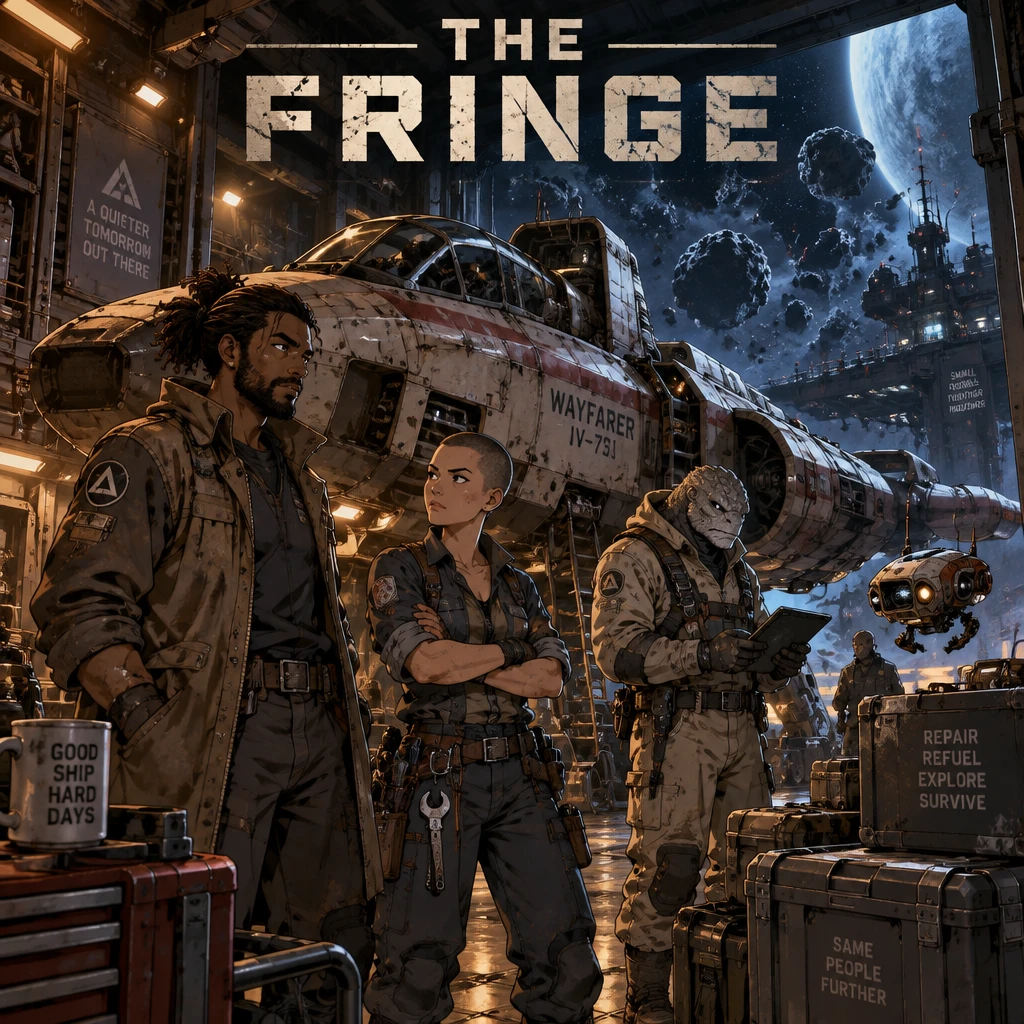
The Fringe is a tabletop action RPG set in a hard sci-fi space opera at the edge of settled space — the Fringe System and the worlds around it — where humans, cyborgs, androids, AIs and alien species live and work. There is no magic, no mana, and no supernatural power. Every ability a character brings to a fight comes from technology, biology, training, and engineering: gene-splices that graft animal traits into a body, cybernetic implants, swarms of medical and combat nanomachines, psi-tech neural interfaces, alien physiology, or plain hard-won skill with equipment. The system uses deterministic formulas with controlled randomness — no dice rolls. Damage, accuracy, crits, dodge, and status effects all resolve through flat calculations with percentage-based variance. If you've played action RPGs with stat scaling, crit builds, and damage ranges, the math will feel familiar.
This manual is for builders — anyone creating content for The Fringe system. Whether you're adding a new planet, designing a species, writing a world event, or building an entire questline, this guide explains how your content fits into the existing framework and what conventions to follow.
The Vision
Before you build, hold the vision in mind — every file, formula, and fight should serve it:
- Hard sci-fi, ground up. No magic, no mana, no supernatural powers. Old spacer myths called the horned Vryk "demons" and the luminous Serathi "angels" — they were wrong. Both are flesh-and-blood aliens with technology and biology, and no ability in the game is supernatural. If a build idea needs a spell, rework it as tech: plasma, stasis fields, medgel and nanorepair, nanite weaves, psi-tech.
- Power has a source and a ceiling. Abilities come from gene-splices, cybernetics, nanomachines, psi-tech (neural tech / alien cognition), training, equipment, and alien physiology. High stats are earned by the grounded: bosses, experimented-on beings, powerful creatures, cybernetics, robots and androids, nanomachines. There are exactly two power pools — Stamina for organic ability work (Experimental, Nano-Enhanced, Splice, psi-tech) and Energy for tech-biology (Cyborg, Android, AI, Vryk, Serathi). No Mana pool exists anywhere.
- The roster is set. Species: Humans, Beastkin, Halfkin, Androids, AI, plus two alien races — the Vryk (warlike horned aliens with iron-grey skin; Concordance-hostile raiders who stage Vryk → Vryk Overlord → Vryk Tyrant → Vryk Apex) and the Serathi (winged luminous aliens; Concordance mediators who stage Serath → Highwing → Dawnkeeper → True Dawnkeeper). Character types: Baseline, Cyborg, Nano-Enhanced, Splice, and Experimental — Experimental is lab-rewritten biology (designed organs, rewritten endocrine systems), with power stats capped at 100/60 like Nano, fueled by Stamina.
- A living, dangerous frontier. The Galactic Concordance keeps the peace — imperfectly; some races still discriminate against humans. The Mercenary Guild ranks every freelancer from the bottom up. A hidden assassins' organization only ever contacts you in-story. The Syndicate runs the criminal underground underneath everything. Bounty hunters chase wanted players, and robbery risk rises with an area's danger unless a character carries a dangerous reputation. Players can build ships freely and crews matter — solo play stays viable through stealth, cybernetics, and nanomachines.
- Scenes are real places. Locations support a day image and a night image — same scene and framing, different lighting — and the GM swaps them when the scene's day phase shifts. When a place, character, or thing undergoes a major change (destruction, overhaul, transformation, storyline payoff), update its description and regenerate its image.
- Layered cosmos. Universe > Galaxy > Solar System > planets/moons/stations > places within. Every location file sits somewhere in that chain.
Grounded capabilities
Build characters and encounters for Grounded play. Use physical limits, realistic hazards, crew support and documented technology. Limited alien psychic traits need clear range, resistance and counters.
Design Philosophy
The system has a few core commitments that shape everything:
No levels — use drives growth. Characters have no level and earn no XP. Stats move in small GM-awarded steps from stressed use (taking hits → CON, running → DEX, hauling → STR, study → INT, and so on), with decay from neglect, sickness, injury, or hostile abilities. Caps come from build, species, and type — that is the whole ceiling. Design content (gyms, tutors, hazards, training arcs) as stat-movers, not XP dispensers.
Threat follows the situation. Use the location, numbers, equipment and preparation to set stakes.
Formulas replace dice. Every mechanical interaction — attacking, dodging, crafting, status effects — uses formulas. Players calculate their stats and know exactly what they can do. Randomness exists only in damage ranges (Min%–Max%) and hit/dodge rolls (1–100 against a threshold). Stat-direct HP replaces the old level-multiplied version: 50 + (CON × 5) + (CON × HealthTierBonus) + (CON × BuildMultiplier).
Species and Type are separate. A character's biology (Species) is distinct from their modification (Type). A "Human Experimental" is a baseline human whose biology was deliberately rewritten in a lab. A "Vryk" is a Vryk — their alien physiology IS their power. This split determines which resource pools a character accesses (Stamina or Energy, never Mana) and which progression path they follow.
The world doesn't wait. Events advance, factions maneuver, and NPCs pursue their goals whether the player is watching or not. The Living World system ensures the universe feels real and that player choices have lasting consequences.
What You'll Find Here
This manual covers:
- File Types — the building blocks of Fringe content and when to use each one
- Characters — how Species, Types, stats, and resources fit together without levels
- Locations & Maps — the six-level cosmic hierarchy and how to expand it
- Encounter Design — scaling philosophy, enemy archetypes, and boss encounters per build
- The Living World — events, factions, and NPC agency
- Crafting & Economy — credits, equipment, and the quality tier system
- Voice & Style — how to keep new content consistent with the existing world
Each chapter focuses on intent and constraints — what the design is trying to do and what rules to follow — rather than restating formulas you can already find in the GM instruction files.