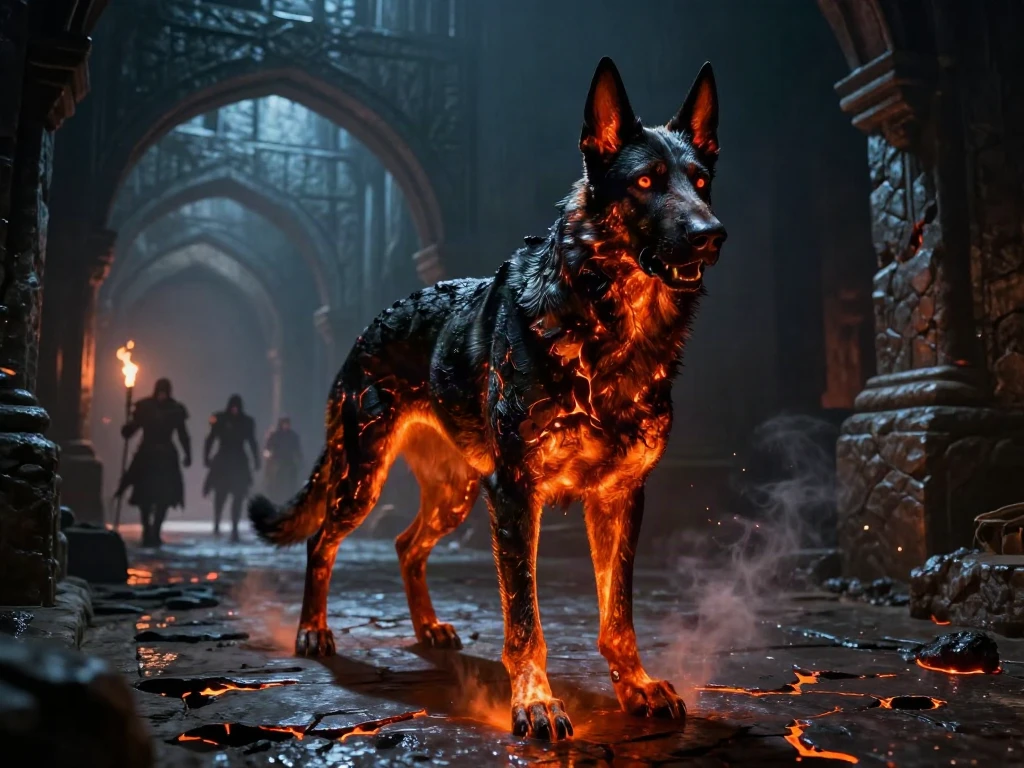
The premise
You died as a human. You wake as a level 1 monster — a blob, a rat, a hatchling of something worse — at the very top of a single dungeon that is the entire world. There is no town, no shop, no sky. There is only down.
The dungeon is a vertical food chain. Every floor deeper holds stronger monsters and, deeper still, human adventurers: always enemies, always organized, always working in squads while you are alone or part of a small pack. Everything that lives down here eats, sleeps, and evolves. The player's goal is simple and brutal — evolve all the way up and become the dungeon's final boss, the strongest thing in the world.
Everything in the system serves that one arc: level 1 vermin to level 100 apex.
Levels and evolution
- Levels run 1–100. The player starts at level 1 as a juvenile form.
- Every 10 levels is an evolution threshold: the monster transforms into a new species form (slime baby → slime → adult slime → elder slime → ancient slime → …).
- Level 100 is the final evolution — the last form, and the qualification for claiming the final boss throne at the dungeon's bottom.
- Evolution is not just a stat bump: each form changes the monster's body, diet, sleep needs, and which skills it can learn or fuse.
Flavor: evolution is the dungeon's own law, felt in the bones. When the threshold nears, the body grows restless — hunger spikes, old skills itch, and the monster must survive a molting stretch of vulnerability before emerging as something new. The deeper floors literally reshape you; a slime that eats enough fire-variant prey on floor 6 molts differently than one that never left floor 3.
Skills and feats — the core mechanic
Skills/feats are the beating heart of the system, more than levels are.
- Trainable: skills improve through use and practice, not through menus.
- Fusion: two skills/feats can be fused into a stronger one — but only through fixed recipes. The fusion chart is a curated craft system, not freeform combination. Discovering a recipe is content; every recipe should feel like a secret worth hunting.
Flavor: fusing is eating in the metaphor of this world — a monster internalizes two instincts until they collapse into one sharper one. A "Sticky Grasp" skill fused with a "Acid Spit" skill might become "Corrosive Web." Recipe hints come from eating rare prey, from dungeon carvings, or from watching another monster use the result.
The dungeon as difficulty curve
Depth IS the power scale. Species are fixed per floor band, and each species has a fixed temperament toward other species: aggressive, passive, friendly, or not interested. This makes the ecology readable and lets the player plan routes — friendly species become allies or food sources, aggressive ones become walls.
- Monsters: temperament is fixed per species, never rolled.
- Adventurers: always hostile, always laterally stronger than the monsters of their depth, and they use group tactics — shield lines, ranged covering fire, bait-and-ambush — because they are people, not beasts. The player fights alone or in a small monster pack, so adventurer fights are asymmetric and frightening by design.
Survival meters
Three meters make every day a decision, and no monster has an inventory — the body is the only storage.
| Meter | How it works |
|---|
| Hunger | Rises constantly. Satisfied by eating — killing other monsters (carnivore) or foraging (vegetarian, if the species allows it). |
| Stress | Rises from wounds, darkness, adventurer encounters, forced evolution. High stress degrades skill training and sleep. |
| Sleep | Sleep 4–8 hours per day depending on species. Requires finding a safe rest spot — safe is relative to what shares the floor with you. |
Essence — the third-evolution currency
Beyond level 20 (third evolution onward), evolution demands a special substance. Working name: Essence (alternatives: "cores", "ichor", "vital spark" — pick one and keep it consistent).
Rules that make it work:
- Essence is obtained only from freshly killed monsters — the killer takes it, and no one else. Corpses left to cool yield nothing; every monster in the dungeon wants essence too, so carcasses are stripped almost immediately by scavengers.
- It cannot be gathered from plants, ore, or the environment.
- Monsters have no inventory — essence is stored in the body, which caps how much you can carry and creates a reason to evolve rather than hoard.
- Flavor: essence is the condensed "will to keep existing" of a monster. Killing releases it; the killer's body drinks it. This is why adventurers harvest monsters — and why deep monsters fear adventurers, who arrive in organized harvest teams.
Design intent — what to preserve when extending
- Depth = power, always. Never place a stronger species on a shallower floor; the geography is the balancing act.
- Fixed temperaments, fixed recipes. Ecology and fusion charts are curated tables, not randomness. Consistency is what makes the world feel like a system the player can learn and master.
- No inventory, ever. Scarcity of storage drives every strategic choice; adding carried items would break the fantasy.
- Fresh-kill essence only. The scarcity window (kill → strip → gone) creates constant time pressure and player-vs-scavenger drama.
- Adventurers outclass monsters of their depth and fight smart. They are the raid boss of every floor, not another monster in the list.
- Level 100 = final boss. The cap is a narrative destination, not just a number: the last evolution qualifies you to claim the dungeon itself.
Suggested next steps
- Build out the evolution chain tables (species per floor band, temperament per species).
- Start the fusion recipe chart with 8–10 fixed recipes so the mechanic has substance.
- Decide the Essence name and write it into every rule that references it.
- Define adventurer squad templates (the tactics, roles, and equipment kits per depth band).