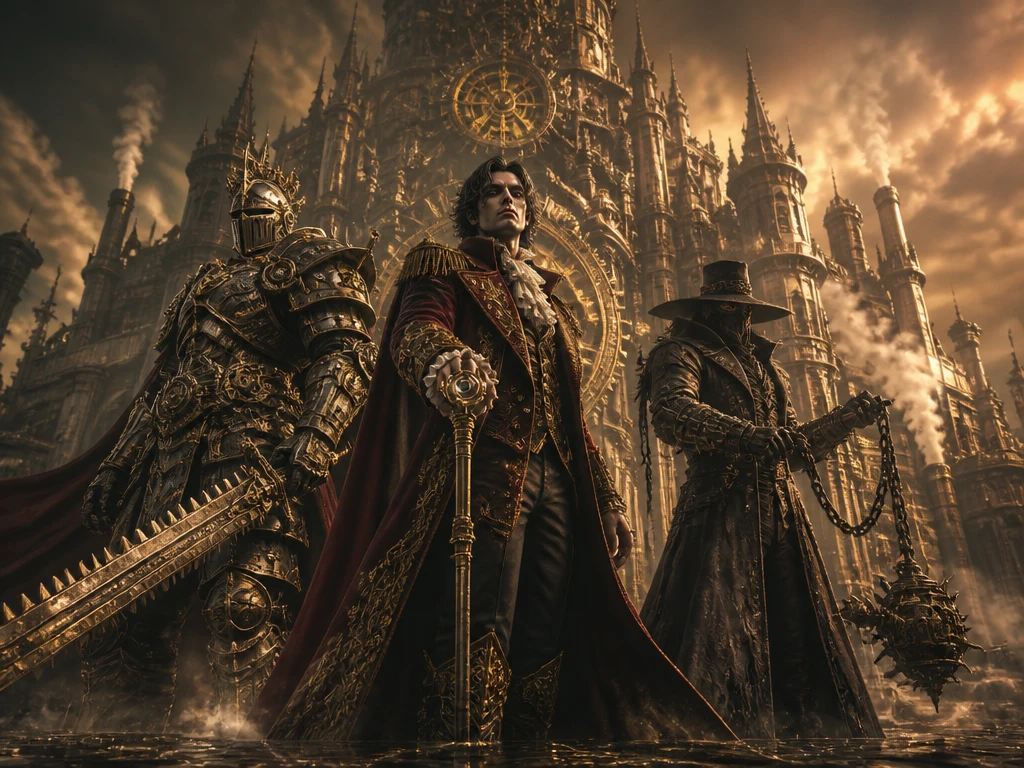
You are stepping into a world where the future was built on a grave. Steam-powered industry has reshaped civilisation, but the land it devoured has not forgotten — and neither have the things that lived there. This chapter is what your character would know, or suspect, or have heard in a tavern on a bad night.
The World at a Glance
Railstad is a vast realm connected by rail lines and airship routes, dominated by a single city: Cogsmoore, the great forge-heart. Beyond its walls lie haunted fenlands, a burning forest, and mountain ranges riddled with ancient tunnels. The age of magic did not end — it was buried under iron and progress, and it is stirring in its grave.
Trade flows along the rails. Airships patrol the skies. But in the fens, things with too many teeth crawl through alchemical runoff, and in the deep forest, hunters with eyes like winter frost still draw bows that predate recorded history. This is a world where the line between machine and miracle has blurred beyond recognition, and where the worst monsters are the ones who built the system.
Cogsmoore: The Forge-City
Cogsmoore is a city of brass and soot, where clockwork cathedrals tower over streets that never sleep. It is governed by the Wellingbor Royals — a dynasty that has held the throne for generations — and policed by the Cogsmoore Guard, a force that ranges from ordinary city watchmen to elite steam marines aboard airships.
The city is stratified. At the top, the Royal Quarter houses the aristocracy in gilded towers. Below, canal districts hum with trade and invention. Further down, in the shadows of the industrial sprawl, lies Cogsmoore's Refuge — a slum where faeries and satyrs live in poverty under constant Guard surveillance. And beneath everything, in tunnels lit by magma veins, Furnacedeep grinds on: a subterranean nightmare where chained labourers mine the ore that feeds the city's furnaces, and a whispered rebellion festers in the dark.
The city runs on faith as much as fuel. The Cog Church preaches that industry is divine — that the turning of gears mirrors the turning of the cosmos, and that those who labour in the factories serve a sacred purpose. Its influence is vast, its doctrine rigid, and its priests are not above declaring old magic heretical.
The Fey Exile
Before the first rail was laid, the Verdwood Expanse belonged to the fey. The eladrin — an ancient aristocracy of tall, cold, long-lived hunters — ruled the forest as its wardens. Common faeries and satyrs lived under their protection. Their courts were carved into living wood. Their laws were written in the language of seasons.
Cogsmoore came for the Verdwood the way it comes for everything: with fire. The Burning lasted three seasons. Alchemical firebombs launched from early airships turned ancient groves to charcoal. The eladrin fought with bow and blade and winter storms conjured from old magic. They killed hundreds. It was not enough.
The survivors fractured. The largest court — the Frost Court — retreated deep into the heart of the forest and sealed itself behind illusion and cold iron. A splinter faction, the Court of Embers, broke away to wage guerrilla war from the burned boundary. A third, the Court of Thaw, chose diplomacy and infiltration, sending envoys into Cogsmoore itself. All three claim legitimacy. None agree on what comes next.
The common fae had no strongholds. They fled to Cogsmoore, to the only place that would take them, where they now labour in the Satyr's Forge and survive in the margins of the Refuge. The eladrin courts view them with contempt — cowards who abandoned their people. The refugees view the courts with bitterness — nobles who hid in the forest while their kin burned.
The old magic is fading. Each generation of eladrin is slightly less potent than the last. The Burning damaged the deep ley lines that sustained fey power, and no one knows if they will ever heal.
The Five Factions
Five powers shape the fate of Railstad. None of them are good. All of them have reasons.
The Wellingbor Royals — the ruling dynasty of Cogsmoore. They hold absolute authority through loyal nobles and elite Royal Knights. Their grip is tight, their interests are self-serving, and their greatest threat comes not from outside the city but from within — the Cog Church, which questions whether the throne or the cog should truly rule.
The Cog Church — a powerful religious order devoted to the Great Cog, a divine symbol of order and industry. The Church holds enormous influence over the working classes and has declared old magic heretical. It is locked in a quiet power struggle with the Wellingbor family, and its priests are not above using the Guard as pawns.
The Cogsmoore Guard — the city's disciplined military force, ranging from watchmen to elite sky marines. The Guard enforces the law, maintains the borders, and wages a slow war against eladrin raiders. It is the iron fist of whichever faction currently holds its leash, and its soldiers are trained to follow orders, not ask questions.
The Frost Court — the remnant civilisation of the eladrin, hidden in the deep Verdwood. Led by a sovereign called the Winterbloom, they reject all technology and wage a patient, quiet war against Cogsmoore's encroachment. They are proud, dangerous, and slowly dying.
The Celestial Order — a secretive brotherhood of hunters who track supernatural threats within Cogsmoore's walls: ghosts in the gaslight, beasts that shift beneath human skin, faeries driven feral by grief. They use trick weapons and sanctioned magic, and they answer to no faction. The line between hunter and monster is thin, and the Celestial Order knows it cuts both ways.
The Wilds Beyond
Beyond Cogsmoore's walls, the land is wounded and strange.
The Gloam Fens are a toxic swamp fed by alchemical waste from Cog Church refineries. Bioluminescent leeches, sinkholes, and mutated creatures make it lethal to the unprepared. Deep in the fens, ancient hags trade information to all sides, and corrupted eladrin boundary markers weep with trapped fey spirits. The ley lines beneath the fens are poisoned, and the fey faithful who still tend them do so in secret.
The Verdwood Expanse is a vast, tangled forest scarred by fire and warped by lingering magic. Time distorts near its centre, creating eerie temporal anomalies. The eladrin hold its heart, but the burned approaches are monitored by Cogsmoore, and logging crews still push into the outer edges when the Guard clears a path. Thornspire, the great tree-citadel at the forest's core, was half-consumed by the Burning and regrew in twisted, scarred shapes.
The Blackspine Mountains are a towering range rich in coal, once home to thriving dwarven mining cities now controlled by human syndicates or fallen to rogue cults. Beneath the mines, ancient fae burial tunnels hold relics of immense power — artefacts the eladrin have sworn to protect and Cogsmoore would kill to claim.
The Species of Railstad
Humans are the dominant species in Cogsmoore — ambitious, adaptable, and responsible for the industrial age. They built the rails, the airships, and the forge-cities. Not all humans are complicit in what was done to the fey, but the system they built profits from it regardless.
Eladrin are the ancient fey aristocracy — tall, pale, and long-lived, with an unsettling stillness that makes them easy to mistake for statues in the deep woods. They are renowned hunters and warriors, wielding longbows with lethal precision and channelling cold-fae magic that predates recorded history. Eladrin reject all technology as a corruption of the natural order. Where common fey are whimsical, eladrin are deliberate and dangerous.
Faeries and satyrs are the common fey — smaller, more numerous, and far less powerful than their eladrin betters. Many now live in Cogsmoore's Refuge, labouring in factories or surviving on the margins. Some have turned to dissidence. Others have simply given up. The eladrin courts view them with contempt; Cogsmoore views them as a resource to be exploited.
Werewolves exist in the shadows of Railstad — cursed, feared, and hunted by the Celestial Order. Some are feral predators. Others are people fighting an affliction that the Cog Church calls hereditary sin. The Order tracks them with grim efficiency, and the line between a werewolf who has lost control and one who was framed is not always clear.
Automatons are clockwork constructs — machines built to serve, now increasingly common in Cogsmoore's workshops and factories. Some are simple labourers. Others display a flicker of something that might be consciousness. The Cog Church considers them blessed by the Great Cog. The Frost Court considers them abominations. The truth, as always, is more complicated.
Playing in Railstad
This is a world of moral greys. The Guard who brutalises the Refuge may be the only thing stopping a worse atrocity. The eladrin hunter who burns a logging camp is defending a homeland that was stolen. The Celestial Order hunter who puts down a "monster" may be executing an innocent person on a bad tip.
The themes of this campaign are industry vs. nature, power vs. conscience, and survival at the cost of identity. The rails always lead somewhere darker, and every faction believes it is right. Your character will have to decide what they are willing to do — and what they are willing to become — in a world that punishes both mercy and cruelty.
Trust nothing. Follow the steam. And watch the gaslight — the things that move in it are not always human.