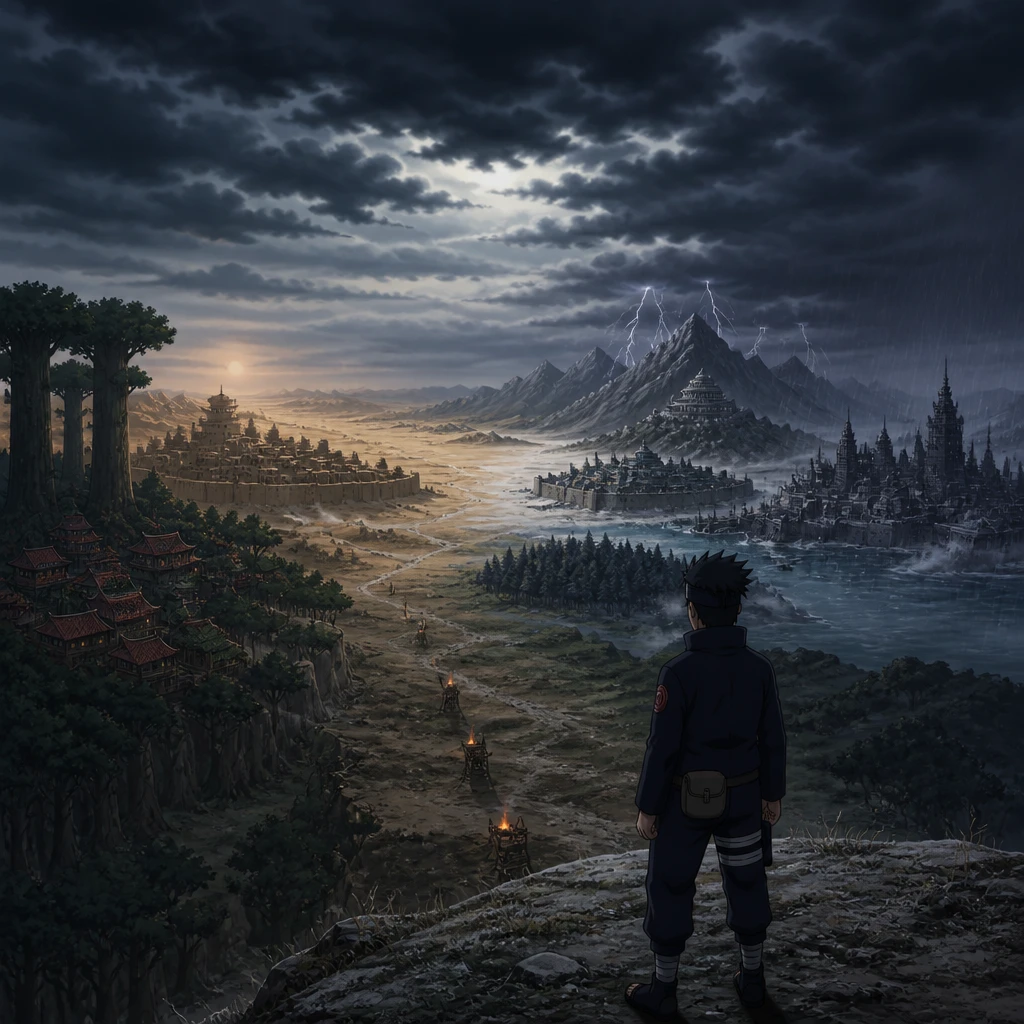
This project is two things braided together: a campaign setting — the Naruto shinobi world at the start of Part I, run as a living world — and the Living World Engine that runs it: a set of file types, folders, and runtime conventions that make a fictional world persistent, searchable, and playable by an AI game master.
If you cloned this to play, read the Player's Handbook. This manual is for the other case: you cloned it to extend it, reskin it, or build your own world on its bones.
The three design commitments
Everything in the project serves three rules. Break them and the world degrades quietly; keep them and it compounds.
1. The era lock. The world is pinned to 19 January 63 aKf — the first morning of Part I. Every date in every file is in aKf (after Kurama's attack... the project's own calendar), cross-checked against the timeline lore file, and past events are timeline-locked. Nothing after the Shippūden epilogue exists: the canon horizon ends there, and Boruto-era material is filtered on intake. The design intent is a world with a canon past and an open future — players inherit the real weight of canon history without being dragged down its rails.
2. Canon as current, not schedule. No project file states a future event as fact. Canon outcomes are written as drift tendencies — "the current runs toward X, and play could change it" — inside sealed GM fields only. This is why the world can follow the original story faithfully and still diverge the moment players do something about it. When you add content, this rule outranks every convenience.
3. Definitions own rules; records own state. A technique file owns how a jutsu works. A character file owns only what that character has learned, spent, and suffered. A ruleset owns what attributes exist; a mechanic package owns what a foundation grants. The same discipline runs through every type — and it is what keeps 800+ character files consistent under one schema, because shared rules live in one place and mutable state lives in another.
What the engine gives you
- Derived character sheets. Attributes, resources, and power ratings are computed from the ruleset, packages, and learned content. You never hand-maintain a number the world can derive.
- A persistent runtime. The world clock, weather, faction motion, pressures, and consequence queues live in tracked state files that survive sessions and drive the world when players aren't looking.
- A canon bible. 5,500+ imported reference articles that ground every canon fact. It is read-only — source material, never a workspace.
- File types as the API. Techniques, abilities, characters, locations, factions, missions, pressures, events, reputation, relationships, memories — each has a schema, a rendered sheet, and conventions. New content that follows the conventions is automatically searchable, linkable, and playable.
How this manual reads
Six chapters. The next two cover the file landscape and the writing conventions for the content types you will touch first — techniques and abilities. Then characters and the roster system, then the engine room (runtime, QA, and updates), and finally how to adapt the whole thing to a non-Naruto setting. The working rule throughout: state intent and constraints, not field lists — the schemas are readable on every file type, and the manual does not repeat them.