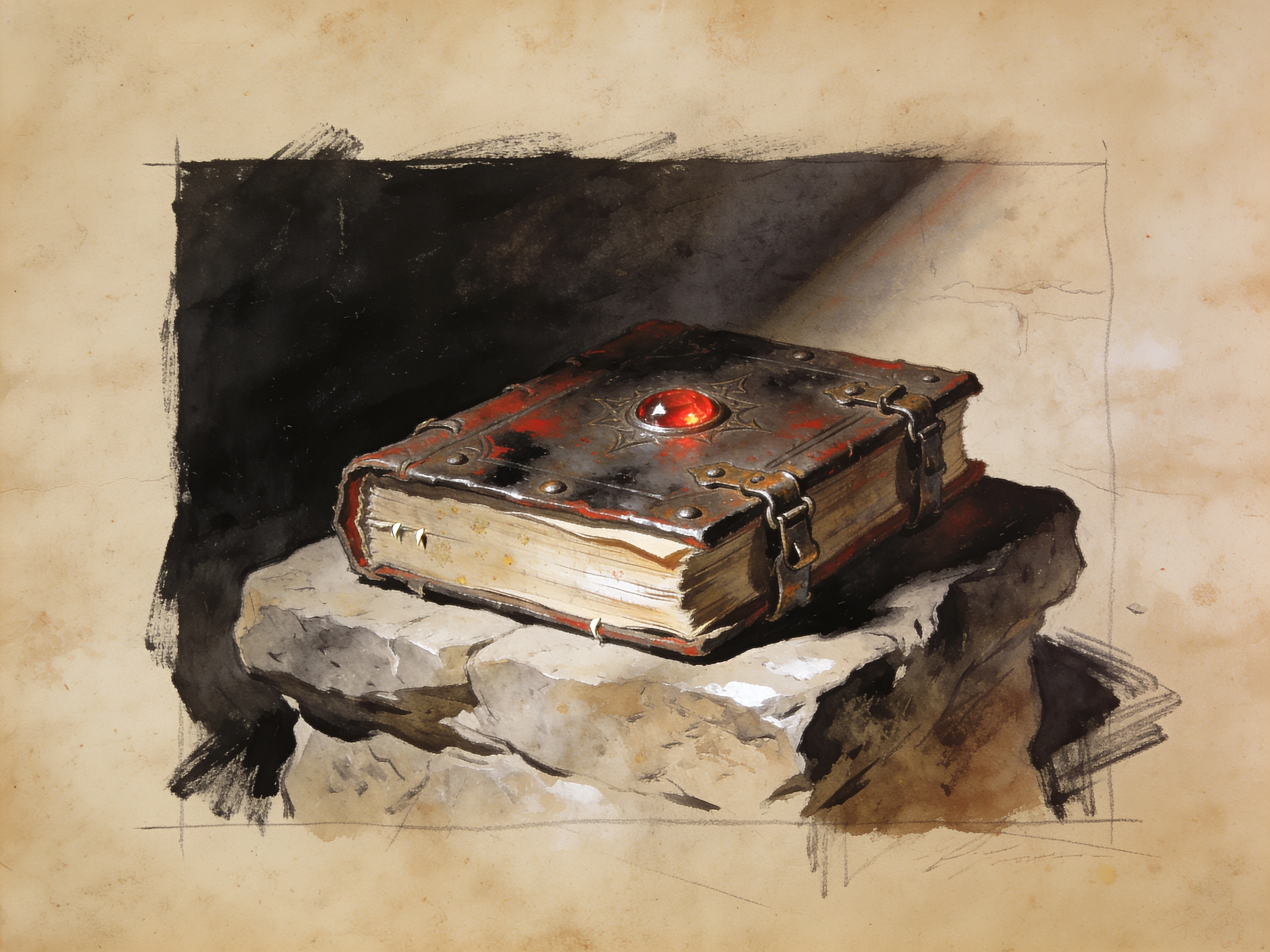
Lingua Magicka is one year — roughly 1000 AD — seen from several corners of the real world at once. A player here is never an invincible warrior; they are a ritualist, a cunning-woman, a scholar of saints, and their strongest tool is usually the tongue, not the sword. Build with that in mind and the rest follows: danger is social and situational as often as it is a stat block, and every place has an opinion about what a magician is.
This manual is for the next person who wants to add to the world without breaking what holds it together. It assumes you have read the Player's Handbook and know how a session plays. What follows is the architecture.
The world is layered, not flat
Geography nests. From the top down:
- The root. @Missing file is the front door of the map — every campaign sits somewhere beneath it. Its whole job is to make the other places visible: knowing that five other regions exist in the same year is most of what makes any one of them interesting.
- Grouping regions. A real-world country or coast that gathers smaller places. @Missing file is one — it holds travel times, who rules where, and the sea-lanes, and it points down at the playable regions inside it.
- Playable regions. The unit a campaign actually lives in — @Missing file, @Missing file, and their siblings. A region carries the period, the local myth, the troubles of ordinary people, and the signature field: how a ritualist is read here. Each playable region is also an encounter table — it is named in the Region list on @Missing file, and that one selection decides which Enemies oracle is in force.
- Sites. The places a player stands: a town like @Missing file, a delve like @Missing file. Each links up to its region and has its own local map, with label pins for its points of interest.
A new region is a new middle layer with its own sites hung beneath it, slotted under a grouping region and registered on the world state. The next chapter builds one.
The file types, by their job
You do not need every type to make a place. A region leans on a few:
- Location — regions, towns, and delves alike.
dangerLevel says which it is (safe town, wilds region, dungeon or lair delve), and notes is where the GM-facing truth lives.
- Oracle — a weighted table the GM rolls. Every region has an Enemies oracle; the project also has shared loot, gem, and lead tables you reuse rather than rebuild.
- Creature — a stat block. Reuse the generic ones (bandits, wolves, the walking dead) freely; author only the few that are this place's and nowhere else.
- Character — a pregen the player can take. Not NPCs: the GM mints recurring people during play as they become important.
- Game Start — the opening scene that drops a player into the content, names real files, and sets the region.
Build a palette, not a cast
A region supplies flavour, troubles, threats and places, and the GM builds the people out of that during play. Don't write named NPC files ahead of time. A game start may suggest who should be in its opening scene, as roles (a merchant, a fellow captive) rather than as files. Every file you add is something the GM has to sift through, so keep the project thin and make each file earn its place.
The same applies to rules. Every GM instruction file takes up room in the GM's context, and the more there are, the less reliably any one of them is followed. Before adding one, ask whether the GM could just narrate the situation and use its own judgement, given the right facts in a location or creature file. It almost always could.
The one rule that makes a place feel like here
Every region file answers the same uncomfortable question: how is a ritualist read in this place? Who is safe to call on, who is dangerous, and in which tongue the working must be spoken. That single section is what separates a Lingua Magicka region from a generic fantasy map — it is the reason the same character plays differently in the Welsh mountains, in a Swahili port, and on a Chinese frontier. Write it for every region, and write it first.