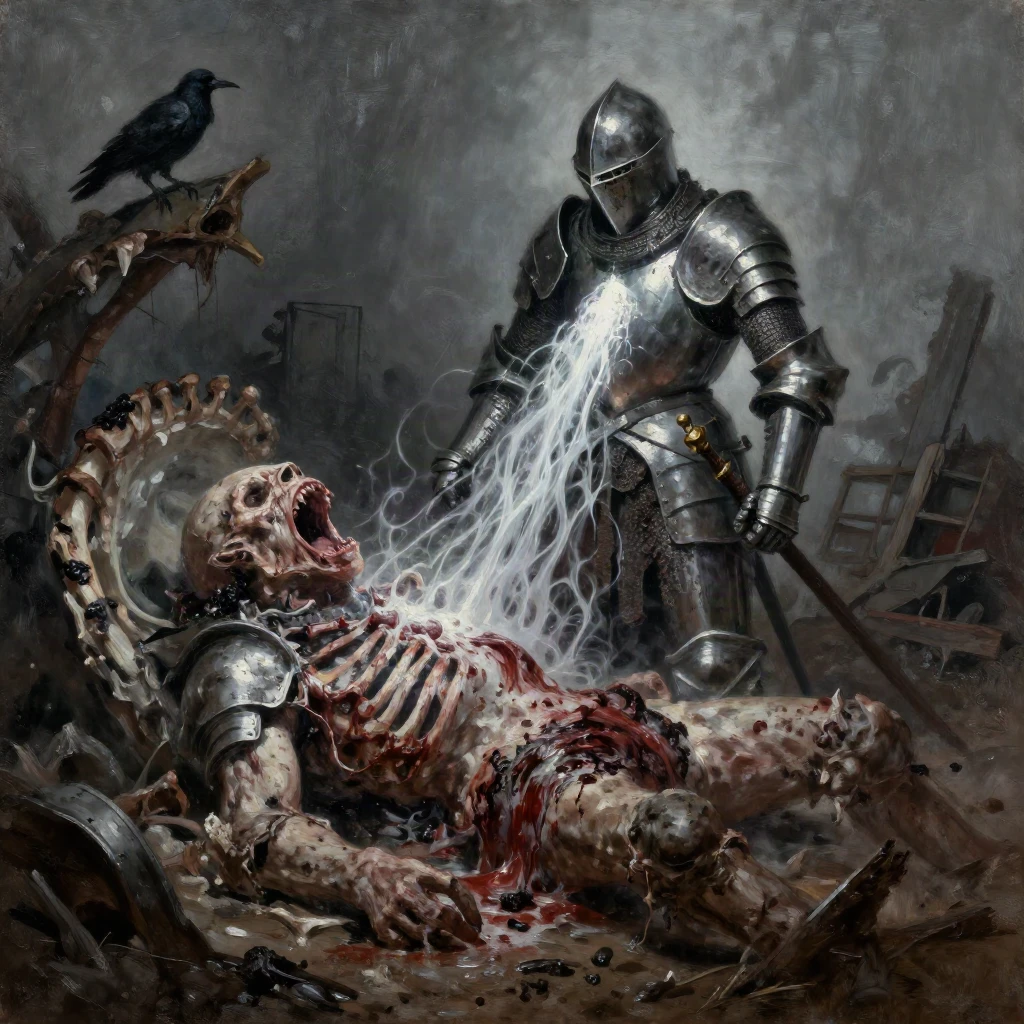
Everything you are, you took from someone who tried to use it on you — or from something that never got the chance to finish the lesson. When a power-holder dies, their arts do not vanish. They congeal into glass.
What marks you
An ability, skill, or spell is marked the moment it is used on you — or the moment you see it used at all. You do not have to be the target. Standing beside a companion while a witch curses them marks the curse in your mind just as surely.
A mark is no longer a ticket — it is reconnaissance. What you witness tells you the shown hand: the arts you can expect the glass to hold when the thing dies, and which rumors are still rumors. The mark tells you what you know; it does not tell you everything the corpse carries. And marks cut both ways: every power you use in front of witnesses is a power someone else now knows to hunt you for.
Not everything marks. A soldier swinging a sword marks nothing; the sword is a tool, not a talent. What marks you is the practiced art behind it — the footwork, the hex, the trick with the blade. If you could not learn it by watching, the GM will tell you.
Passives — the always-on powers like thick hide or dread aura — can never be witnessed, only endured. A passive marks you when you are directly affected by it: your blade bites the hide, you stand inside the aura. Watching from a distance marks nothing.
A mark lasts exactly as long as the fight that gave it. Walk away, and the memory cools — but what they carried, the glass may still remember.
The congealing
Every kill mints glass — no duel, no gate, no same-fight rule. The thing that marked you last week can die next month and still pay. When a power-holder dies, their corpse congeals orbs: one from a common corpse, two from a boss, three from a legendary, five from a god, if the story is mad enough — and a person pays by their hand: a third of the arts they carried, never fewer than one, never more than three. A rich man's deep hand pays like a master's. The dice no longer decide whether you walk away with something — only what.
The ladder. Every art on the dead one's card is weighed by its tier:
| Tier | Weight |
|---|
| T1 Trick | 8 |
| T2 Craft | 5 |
| T3 Moderate | 4 |
| T4 Singular | 2 |
| T5 Legendary | 1 |
Add the weights of every art the creature carries and roll 1d(total) per orb, counting down the list from the top. High tiers are narrow rungs; low tiers are wide. If two orbs land on the same art, reroll — an art congeals once per corpse, and the rest goes into the ground.
The fast band. The weights sum to twenty, so the ladder can be rolled as a single d20 — same odds, no arithmetic: 1–8 trick (dun), 9–13 craft (green), 14–17 moderate (blue), 18–19 singular (violet), 20 legendary (gold). Roll the band, then take an art of that tier from the dead one's card. A band the corpse cannot pay rerolls — an art above the card's tier never congeals — and a secret keeps its own door: if the corpse carries one, it surfaces on a natural 20.
The artless corpse. Most people carry no arts at all, and a ladder with nothing to roll pays nothing worth having: the artless corpse mints a dead bead — glass with nothing inside, worth a ha'penny to a jeweler and nothing to a spoiler. Most corpses of ordinary folk pay beads. Some don't. That gamble is half the reason to check.
Hidden arts. Some cards carry a secret — an art nobody chose, no scout has ever seen, and the creature itself cannot use. A secret is latent: the wild grew it and never taught the carrier to reach it. Fighting the wolf teaches you nothing about her secret; the rumor is the only intel there is. Secrets weigh half their tier's weight, and the glass is the only place they come out. They say there's a wolf out there with wyvern's blood. Nobody has checked twice — and nobody ever decided she would.
Who rolls. Each orb is rolled by a different survivor of the fight — killing blow first. Let the last hit matter without letting it own everything.
Kills are contested. The killing blow does not have to be yours, and the corpse belongs to the survivors of the fight that felled it. Battlefield scavenging is legal and intended; battlefields are markets, and vultures eat well.
The keyed stat still rules. Whatever congeals is keyed to the stat it was always keyed to — sharp martial tricks to Strength or Dexterity, spells to Intelligence or Wisdom, endurance passives to Constitution — and it lives or dies by the slot rules below.
The glass
The congealing decides what congeals; the glass decides what happens next. An orb is a power with no mouth to feed it. What you do with it is the real decision:
Crack it. The art grows into you as it lived in the dead — permanent, recorded on your sheet, subject to every slot rule you already know. An orb of an art you already carry crumbles worthless in your hand. A cracked orb is gone forever; the power is yours for life.
Hold it. An uncracked orb is ordinary loot — sell it, trade it, give it to a companion, or get robbed for it. No mark, no roll: whoever holds the glass holds the art. Violet and gold orbs wear their tells on the glass — carrying one is a confession to anyone who knows how to read it. The glass exchange prices them; see the shopper's market.
And the sharpest edge in the trade: you cannot pour your own powers back into glass. Orbs mint only at kills and burn once. The strategy the trade teaches is this: glass is money, and money is exposed; a power in the flesh is protected. If you fall, your corpse congeals what your card pays — one orb for most lives, two or three for the great ones — and the rest of your collection is buried with you. But everything in your pouch goes to whoever holds it. Carry your power in your body and it is safe, unsellable, and yours. Hold a fortune in glass and you are carrying a target with a color code.
The rest of the corpse
The mark is the art, not the arm. Everything physical on a body — weapons, armor, coin, spellbooks, strange components — is ordinary loot. Take it when the fight is over, no roll required, no mark needed. A sword does not teach you fencing; equipment changes hands freely, and only the knowledge inside the dead demands the ladder.
Gold, teachers, and other roads
The kill is not the only road to power — only the surest one.
A willing teacher asks no corpse. If someone knows an art and genuinely wants to teach it, you can learn it the slow, honest way: weeks of training and a price in coin or favor. No mark, no roll, no body. What this road cannot give you is anything its owner refuses to part with — and the world's finest arts are guarded jealously by the living, or worn by creatures that cannot speak.
Passives are the shopper's market. Moderate-strength passives — poison resistance, night eyes, a swimmer's lungs — can be bought from trainers, temples, and the occasional surgeon. Purchases always take: gold and time guarantee what the ladder never promises.
Nature is not for sale. No market sells regeneration, flight, or a hide that turns blades, because no one can teach them. Those powers are grown, not learned, and they exist only on the living — until the kill weeps them out as glass. To take one, you must do what the spoils demand: endure it, kill it, and land on its narrow rung. The market doesn't sell nature; it sells what nature let slip.
Yours forever
Every power you hold — cracked from an orb, bought, or taught — is recorded on your character sheet permanently. It functions for you as it functioned for its owner, subject to what your stats can carry.
A slot is a slot. Each power occupies a slot in the stat it is keyed to, no matter where it came from. Bought passives and kill-taken arts compete for the same space, and the swap rule does not care about your receipt: if your slots for a stat are full and a new power tempts you, you may swap it into an old slot — and the displaced power is permanently lost. Gone from your sheet, gone from the world. Even if you paid good money for it.
This shapes a whole career. Young characters load their six base slots with shop-bought passives and feel well defended. Then they meet stranger enemies, win stranger glass, and trade the comfort of the market for the arts of the dead. That migration is the intended arc — spend your dead wisely.
How much you can carry
Every power occupies a slot in the stat it is keyed to. Each stat starts with room for one power, and grows past that as the stat grows:
| Stat score | Slots for that stat |
|---|
| 10 or lower | 1 |
| 12 | 2 |
| 14 | 3 |
| 16 | 4 |
| 18 | 5 |
Each 2 points over 10 opens one more slot in that stat. Odd scores round down — a stat at 13 holds as much as one at 12. Low stats never cost you slots; a stat below 10 simply holds its base one. Your character sheet tracks your slots and what fills them.
The crowded field
You are not the only one playing this game. The wild places are worked by hunters, wardens, poachers, and fortune-seekers — all of them watching, all of them marking, all of them hungry. Three things follow:
Everyone can see you. Every power you use in front of the crowd, they witness — and a witnessed art is a mapped art: they know your card's shown hand. Your collection is always on display to the people best qualified to want it.
Kills are contested. The beast you bled for an hour belongs to whoever's blow lands when it dies — and its glass is rolled for by whoever survives the fight. Rivals will shadow your hunts, time their strikes, and scavenge your failures. Some will fight you for the corpse. Some will wait for the pouch.
Death is a transfer. If you fall, your killer's crew rolls the ladder over everything you were — what your card pays congeals for the taking, usually one art, more for the great ones. The rest of your collection goes into the ground with you; everything in your pouch goes to whoever holds it. Glass is exposed, flesh is protected — but flesh can never be sold. Choose what to carry accordingly.
Creatures and people
The rules bind differently depending on what you kill.
Creatures are a renewable vein, not a reprint. No two of a kind grow the same arts — every beast is its own casting, and the wild never prints twice. Some of what a beast grows, the market has learned to imitate: a boar's poison resistance, a hawk's eye. If the ladder never gives you the art you wanted from a wolf, the wilderness offers a different vein: another wolf, another growl. Patience, not permanence, governs the wild spoils.
People are not renewable. Every person's art is a single printing. Kill the old duelist and his orbs congeal from everything he knew — a third of the hand: one orb for a common life, two or three for a master. The famous riposte, the trick he guarded, the art he never showed anyone. The rest of a life's work is buried with its keeper. Crack the glass and the riposte lives in one body: yours. Trade it away and the art waits in it, unhoused, for the next hand. Human spoils are the rarest currency in the game, and the decisions around them are the heaviest you will make.
The sky has a ceiling
The five tiers of spoils spread across twelve levels of creature: trick (levels 1–3), craft (3–5), moderate (5–7), singular (7–10), legendary (9–12) — and the bands overlap at the seams. A level 7 beast may be a moderate blue take or a violet singular, and nobody at the table knows which until the corpse pays. One rule is worth more than the whole table: hunt them young. A legendary mints the same three orbs at level 9 as it does at 12, and the young one can be survived.
As for what lives past level 12 — there is no past level 12. The hardest thing that bleeds is a 12. What the old stories call gods is weather: no combat line, no corpse, no glass. You cannot loot the storm; you can only worship it, bargain with it, or be elsewhere when it arrives.
But a storm can land. If a god ever takes flesh and walks the wilds, it fights on the 12 line — no harder a hitter than the apex legendary — and it bleeds like anything else with a corpse. What lands is not numbers; it is a hand: ten, twelve arts where a legendary carries five — ten things that mark, ten rungs on the ladder. Kill it, and the corpse pays five orbs, rolled by five different survivors — or by the survivors there are, more than once if the crew came home short. It is the only kill in the world that can leave every survivor holding an orb of their own. The religions all agree the god cannot be killed. The hunters' correction, whispered: it cannot be killed up there. It has to come down. So make it want to.
What the world sees
Most powers are modest, and modest powers go unnoticed — nobody hunts the owner of shop-bought night eyes. But singular powers are signatures. The blade that catches moonlight twice belongs to a school; the hex with the wrong-shadow stink belongs to a coven. Use one where the wrong eyes can see, and the art announces both of you: what you can do, and who is missing from the world.
The wise carrier learns restraint — the signature power stays holstered when witnesses gather, and comes out only for fights no one will walk away from. The reckless become stories.
And stories travel. The people who made the art, share its blood, or mourn its original owner do not forget where it went. Some come to avenge. Some come to reclaim what they say was theirs all along — and if it sits uncracked in an orb, they may come with coin instead of steel. A few come with an offer: you fight like a Calloway — maybe you should be one. How you answer such visitors defines the second half of a collector's life. Power taken from the dead is never entirely yours. It is only yours until someone stronger cares.