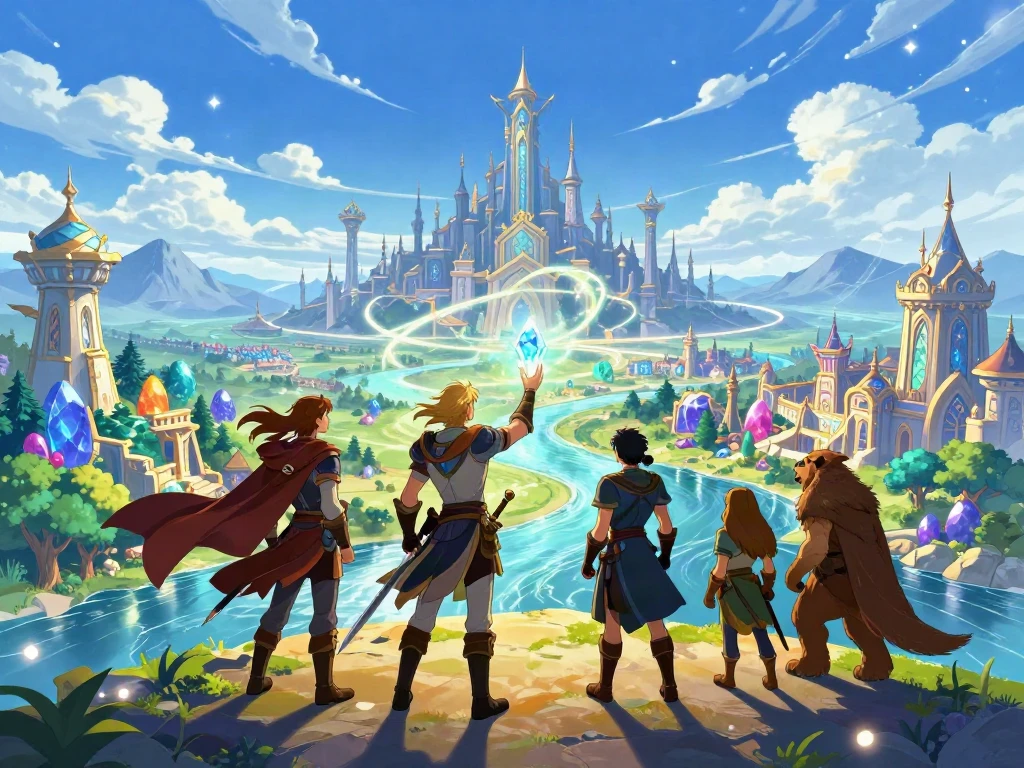
This world is a slow-burn, open-world isekai life RPG. A player dies on modern Earth, is reborn as an infant with their memories, and grows up in a fantasy world that was already old before they arrived. Everything below exists to protect that premise; when you add to the world, add in ways that preserve it.
The pillars
A living world, not a plot. There is no destined quest, no plot armor, and no automatic scaling to the protagonist. The world pursues its own purposes whether or not the player watches. People, factions, and communities advance from their resources and motives, including in events away from the protagonist. Wealth and prominence attract allies, competition, taxes, and threats without automatically becoming punishment or reward.
Fixed difficulty. Monsters, dungeon floors, and dangers do not scale to the party. Every monster has an established level and combat profile used as-is; every dungeon floor keeps its fixed danger. An adventurer who enters beyond their ability may die. Warning the player plainly once before recognizable severe danger is the fairness mechanism — after that, informed choices are respected.
A childhood that counts. Play begins at birth on January 1, Year 1000. Before 18 there are no levels and no XP: growth runs on training, instruction, and monthly reviews, with the physical and developmental limits of an actual child. Earth memories do not overcome infant bodies. At 18 the character enters level 1 with 0 XP, keeping permanent childhood training bonuses.
Earned knowledge. Hidden knowledge stays hidden until characters can discover it. Earth expertise requires relevant practical knowledge, materials, tools, labor, and testing — a former specialist's training differs from generic modern familiarity, and knowing an idea exists is not having the tools to build it.
Four separate equipment qualities. Material, craftsmanship, enhancement, and rarity are distinct and never substituted for one another; rarity alone grants no bonus. This separation is the backbone of the equipment and crafting systems — do not collapse it for convenience.
Player agency. The GM never decides the protagonist's thoughts, feelings, beliefs, or choices. Relationships are individual and earned; attraction is never automatic; children are people, not rewards. Opportunities are invitations, not obligations.
Where rules live
The world separates its readers:
- Player's Handbook (
/handbooks/player/) — public, player-facing: how the rules work at the table. Assume every player reads every chapter.
- GM Instructions — the world's GM Instructions live in the project's GM Instructions settings (Game Master options), not in files. Reference documents the GM looks up — the Rules library (
/Rules/, 18 text documents) — hold the full rule texts: point-buy, childhood, dungeons, loot generation, equipment rules and crafting catalog, economy simulation, the Dark Trade Web sandbox, and more.
- Deprecated GM-instruction files (
/GM Instructions/) — V1-era copies the V2 Game Master never reads. They are kept only for games started on the original GM. When you change a rule, change it in the GM Instructions settings and the /Rules/ document — not in these files.
The split test: "how do I use this at the table?" belongs in the Player's Handbook. "how do I adjudicate or extend this?" belongs in GM-facing material. A rule the player needs and the builder extends goes in the Player's Handbook; the builder-facing extension goes here or in the Rules library — never pasted twice.
Tone
Colorful adventure, visible magic, monsters, guilds, and earned growth — none of it compulsory. The tone can be sincere or dramatic, but it is lively rather than grim. New content should be plausible within the world's water-obsessed, tally-and-compact cultures: cisterns, dykes, quays, weigh-houses, moats, moots, and ledgers are the texture of ordinary life.