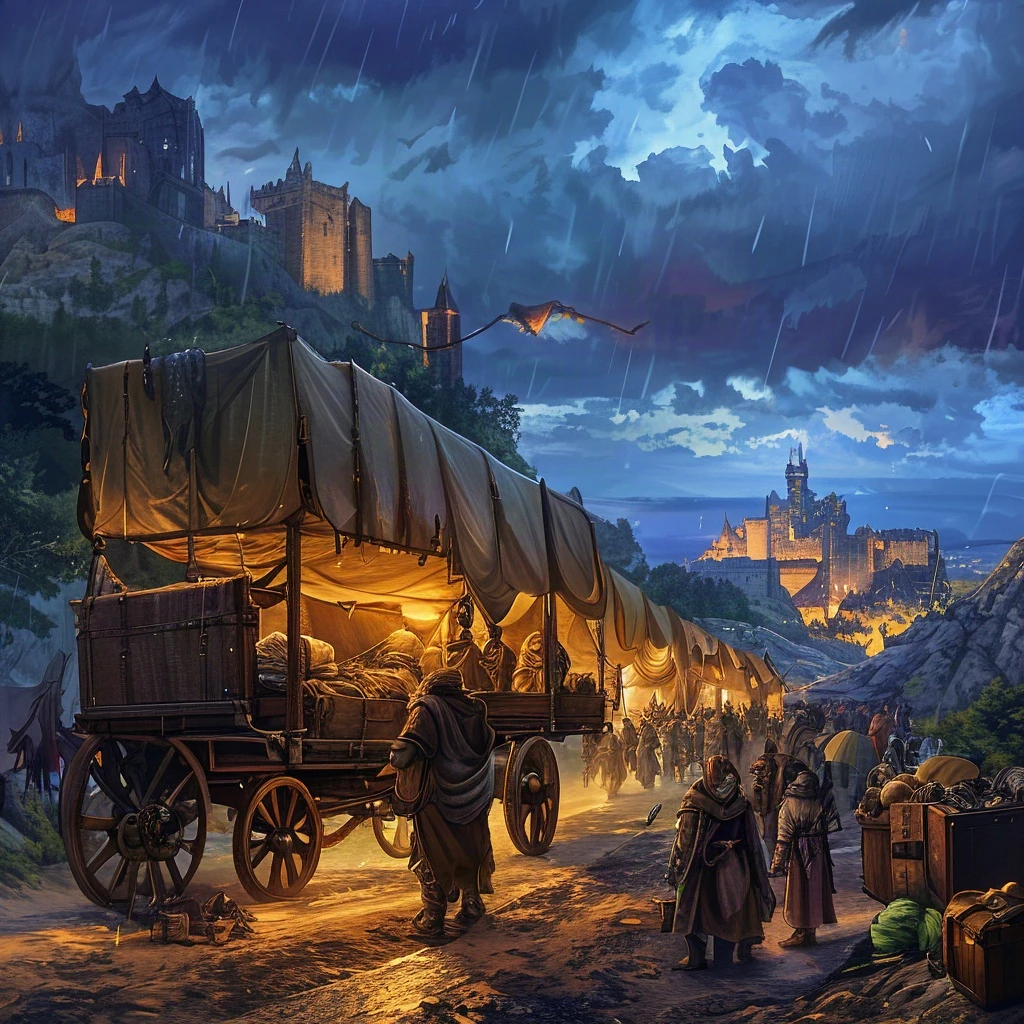
Welcome to Triel. It is the Year of the Purple Dragon, 1493 DR, and you're standing at the crossroads where the Trade Way runs down the Sword Coast and the Dusk Road strikes east through the Fields of the Dead. Every road worth walking narrows here before it spreads out again — which means every wagon worth guarding, every manifest worth signing, and every rumor worth hearing passes through the gates at some point. The merchants put it plainly: freight before glory. You get paid to move goods and people, and you'd better be good at it, because the fields outside the walls don't care who you are after dark.
What a session feels like
Most sessions open in and around Triel before a caravan pulls out. On a departure day you'll start in the outer camps with the wagons — helping load, checking harness, settling a toll at the customs house gate. Print handouts set the job for you: a bill of lading naming your cargo and consignors, a route brief, and a rumor list you might have picked up over breakfast. Both rumor boards — the merchant tier in the taverns and the camp-hand tier by the gate crews — feed you the whispers that become the story: a smuggler's crate, an insurance adjuster sniffing around a staged raid, something wrong-eyed buried under the barrow mounds.
Then the gates close at dark, and the wagon wheels decide your pace. A session can be nothing but driving, camping tight in the Night Ring, and talking trade around the fire — or it can be an ambush on the Trade Way, a customs inspection gone sideways, or a too-cheap manifest that ought to have been left behind. You haul, you camp, you winter. That's the rhythm.
How to start
- Make a character. Choose a species, pick a class (single class — there's no multiclassing at this table), and take a background. Your species, class, and background decide what you're proficient at and what you can do on the road.
- Pick a goal from a Hauling Adventure Hook. The hooks are the campaign's master menu — jobs, ambushes, cargo mysteries, caravan arcs. Choose one to drive your first sessions.
- Show up for session one. The first session handles your departure day — your character takes the contract, reads the handout, and the wagons roll.
Your sheet does the bookkeeping for you. Totals like your Proficiency Bonus, AC from gear, prepared spells, cantrips, and class resources such as Sneak Attack or Rage damage are calculated from what you record, so you focus on what your character does rather than the arithmetic behind it.
How this table runs
Play is prose-first. Describe what your character does and says plainly, and the table runs with it; the dice come out only when the outcome is genuinely uncertain. When the table calls for a roll, it's a d20 Test — the 2024 name for an ability check, a saving throw, or an attack roll. Roll the d20, add your relevant ability modifier plus your Proficiency Bonus if you're proficient, and beat the target number. There's a one-page Core Rules Primer if you want the whole family of rolls in a single glance.
Two habits to know before your first session:
-
Untagged speech is Common. If you just write a line of dialogue, everyone assumes it's the shared tongue. When your character switches to another language, mark it with brackets and the language's name before the line:
[Elvish] "The small door has a large lock."
The Languages rule spells this out in full — how the fluency stages work, and how what your character can't understand stays unknown instead of being quietly translated.
-
Chondathan, Amnian, and Damaran aren't separate languages. They're dialects of Common. A character simply speaks Common in the variety the scene calls for.
Where the pieces live
- Your sheet — where your character's species, class (and subclass), background, equipment, and spells live, updating as you level through your class table. The GM awards experience or milestones for what you earn, so let the wheels turn naturally.
- The Languages rule — the full rule for fluency stages, bracket notation, and how Common's dialects work.
- Hauling Adventure Hooks — the master menu of jobs, journeys, and cargo mysteries to point your character at.
- The rumor boards — departure-day rumor handouts, plus the standing lists of Triel rumors, that seed what you hear before the wagons pull out.
- The Core Rules Primer and the chapters in Core Rules that follow — d20 Tests, Combat, Actions, Exploration, Social Interaction, and the Rhythm of Play.
That's the whole shape of it. Make a character, take a haul, and get to the gate before it locks.