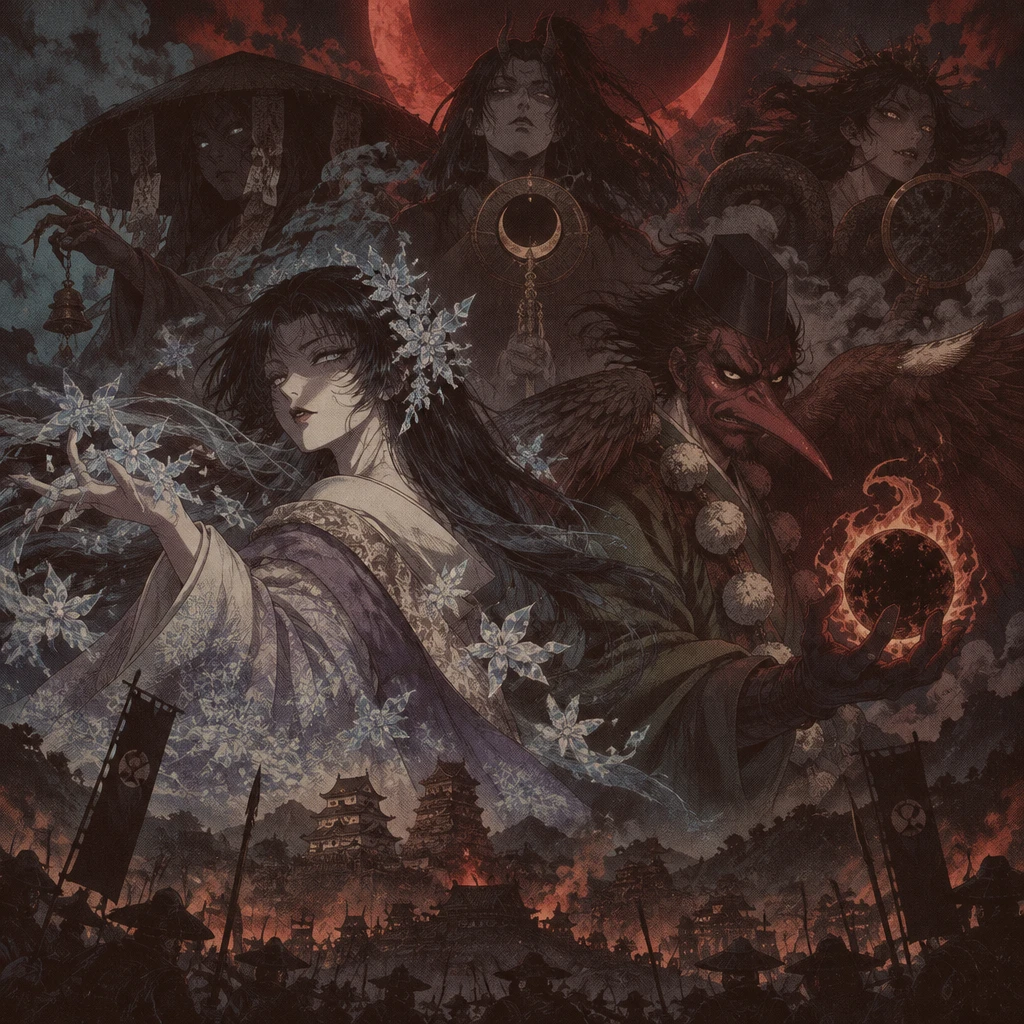
This book is for whoever is building on Blood Aria: Japan. Combat here is deliberately narrative-forward, gritty, and fast: a fight is a handful of beats resolved on one core roll, and the consequence that matters is the wound, the debt, or the reputation — not a grid of hit points. This chapter is the mechanical spine under that philosophy, how to run it, how to balance it with the schema, and how to adapt it if you take the system somewhere else.
The resolution core
Everything contested uses the Night Roll: one d10 + a stat modifier + edge, versus a threshold the Narrator sets.
Modifier comes from a stat on 3–18: 8–9 –1, 10–11 +0, 12–13 +1, 14–15 +2, 16–17 +3, 18–19 +4, 6–7 –2, 4–5 –3; equivalently floor((score − 10) / 2). The character stats object already holds all six. A creature's abilityScores gives you the same conversion.
Edge is a +1 per genuine advantage — help, training, a true-Silver blade, a Relic whose purpose this is, an oath actively honored. Cap stacking at +2 unless the fiction is extraordinary; letting edge creep upward is the fastest way to flatten every scene into a coin flip.
Thresholds — set by how far the odds actually favor the failing side:
| Situation | Threshold |
|---|
| Easy (day-to-day, fair) | 7 |
| Fair (even fight, alert foe) | 10 |
| Hard (outnumbered, feared, cornered) | 13 |
| Brutal (hopeless, star-rated) | 16 |
Read the result by margin M = (roll + mod + edge) − threshold:
- M ≥ +3 — clean win, no cost.
- M 0 to +2 — success at a cost; the player picks from a short bill (composure, a burnt edge, give ground, fail-damage on an ally).
- M < 0 — the fiction turns against them; apply real harm.
- Natural 10 — always a success plus a small gift (a tell, a lamp holding, a sprite spark). Natural 1 — always trouble; make it interesting before you make it painful. A flat d10 over a d20 keeps the tails small and the middle honest — your wanderers can be good, but nothing here is ever safe.
Combat flow
Combat is resolved in a small number of beats, not rounds-of-turns-by-the-book. On your players' beats they hold one intent:
- Press — attack, advance, force the issue. Roll the Night Roll against the foe's resistance; a clean win separates, disarms, or injures as intended.
- Guard — no action now; set a hold and answer the next threat at your trigger with +1 edge. This is how a door, a companion, or a retreat line actually gets protected.
- Flee — break away, create distance, carry someone out. Make retreat a skill the party practices; a party that never leaves a fight clean dies one fight at a time.
A fight decides in roughly two or three passes. If a combat has run past six beats, the question you were asking has stopped being a fight and become attrition — so end the scene and escalate to a wound or a set-piece.
Composure and wounds
Damage is largely narrated, but it needs a ledger. Composure is the pool that eats shrug-off harm: 6 + Constitution modifier + level (Constitution sits in the character stats; level in level). When a clean hit lands, composure absorbs it. At zero composure the next real hit is a wound:
- Shaken — flesh cut, rattled nerve. –1 edge on the next roll. Gone by morning.
- Mauled — cracked rib, deep gash, bleeding begun. –1 edge until cleanly bound (good hands, heat, a day). Days to heal.
- Broke — a hand, leg, or eye. A permanent scar. This is where characters retire, go broken-brave, or relearn the blade.
- Downed — bleeding, unconscious, or taken. A downed wanderer is a scene, not a death. Survivors choose what follows, and everyone who walks away is changed.
Put plain descriptive harm in a character's notes, or a wound as an entry in inventory marked as a consequence, so the sheet itself carries the scar. Do not over-mechanize wound penalties — one number, –1 edge, is enough to make them sting without bookkeeping.
Blood dice — the combat economy
Combat in this world runs on literal blood. Track a session pool of blood dice (usually 2–4). Spend one to ignore a wound penalty for a scene, reroll a Night Roll, call a Relic or sprite gift, or keep fighting at zero composure for one more beat. Refill blood dice only by the things the world prices in blood: feeding, signing a blood-oath, cutting yourself into a furnace to carry a name. This makes the setting's fuel economy a mechanical cost at the table, not a lore aside — players start treating blood like the currency it is, because it is. Use it to make every ethical trade-off real.
Metal as design lever
- Argenite — a tool. No edge, no ceremony. The default; don't reward it.
- True-Silver — guarantees harm against blood-bound and vampiric things and disrupts vitae machinery. Not a numeric bonus against ordinary foes; a hard, player-chosen lever that also makes its bearer a name predators remember.
- Relic — grants edge to the single thing it was made to do, and only while its bearer honors that purpose. The purpose answers for behavior, which is the whole design intent.
- Sword sprite — a small personal gift while the bond is honored. Offending the sprite costs the edge at the worst moment; that should be a story beat the Narrator earns, not a trap.
None of these should be turned into flat attack bonuses that stack into the +2 edge cap. They are reasons to roll well, which is edge, and edge is capped.
Balancing with the schema
The creature fields were built to feed this system directly:
stars (1–5) — narrative threat: how many wanderers it menaces and how many nights it takes to meaningfully hurt. A 3-star night rat is a dark-alley terror; a 5-star is a decision, not an encounter target.intensity (1–6) — mechanical deadliness that adjusts the threshold when the party engages it directly (caster 13 / brute 16). Keep stars and intensity roughly in step.role — minion / elite / boss. Minions fail loud and die fast; elites reward a clean win; bosses are set-pieces with an objective — an airship to cripple, a grudge (the grudgeMoment field) to break, a countdown to disrupt — never an HP grind.hitPoints, armorClass, initiative — treat as descriptive scaffolding: the Narrator reads AC as how hard it is to land, hit points as composure it owns, initiative as who frames the first beat. Convert d20-style DCs and hit bonuses from the details text into threshold-talk on the fly rather than copying them one-to-one — the moment the fight becomes a spreadsheet of mods, you've left this system.
Pacing: the "war as weather" design means combat is optional, intermittent, and consequential. Vary the diet — some fights are set-pieces (stars roll in, a Houdini exit), some are decisions best declined, and the best-dressed session should end more often with a debt signed than a corpse counted. When a player wants to lose, let them — losing well is a lever, and the levers chain into the war's resolution.
Adapting elsewhere
If you lift this system to another setting, the moving parts stay: one core die, modifiers from a six-stat block, a threshold ladder, an edge cap, a short composure pool, wounds that scar, and one commodity the fiction already treats as currency turned into spendable dice. Everything that tingles like this world — silver, blood, reputation, daddy-light — is a skin on that skeleton. Change the commodity, change the named metals, keep the backbone.