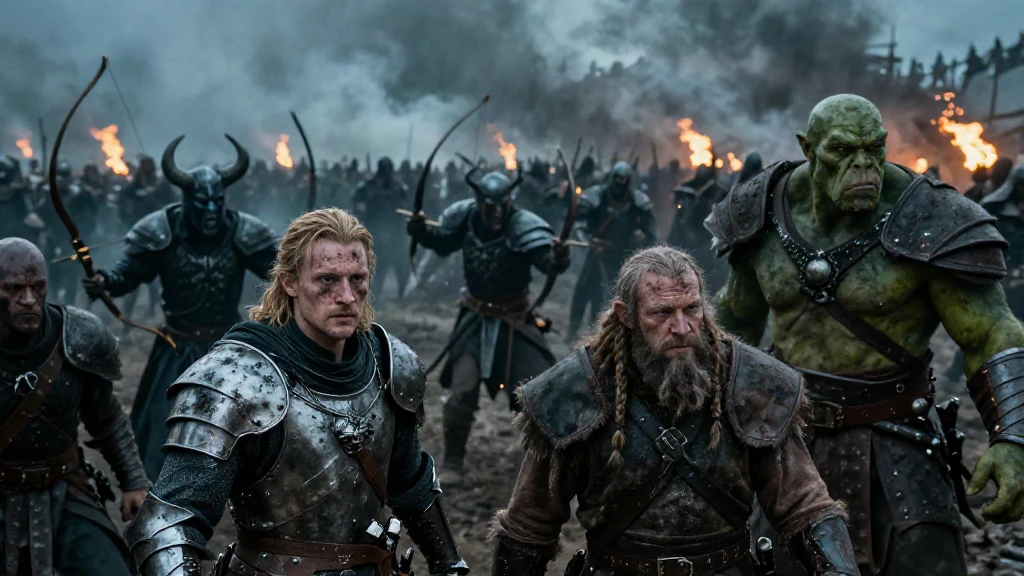
There is no secret plot. There is a continent, ten banners, and a question that will be answered in steel and stone: who holds every City?
The Single Objective
The campaign ends when one faction's pin sits on every City on the Valderra map. Not every village, not every castle — every City. In this project:
- City / Town — economic hubs that sustain a region; the only settlements that count toward victory.
- Castle / Fort — military holds that project power and anchor bound fiefs.
- Village / Outpost / Ruin — bound fiefs. Each is tied to a liege City or Castle via its Liege field. When the liege falls, its villages fall with it — Mount & Blade style.
The source of truth is two fields on every Location: Controlling Faction and its map pin color, which must match. The Valderra Region itself is never owned — it is the container. It holds the war; it is not held.
Your job as GM is to make that map feel consequential.
The Ten Factions
Two per people, by design. Each race has a baseline — not a restriction — so players understand the cultural poles before they mix them or break from them entirely:
| Race | Faction A | Faction B |
|---|
| Human | Crown of Ashes (Imperial Monarchy) | Salt Coast League (Coastal City League) |
| Elf | Cerethil Sylvanguard (forest wardens) | Lyrandiel Starholds (exiled high palace lords) |
| Orc | Kraggathi War Moot (moor horde) | Garnak Stone Pact (settled hill-fort builders) |
| Dwarf | Kar-Azdun Deep Holds (high-peak vaults) | Brundhal Road Guild (caravan/road oligarchy) |
| Tiefling | Ashtari Concord (imperial law, Republic) | Emberwild Pact (waste outcasts, Tribal) |
Every faction description already notes who leads versus who it recruits — use that to justify mixed-race warbands naturally. Players may start in any faction regardless of race, and may found entirely new factions mid-campaign. That is intended.
Mount & Blade, Not D&D
This is your most important tone call.
- Do not run fantasy quest loops. No ancient prophecies, no dungeon-of-the-week, no "adventurers needed" board full of monster hunts.
- Do run Mount & Blade-style missions: paid, practical, factional work. Delivery, escort, debt collection, recruiting, resupply, carrying dispatches, hunting deserters. The reward is coin, reputation with a faction, and a change on the map — prosperity, loyalty, or garrison strength shifting by a point or two.
- Civilian life is valid play. A player who wants to run a tavern, farm a village, trade between Towns, or work as a builder is playing correctly. Their prosperity and loyalty affect the war even if they never besiege a wall. Support it. Give them ledgers, not lore dumps.
Encourage, Don't Mandate, the Conquest
The conquest is the spine — every session should keep the war visible (banners, patrols, prices, rumors of which City fell). But never force a character to enlist. Let pressure be economic and social, not scripted.
Practical tools:
- Status, Loyalty, Prosperity, Garrison, Fortification on every Location are your levers. Move them visibly when the war touches a place.
- atWarWith on Factions makes hostility explicit. Use it.
- Notes on Locations is where you store the GM truth: secrets, hooks, exits, who really controls the grain.
Your Table Contract
Tell your players in session zero: "This is a world at war you can try to conquer, or try to live in while it burns. Both are the game." Then honor it.