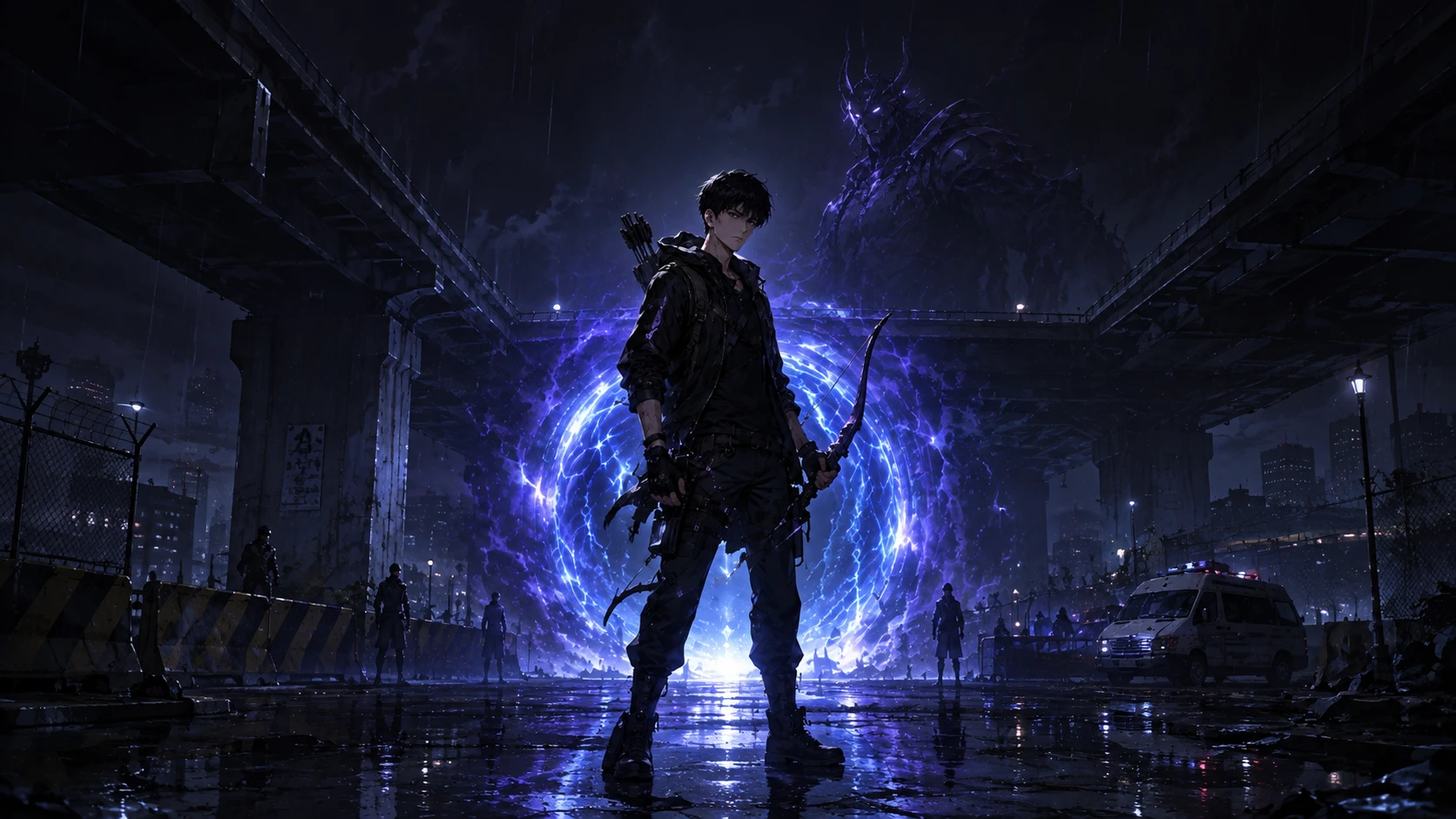
Seoul survives around Gates: portals into monster-filled dungeons that licensed Hunters clear for money, status, and the chance to come home. Your registered rank is supposed to define your limits.
Then the System chooses you. Level up, spend Stat Points, learn skills, take harder contracts, attract guilds, and eventually command a Shadow Army. The world still sees the rank on your license; every raid makes that harder to believe.
No setting knowledge is required to begin.
Glimpses
Author's note
Built for fast progression without mandatory grind: one core 2d6 roll, persistent consequences, meaningful money and gear choices, and a campaign that climbs from low-rank survival to A-Rank threats.
Inside the World
190 entries · 12 types
Characters
12 total
Encounters
24 total
Equipment
47 total
Game Starts
3 total
Gates
11 total
GM Instructions
10 total
Guilds
5 total
Locations
18 total
Monsters
29 total
Quests
14 total
Skills
17 total
Shadows
0 total
Player's Handbook · Chapter 1
Start Here
You are a licensed Hunter in modern Seoul: part contractor, part first responder, part dungeon delver. Gates open into monster-filled spaces that ordinary people cannot survive. Hunters enter them for money, reputation, and the chance to come back stronger.
A Hunter gate site in Seoul
Your character is different from most Hunters. The System gives you levels, stats, quests, skills, and growth that the public Hunter ranking system does not understand. The world still sees the rank on your license. You see the numbers underneath.
The sixty-second version
Play follows one loop:
Choose a goal → describe what you do → roll only when failure matters → live with the result → gain money, XP, gear, or information → take on something harder.
You do not choose from a fixed menu of actions. Say what your Hunter actually does: climb the collapsed stairwell, draw the monster into a narrow lane, spend mana on a barrier, bargain for a better contract, inspect a mana signature, retreat, rescue someone, or take the dangerous route because the payout matters.
When an action is uncertain and the outcome matters, the GM asks for one roll. Most of the game is simply decisions and consequences.
What is public and what is yours
Your registered rank is legal, public information. E is the bottom of the ordinary scale, followed by D, C, B, A, and S. A rank changes only through an in-world re-evaluation or official event.
Your System level, XP, stats, Stat Points, hidden quests, and System-only rewards are not automatically public. Other Hunters can notice what you actually do, but they do not gain access to your character sheet because you fought well.
That distinction is the heart of progression play. You can outgrow the reputation that follows you into a room.
What a session feels like
A typical session moves quickly between four kinds of decisions:
Before a Gate: choose a contract, inspect the risk, form a team, buy gear, or decide that the money is not worth it.
Inside a Gate: navigate hazards, fight monsters, conserve HP and Mana, protect people, and decide when to push deeper.
After a Gate: collect your legal share, keep or sell loot, recover, improve gear, and deal with the attention your performance earned.
Between Gates: spend Stat Points, learn Skills, build Association Reputation, consider guild offers, and choose what kind of Hunter you are becoming.
You never need setting knowledge before your first scene. If a fact is established as something your Hunter already knows, treat it as known. The game rolls for uncertain outcomes, not for permission to understand your own starting situation.
Your first decision
The cleanest way to start is simple: make your Hunter, choose a starting situation, read the situation in front of you, and answer one question in character: