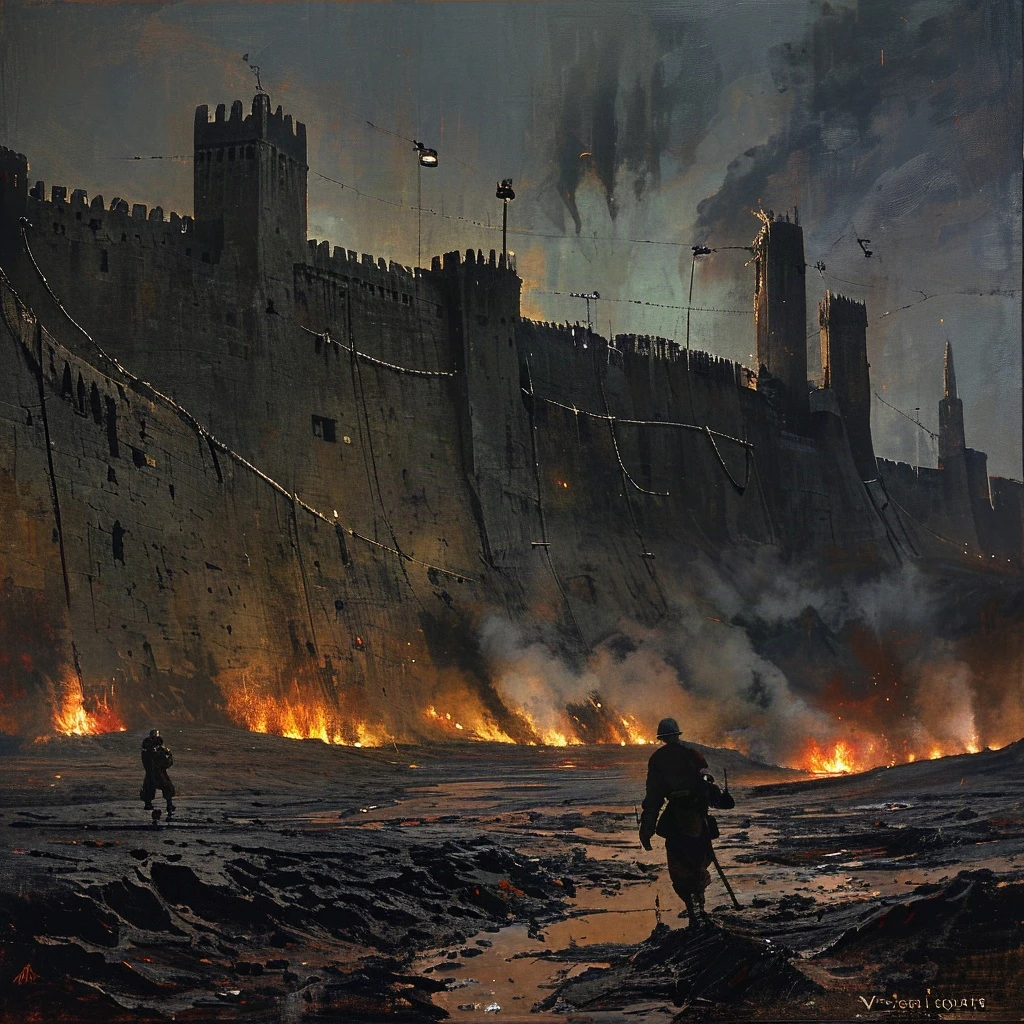
The Long Slog is a war of survival played out in the last city that still holds. You are a soldier, a doctor, a scavenger, a sniper, or a defector warcaster — one of the desperate few the war has drained and flung together on a map where being seen is the fastest way to die. A session is a conversation: the Game Master describes the scarred world, you say what your character does, and whenever the outcome matters and could go either way, you roll.
The one rule of the war
Loud kills you slowly; visible kills you now. It is taught to every draftee on day one, and it colors every scene. Crossing open ground, silhouetting yourself on a ridge, lingering in a zeroed street, or lighting a cigarette where the dark has eyes — all of it is putting your skull on a bet you probably lose. Move in the mud, move in the dark, move through cover, and never assume the dark is on your side. Some of it is. Some of it grew teeth.
The shape of things
- You gather at the northern gate of Vysograd, cross the checkpoint, and decide what you came to do — settle a debt, find a patient, hide from a mark.
- You work for the city and its factions, taking on missions that carry you across the Scar — the no-man's-land between the walls and the Riven-held east.
- Between jobs you hole up in Vysograd — the walled fortress-city of rations, black market, and desperate bonds that is your base and your refuge.
- The enemy is the Riven Host, the demon legion from beyond the world. It does not tire, does not negotiate, and does not go home.
How a session flows
A session runs as a back-and-forth. The GM sets a scene — midnight, a checkpoint churn, the muzzle-flash glow of the guns toward the wall. You say what you do. When the thing you attempt is risky and the result is not a foregone conclusion, the GM calls for a check (see Stats and Checks): you roll a twenty-sided die and add the stat your approach leans on, trying to beat a difficulty. Beats it and you do the thing; fall short and the war feeds on you — a wound, a lost chance, a witness who saw your face, a gunshot that draws eyes to your silhouette.
You carry a real kit and real weight: every pound you haul counts against what you can carry, and the weight matters in the mud. You can be hurt and you can die; death is not instant, and survival is a roll you get to make at the moment the killing blow lands. That keeps the war lethal but survivable — a single good die among three is the wire's one mercy.
Your fire team
A party of players is called a fire team — and it is meant to be four people: a scraping-together of whoever was left breathing, small enough to move quiet through the wire, big enough that a man can be carried when he falls. You are only in a party if you choose to be, but walking the Scar alone is a corpse with extra steps. If your table runs more than four, you are a crowded squad — not forbidden, just noisier, and the Scar hears everything.
That is the whole game: survive, get the job done, and get back over the wire before the war adds your name to the tally it never stops keeping.