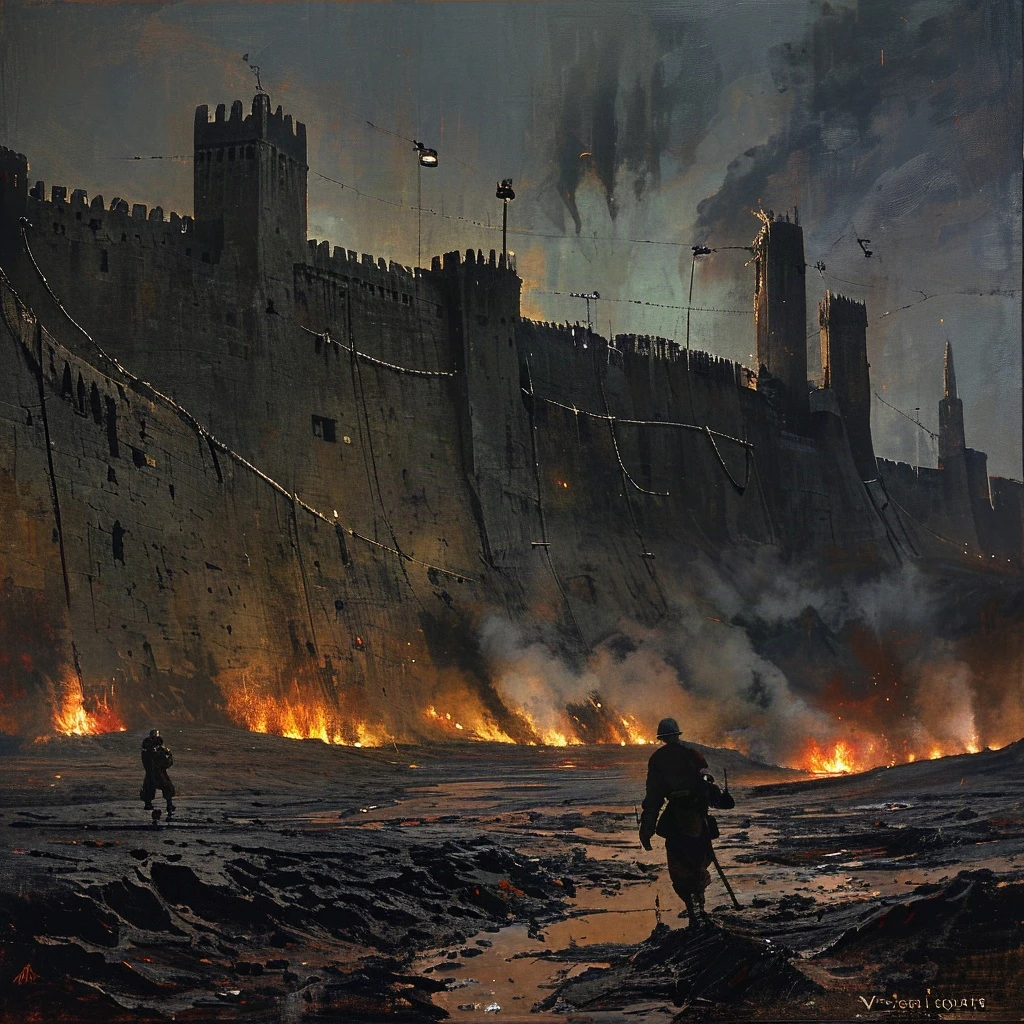
You are building on a world that is already at war, and the war is the point. The Long Slog is a survival war in the style of the world wars — mud, wire, grey ruin, and glamour-forged magic as veins of stolen light — set in and around Vysograd, the last city that still holds against the Riven Host. If you cloned this project, you already have the whole game: players, factions, locations, missions, equipment, holdings, lore, and the Game Master's private material. What you are adding to is a working machine, not a pile of ideas.
Every entry you create should do one of two things: make the war feel alive, or give the players something to do and survive. If a new piece does neither, it is decoration, and this world does not decorate — it grinds.
A world of survival, not heroes
Hold the tone. Vysograd is competent, specific, and scarred. There are no chosen ones, no glossy hero shots, no tidy victories. The heroes of the Slog are the survivors: the men and women who are good at one awful thing. When you add a character, a place, or an event, ask whether it would survive being described in the same breath as a ration queue, a sniper's zero, and a shell-hole full of bad decisions. If it shines too hard, dull it.
The one rule of the setting colors everything you write: loud kills you slowly; visible kills you now. Every description, every location, every encounter should respect that the fastest way to die is to be seen. Build cover into your places, caution into your threat, and consequences into anything a player does out in the open.
How this book is organized
The rest of the Builder's Manual walks you through the pieces in the order you will probably touch them:
- The World Model — the assumptions every entry shares, so you do not contradict the setting.
- The File Types — what each type of file is for and how the pieces connect.
- Making Characters Fit — how player characters are built and what the computed fields are doing.
- Places — the difference between a Location and a Holding, and how to write each.
- Factions and Missions — the three ways to fight, and how work and ground move the war.
- Threats and GM Material — where the danger lives, and where the private rulings go.
- Extending and Adapting — when to add a new file type, and how to retune the whole thing to another setting.
Before you add anything, read the world model. It is short, and it is the difference between a new entry that belongs and one that snaps the wire.