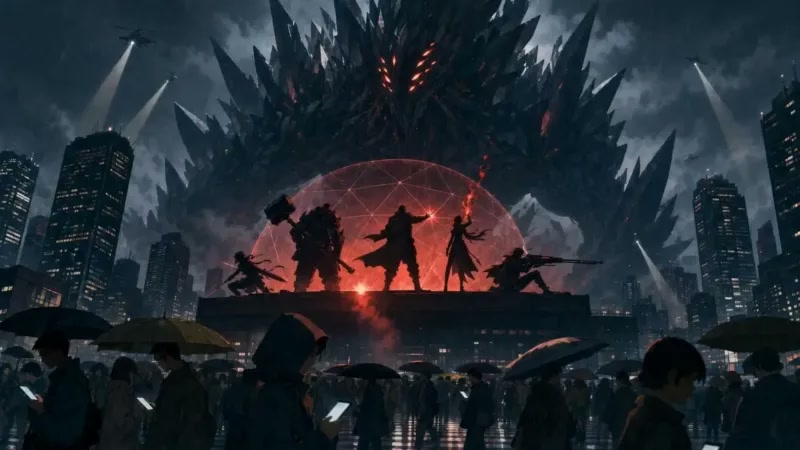
Project Sable: The promise
Prologue
Annex B does not appear on any map of the PATH. It hides behind a construction hoarding that has promised renovations for nine years, three levels beneath the bank towers of the financial district, where the rumble of the subway comes through the walls like weather. Three F Rank badges came off the press this morning, serial numbers still bright, and one of them is yours.
In the ready room, under the wall clock, Instructor Gabriela Mendoza sets a sealed envelope on the table. She is a compact, silver-haired woman in her early fifties, dressed like any commuter in a gray wool coat and practical boots. The only sign she is SABLE at all is the badge pinned inside her lapel. The rookies trade stories about her. Twenty years in Watch Division, informant networks on three continents, and an old workname, Owl, that senior agents still use with respect.
I ran informants for twenty years, and I will tell you what I told every one of them. The best surveillance is the kind where the target buys you a drink and tells you everything. Tonight is simpler than that. Tonight you only have to watch.
Inside the envelope is a photograph of a man in a gray coat, a schedule, and a single page of orders. A subject flagged by Curtain has been meeting unknown contacts at the Harbourfront Night Market after the stalls close. Your cell will take an observation post, log every contact he makes, and report back before dawn.
The last line is in red ink, so hear it in my voice. Do not engage. Do not be noticed. If that man so much as remembers your face, this stops being a first assignment and starts being a career problem.
The envelope goes into the burn tray and curls to nothing. Above ground the cold will be the real kind, lake wind funneled between the towers, and the market is a forty minute walk or a short ride on the streetcar.
The market closes at eleven and he arrives around midnight. Streetcar or walk, your choice. Any questions before I open this door?
Cole Cassidy: what if things go south
[Picture: da1e782f-7f47-46b0-afac-aa16ce6a4203-removebg-preview]
The other rookies shift in their seats. Mendoza's expression doesn't change, but there's a knowing edge to the way she folds her hands — like she's heard this question from a hundred faces that all ended up in the same place.
Gabriela Mendoza: Then you adapt. That's what the badge is for.
She taps the lapel where her own badge hides under wool. Her voice stays level, the way someone talks about weather they've lived through too many times.
If the target makes you, you散dissolve. Different exits, no eye contact, separate routes back to the PATH. You each have a emergency contact protocol in your packets — use it only if someone doesn't show at the rally point within thirty minutes.
She reaches into her coat and produces a small black case, opening it to reveal four identical earpieces, each no larger than a grain of rice.
Gabriela Mendoza: Comms. Low-band, encrypted, range of about two blocks. Channel changes every six hours. If you hear static instead of a voice, someone is jamming — and that means you leave immediately, no questions, no heroics.
She slides the case across the table toward Cole. The earpieces catch the fluorescent light for a moment before she closes her hand over it, as if to say — not yet.
Gabriela Mendoza: The real answer to your question is this: nothing goes perfectly, and anyone who tells you otherwise hasn't been in the field long enough. What matters is that you come back. All of you. That's not a suggestion — it's an order.
Cole Cassidy: all right we walk
The Walk to the Waterfront
The Walk to the Waterfront — 10:15 PM, cold lake wind
The four of you emerge from the PATH through a service door marked TRANSIT AUTHORIZED ONLY and step into a Toronto that doesn't know you exist yet. The financial district towers loom behind, their lobby lights already dimmed for the night. Ahead, the lake wind pushes against you like a wall — sharp, wet, carrying the smell of grilled meat and fried dough from the harbourfront stalls three blocks south.
Émile: So — we blend in, find a spot, and watch. Easy first job, yeah?
Naia: Don't jinx it. Last person who said 'easy' in Mendoza's stories ended up hiding in a dumpster behind a fish market.
Piper: Biscuit's already mapping the area. I've got eyes on the market from above — four rows of stalls, lake to the west, food vendors at the south end. Looks like the main crowd is thinning out already.
You pass through the last block of office towers and the waterfront opens up before you. The Harbourfront Night Market stretches along the promenade — a patchwork of canvas awnings and string lights, still alive with late-night browsers but clearly past its peak. The lake beyond is a black mirror under a half-moon, and the wind off it makes the stall canvases shudder. A few boats bob at the docks to the west.
Your target isn't here yet. You have just over an hour to find good observation positions and become invisible.
Cole Cassidy: piper can biscuit see if those boats are empty
Piper: On it. Biscuit's heading out now.
Piper taps her temple and a small utility drone lifts from her belt — a battered thing the size of a sparrow, painted matte black, with a single glowing sensor eye. It hums once, catches the lake wind, and skims out over the water like a hunting bird.
The drone sweeps the three boats moored along the west side of the promenade. One by one, Piper relays what Biscuit's camera shows on her visor — and by extension, to the group.
Piper: First boat — small sailboat, cabin closed, no lights. Looks like it's been tied up for a while. No one aboard.
Piper: Second boat — fishing trawler, older. There's a cooler on deck and a coffee thermos. Engine's cold but someone was here recently. Maybe a market vendor who docks here instead of driving.
Piper: Third boat — bigger. Cabin cruiser, name on the stern says Night Heron. There's a light on inside, low. Biscuit's picking up movement. One person, maybe two. They're just sitting there. Waiting for something.
The Night Heron sits at the far end of the dock, closest to the open water. Its hull is clean, well-maintained — not a pleasure craft someone keeps for weekend fishing. The kind of boat that can leave quietly and arrive somewhere it shouldn't be by morning.
Naia: That doesn't feel like a casual dock job. Who brings a cabin cruiser to a fish market at eleven at night?
Émile: Could be our target's ride out. Or someone he's meeting.
Cole Cassidy: okay i want biscuit on a fly over . i'll get on the small sailboat
Cole peels away from the group, hood up, moving along the dock edge where the shadows pool deepest. The lake wind works in his favor — every creak of canvas and splash of wave against hull covers the sound of his boots on wet wood. The other boats rock gently as he passes, and the Night Heron's cabin light stays steady. No curtain twitch. No silhouette at the glass.
He reaches the small sailboat and slips over the gunwale into the cockpit. The cabin is cold, faintly smelling of old rope and mildew. Nobody's been aboard in weeks. Cole settles low against the coaming, the sailboat's mast giving him a clear sightline to the Night Heron — maybe forty feet of open water between them.
Piper: Biscuit's circling now. I've got the Night Heron on thermal.
Piper's voice comes through the earpiece, quiet and steady. The drone orbits the cabin cruiser in a slow spiral, its sensor eye feeding data back to her visor.
Piper: Two people inside. One seated at the helm — heat signature says broad build, not moving much. Second person is below deck, smaller. They're not talking. Just... waiting.
Émile: Our target arrives at midnight and it's almost eleven. Those two might be his welcoming committee.
Naia: Or they're the reason we were told not to engage. That's a lot of muscle for a casual meetup.
The market continues to thin. A few late-night food vendors are packing up their grills. From the Night Heron, a single amber glow — someone lighting a cigarette on the aft deck, barely visible through the cabin window. They smoke slowly, patient, watching the water.
Cole Cassidy: piper does biscuit have facial recognitoin
Piper: Biscuit's got a camera and a sensor suite, but facial recognition? Not off the shelf — she's a utility drone, not a Watch Division spy kit.
Piper taps her visor, scrolling through the drone's feed. The Night Heron's occupant on the aft deck is still smoking, their face mostly in shadow.
Piper: I can get you a clear shot when they step into the light, though. If you've got a photo from the briefing packet, I can compare it manually on my visor. Old school, but it works.
Naia: Mendoza gave us a photograph. It's in the envelope — did anyone keep it?
Émile: I've got it. Want me to send a photo to Piper's visor?
The brief photograph from Mendoza's envelope shows a man in a gray coat, mid-forties, sharp features, dark hair going silver at the temples. The kind of face that could be anyone in a crowd — which is exactly the point.
Cole Cassidy: yes cross reference it with the smoker
Piper: Pulling up the photo now. Biscuit, get me a better angle on that smoker — I need their face, not their silhouette.
The drone adjusts its orbit, dropping lower over the Night Heron's stern. The smoker hasn't moved — still seated, one arm draped over the gunwale, the cigarette a tiny orange dot in the dark. Then, as if feeling the lake wind shift, they turn their head slightly. The cabin light behind them catches the side of their face — sharp cheekbone, silver at the temples, a jawline that could cut glass.
Piper: Got it. Hold on — comparing now.
A beat of silence on the earpiece. Piper's visor displays two images side by side: the briefing photo from Mendoza's envelope, and the live feed from Biscuit's camera. The angle is different, the lighting worse, but the features line up. Same sharp geometry. Same silver creeping through dark hair. Same measured stillness of someone who's spent a career not being noticed.
Piper: ...It's him. Our target is on the Night Heron. He's the smoker.
Émile: So much for the welcoming committee. He's his own welcoming committee.
Naia: Then who's below deck? And why arrive early to your own dead drop?
On the Night Heron, the target finishes his cigarette. He stubs it out on the gunwale with deliberate care, then stands — and for a moment, his full silhouette fills the cabin window. He's taller than the photo suggested. Broader. He reaches for something inside the cabin, then disappears below deck. The amber light inside goes out.
Piper: He's gone dark. I've lost the thermal — something's blocking the sensor. He might have gone below, or... I don't know. Biscuit can't see through the hull.
Cole Cassidy: He's still on the boat. He just killed the lights. Stay on him, Biscuit — watch the waterline. If anyone moves, I want to know.
Cole Cassidy: keep still if anythings moves log it
Cole Cassidy: Everyone hold. Eyes open, mouths shut. Piper — Biscuit logs everything. Timestamp it. I want a record of every boat, every footstep, every light that moves on that water.
The cell goes quiet. Piper settles against a crate, visor glowing faintly as Biscuit's feed streams in real time. Émile melts into the shadow of a closed food stall, one hand resting on the grip of his weapon. Naia crouches behind a stack of lobster traps, her back to the water, ears open to the promenade behind them. On the sailboat, Cole is a still shape in the cockpit, nothing moving but his eyes.
The market empties. A food vendor wheels his cart past the dock entrance, glances at the boats, and moves on. The string lights along the promenade flicker once in a gust of wind, then hold. The lake laps against the hulls. Somewhere across the harbor, a foghorn sounds — low, patient, rhythmic.
Biscuit records. The drone's log timestamps every frame: 22:47 — a pair of dock workers pass on the north pier, finishing a shift. 22:53 — a city police cruiser rolls slowly along the waterfront road, pauses, then continues. 22:58 — a small motorboat crosses the harbor from the east, running dark. It passes within two hundred yards of the Night Heron without slowing. No collision course. No signal. Just a boat, moving through the dark.
Naia: That motorboat. Did you see that?
Piper: Logged. No ID, no running lights. Could be a Gray Tide runner. Could be nothing. It's gone now — heading toward the islands.
The Night Heron stays dark. No movement on deck. No light below. The target and whoever is with him are patient — or they're not there anymore. But Biscuit's thermal showed two heat signatures below deck fifteen minutes ago, and the boat hasn't moved. They're still aboard. Waiting.
23:04. Fifty-six minutes to midnight. The harbor is almost still now. The last ferry crossed to the islands twenty minutes ago and didn't come back. Cole's sailboat rocks gently at its mooring. The Night Heron rocks in counterpoint. Two boats, face to face across forty feet of black water. Neither one blinking.
Cole Cassidy: report anyone see anything out of the ordinary
Piper: Nothing on the Night Heron. They're still below deck. But Biscuit picked up something on the north pier about ten minutes ago — a figure, standing at the end of the dock. Just... watching the water. They were there for maybe five minutes, then walked away toward Queens Quay. I tagged the footage. Could be a late-night fisherman. Could be a lookout.
Émile: I've got something. One of the food vendors — the grilled octopus stall, woman with the red bandana — she packed up early but didn't leave. She's sitting in her truck now, engine off, parked on the access road. She's been there for twenty minutes. Watching the market.
Naia: I heard a radio. Faint, could be a marine channel. Someone keyed the mic twice — no words, just clicks. Could be a signal. Could be someone checking if their radio works. It came from the direction of the Night Heron.
Three observations, each ordinary on its own. A person watching the water. A vendor who stayed. Two clicks on a marine radio. Any one of them could be innocent. Together, they feel like the edges of something — the kind of pattern that only shows up when you're watching from the outside.
Piper: Want me to run the truck's plate? If she's a Gray Tide vendor, she might have a record.
Cole Cassidy: Émile, check the truck. Piper, keep Biscuit on the Night Heron. I don't want to miss a move.
[Picture: da1e782f-7f47-46b0-afac-aa16ce6a4203-removebg-preview]
Émile peels away from the food stall's shadow and moves down the access road, hands in his pockets, posture loose — just a guy walking to his car. The grilled octopus vendor's truck is a battered white pickup with a magnetic sign on the door: PETRA'S GRILL — FRESH CATCH DAILY. The engine is off. The windows are tinted. A faint blue glow pulses inside — a phone screen, maybe, or something else.
Émile slows as he passes. The driver's side window is cracked two inches. Inside, the woman with the red bandana — mid-thirties, dark eyes, a scar along her jawline — is staring at a phone mounted on the dashboard. The screen shows a live camera feed. Not the Night Heron. Not the market. A different angle — the north pier, the same stretch of dock where Piper's figure was standing ten minutes ago.
Émile: ...She's watching the north pier. Live feed, different angle. She's not just a vendor.
The woman's eyes flick up. She's seen Émile in the side mirror. For a moment, neither moves. Then she reaches for the window switch and lowers it fully.
Petra: You're not here for octopus, are you?
Émile: Depends. You're not just here for the foot traffic, either.
Petra: SABLE?
The word hangs in the air between them. She didn't flinch when she said it. Didn't whisper it. She said it the way someone says a word they've said before — a professional, identifying another professional. The question isn't whether she knows about SABLE. It's which side she's on.
Cole Cassidy: emile report what's going on
On the earpiece, Émile's voice comes low and measured — the voice of a man who's learned to talk calmly while someone watches him with unknown intentions.
Émile: The vendor's name is Petra. She's got a live camera feed pointed at the north pier. Not the Night Heron — the pier. She just asked me if I'm SABLE. Didn't hesitate, didn't whisper it. Said it like she's said it before.
Petra: I can hear you talking to someone. Earpiece? earbud? Doesn't matter. I know what SABLE looks like when they're on a job. You've been watching the Night Heron for over an hour. So have I.
Naia: ...She's been watching the boat too? Cole, that's not a coincidence. She might be part of the deal.
Piper: Or she's watching for someone else. That camera feed isn't on the Night Heron — it's on the pier. The same pier where that figure was standing earlier. She's tracking something different than we are.
Émile stands by the truck window. Petra's dark eyes don't leave his face. The blue glow of her camera feed reflects off the tinted glass. On the screen, the north pier is empty — just wood and water and the distant shapes of moored boats. But someone was there. And she was watching them.
Émile: You want to tell me who you work for? Because if you're Gray Tide, you're wasting your time — we're not here for you. And if you're something else, I'd rather know now than later.
Petra: I work for myself. But I know who's on that boat, and I know why you're here. The question is whether you know who else is coming at midnight — because I do.
Cole Cassidy: emile get on the fishing boat ill talk to petra
S02 — Approaching Petra
S02 — Approaching Petra — Harbourfront Night Market, 23:08
Émile: Copy. Heading to the boat now. Cole — be careful. She's not afraid of us.
Émile peels away from the truck window and moves fast across the access road toward the dock, boots quiet on the pavement. Cole unclips from the sailboat's rigging, drops to the gunwale, and crosses to the dock in four sure strides. The water laps at the pilings as he strides up the access road toward the white pickup with its tinted windows and magnetic sign.
Petra watches him come in her side mirror. She doesn't start the engine. Doesn't lock the door. Just sits there, one hand resting on the dashboard, the blue glow of the camera feed painting half her face. She's calmer than she should be — which means she either trusts what she knows, or she's got something Cole doesn't.
Petra: You must be the one in charge. The other one — your scout — he had good instincts. Came right to the truck, didn't flinch. You trained him?
Cole stands at the driver's side window. Up close, the details sharpen. The scar along her jaw is surgical — clean, deliberate, the kind you get from a street doc closing a blade wound. Her jacket has a bulge at the hip that isn't a phone. And the camera feed on the dashboard just updated: the north pier now shows two figures approaching from the Queens Quay side, moving in the dark with purpose.
Petra: Before you start asking questions — look at the screen. Those two just showed up. They weren't here twenty minutes ago. Your midnight meeting? They're early, and they brought friends.
Cole Cassidy: piper get visual queens quay side emile stay on the night heron
Piper: Biscuit's already turning. Give me thirty seconds.
On the sailboat, Émile settles into Cole's vacated position, one hand on the rigging, eyes fixed on the Night Heron thirty yards out. The trawler sits low in the water, dark save for a faint green glow from below deck — the galley, maybe, or something electronic. No movement on deck. No lights above. But the engine is idling; he can feel the vibration through the water.
Piper squeezes between two parked vendor trucks and opens her controller. The drone lifts from behind the storage containers with a near-silent whir and arcs north over the market, climbing to sixty feet. On her screen, the harbour unfolds in grainy night vision — stalls, promenade, lake, and then the north pier jutting out into the dark water like a finger pointing at nothing.
Two figures stand at the end of the pier. Both in dark clothing. One is taller, broad-shouldered, standing with arms crossed — a posture of authority, of someone who expects to be waited on. The other is shorter, leaner, scanning the water with a handheld scope. Neither is carrying anything visible. But the taller one has something on their belt that catches the light — metal, curved, the shape of a high-cap magazine or a comm unit.
Piper: Got them. Two contacts, north pier end. One tall, one short. Tall one looks like a boss — arms crossed, waiting. Short one's scanning the water with optics. Can't ID faces yet — they're facing away from the camera. But the tall one has something on their belt. Looks like a commlink... or a magazine. Could be armed.
Petra: That's not who I was expecting. Those two — they weren't part of the original deal. Someone changed the plan.
Naia: Cole. The radio clicks I heard earlier — they might have been signaling those two. Someone on that boat knew they were coming.
The picture sharpens, but doesn't simplify. Two new arrivals at the pier. Petra claims she doesn't know them. Naia heard radio signals from the Night Heron's direction minutes ago. And the clock reads 23:11 — forty-nine minutes until midnight. Whoever these people are, they arrived early, and someone on that boat was expecting them.
Cole Cassidy: what do you mean deal has changed
Petra leans back in her seat. The blue glow of the camera feed paints her face in cold light. She doesn't answer right away — she watches the two figures on her screen, the tall one still standing with arms crossed, the shorter one still scanning the water. Her jaw tightens.
Petra: I'm a broker. I sell information to whoever's buying — Gray Tide, SABLE Watch, sometimes the Vigil. Three days ago, someone contacted me through a dead drop. Said there'd be a shipment on the Night Heron tonight. Off-books. Parts — cybernetic implants, military-grade, the kind that doesn't exist on any manifest. The buyer was supposed to arrive at midnight. Single buyer. Quiet exchange, no fireworks.
Petra: Those two are not a single buyer. That tall one — I've seen him before. His name is Doran Pike. He runs security for a syndicate out of Montreal. The kind of security that involves making problems disappear. He's not here to buy parts. He's here to take them.
She taps the screen with one finger, freezing the feed on the tall figure's silhouette. Even in grainy night vision, the posture reads cold and proprietary — a man who considers the world something he's entitled to take from.
Petra: If Doran Pike is on that pier, the Night Heron's crew is either working for him or about to have a very bad night. And whatever you SABLE people are here for — observation, interception, clean-up — it just got more complicated. Because Pike doesn't leave witnesses.
Naia: Cole. If this Pike guy is here to seize the shipment by force, things could escalate fast. We might be walking into a three-way standoff — Pike's people, the Night Heron crew, and us.
Piper: I'm pulling Biscuit back to the boat. If shooting starts, I don't want to lose the drone to a stray round. Updating the feed now — the shorter one just keyed a commlink. Someone else is on the way.
23:14 on the clock. Forty-six minutes until midnight. The number of unknowns on this map just doubled, and the kind of operation Cole signed up for — a quiet observation job — is starting to look like something else entirely. Pike's arrival changes the calculus. SABLE's mandate is to contain Outbreaks and maintain the cover, but a syndicate muscle job at a public market is a different kind of problem. The question is whether Cole's orders cover this — or whether he's about to write his own.
Cole Cassidy: (i thought i said this in my head) shit so much for just observing
The words don't leave Cole's mouth — they sit behind his teeth, bitter and hot. Twenty minutes ago this was a textbook surveillance job. Watch the boat. Log the players. File the report. Now there's a Montreal syndicate enforcer on the pier, a crew on the Night Heron that may or may not be freelancing, and an information broker sitting three feet away who knows more than she should.
Petra studies his face the way she studies a camera feed — reading patterns. She sees something there she likes, or something she can use.
Petra: You're thinking about your mandate. Whether this falls inside your box or outside it. I'll save you the calculus — it doesn't matter. If Pike moves on that boat and civilians get hurt at a public market, every camera in Toronto catches it. Your cover-up becomes a hundred times harder.
Piper: She's not wrong. The market's not empty — there's still foot traffic on the promenade. If this turns violent, we're looking at collateral AND exposure.
Émile: Cole. The Night Heron just killed its engine. They're drifting. Someone moved on deck — one figure, port side, looking toward the pier. They see Pike. This is happening soon.
The harbor holds its breath. The Night Heron drifts dark and silent. Two figures wait on the north pier. A drone circles overhead. And Cole Cassidy stands in the blue glow of a camera feed, forty-four minutes before midnight, deciding what kind of problem this is going to be.
Cole Cassidy: piper mark the two emile stay on that boat i'll take it from here
Piper: Marking now. Pike and plus-one tagged on the feed. I'll keep Biscuit circling — you'll have eyes if they move.
Émile: Holding. The figure on the Night Heron's deck just went back below. Engine's still cold. They know someone's out here.
On Piper's controller, two orange tags bloom over the figures on the north pier — digital markers that will track their movement as long as Biscuit has line of sight. Pike hasn't moved. His companion lowers the commlink and says something. Pike uncrosses his arms. That's when Cole sees it: a third figure emerging from the shadows at the base of the pier, moving toward them with the measured stride of someone who knows exactly where they're going.
Piper: Hold — third contact. Pier base, moving toward Pike. New tag going up... she's got something in her hand. Looks like a case. Small, hard-shell. Pelican-style.
Petra: That's the buyer. That's who was supposed to come at midnight. She's early too — which means someone tipped everyone off at the same time, or someone's been playing the clock from the start.
Three figures now on the north pier. A case in a woman's hand. A crew hiding below deck on a dark trawler. And Cole Cassidy standing on an access road, sixty feet of market and dock water between him and the next move. The observation phase is over.
Cole Cassidy: emile on me we are getting close to the buyers and pike, piper and naia watch the night heron
Piper: Copy. Eyes on the trawler. Biscuit's got it in frame.
Naia: I see movement below deck. Faint. Someone's still alive on that boat.
Cole pushes off from Petra's truck without looking back. Émile drops from the sailboat to the dock in one motion, crossing the access road to fall in half a pace behind Cole's left shoulder — muscle memory, the kind you don't have to think about. They move through the last row of market stalls, past a shuttered jewelry cart and a string of dead fairy lights, toward the waterfront promenade where the lake opens up.
The north pier is a narrow concrete finger extending sixty feet into the harbor, flanked by old wooden pilings wrapped in frayed rope. No railings. No lights except a single sodium lamp at the base that throws a sick yellow circle on the wet ground. The pier's surface is scarred concrete and barnacle-crusted planking. The lake laps at both sides, dark and still.
Doran Pike stands at the far end, fifteen feet from the pier's edge. His companion is three paces behind him, hand resting on something beneath his jacket. The buyer — a woman, mid-thirties, dark coat, hair pulled tight — stands ten feet from Pike with the hard-shell case at her side. Nobody is speaking. The negotiation hasn't started. They're waiting for someone else, or they're waiting for the right moment.
Cole and Émile step onto the pier. The sodium lamp catches them in its yellow wash. Pike's head turns first — slow, deliberate, the way a predator registers new movement without acknowledging it as a threat. His companion's hand doesn't move from beneath the jacket. The buyer glances at Cole, then at Émile, then back at Pike. Her grip tightens on the case.
Doran Pike: ...Well. This isn't who I was expecting either.
Pike's voice carries across the pier — low, unhurried, with the flat authority of someone accustomed to controlling rooms. He doesn't reach for a weapon. Doesn't square up. Just stands there, weight on his back foot, studying Cole the way you study a chess piece that just moved somewhere unexpected.
Doran Pike: You're not here to buy anything. I can tell by the way you walk. So — who sent you? Montreal? Toronto PD? Or something... less official?
Cole Cassidy: that depends whos asking
The answer lands on the pier like a coin spinning on its edge. Pike's expression doesn't change — not surprise, not irritation. Something closer to interest. The kind of interest a surgeon shows when a patient presents an unusual symptom.
Doran Pike: Fair enough. I'll go first, then.
Pike reaches into his overcoat — slow, deliberate, palms visible — and produces a black business card. No name. No title. Just a phone number embossed in silver on matte cardstock. He holds it between two fingers, extended toward Cole, not quite within reach.
Doran Pike: Doran Pike. I provide security solutions for people who can't afford to have things go wrong. Tonight I was contracted to ensure a shipment reaches its destination. Clean. Quiet. Professional. You look like a professional too — which means you're not here by accident, and you're not here for the fish.
His companion hasn't moved. But the buyer — the woman with the case — has taken two slow steps backward, putting distance between herself and Pike. Her eyes dart between Cole and Pike the way someone watches a conversation they regret being part of.
Doran Pike: So here's my question, and you can answer it however you like. Are you here to stop what's about to happen — or are you here to make sure it goes smoothly? Because those are two very different conversations, and I'd like to know which one we're having before midnight.
The pier is quiet except for water against pilings and the distant hum of the market. Pike waits. His companion waits. The buyer clutches her case. Behind Cole, Émile's breathing is steady, controlled — the breathing of someone who has done this before and knows the rhythm of a moment before it breaks.
Piper: Cole — comms. The Night Heron just lit up. Someone turned on a deck light. I've got movement on the stern. Two, maybe three figures. They're watching the pier. They see you.
Cole Cassidy: bluff we are just makeing sure no one gets hurt here
The words come out easy — the way Cole says everything, like he's already thought about it and this is just the conclusion. Not a threat. Not a play. Just two professionals on a pier, making sure the evening stays civil.
Pike studies him. The silence stretches three seconds, five, eight — long enough for the lake to lap twice against the pilings. Pike's eyes move from Cole to Émile, then back. He's doing the math. Two men on a public pier, no visible weapons drawn, no backup visible. EitherCole is exactly what he says he is, or he's something much more dangerous and very stupid. Pike has met both types. He's not sure which one costs more.
Doran Pike: Peacekeeper. That's a word people use when they don't want to say what they actually are.
But the edge in his voice has softened by a degree. Not trust — Pike doesn't do trust. But calibration. He's reassessing Cole from 'threat to be neutralized' to 'variable to be managed.' That's progress.
Doran Pike: Fine. You want to keep the peace? So do I — violence at a public market is bad for everyone's business. Including mine. So here's what's going to happen. That boat—
He nods toward the Night Heron, where the deck light casts a pale circle on the dark water.
Doran Pike: —has something I was contracted to retrieve. I'm going to walk down this pier, board that boat, and take what I'm owed. The buyer—
He glances at the woman with the case, who flinches under his gaze.
Doran Pike: —is going to hand over the payment she was supposed to bring, because she just realized the terms have changed. And you, peacekeeper, are going to stand right here and make sure nobody does anything stupid. Like I said — nobody gets hurt. Assuming everybody cooperates.
Pike takes a step toward the Night Heron. His companion falls in behind him. The buyer's hand trembles on the case handle. Émile shifts his weight half an inch — a question without words: do we let this happen?
Piper: Cole. The Night Heron's crew is still on deck. Three of them. They've got line of sight on Pike. If he boards that boat, it's going to be four against three in a confined space. Someone's going to make a call, and it's going to be the wrong one.
Naia: I can see the buyer from here. She's reaching into her coat with her free hand. She's got something in there — not a weapon, something else. A phone? A tag? She's about to signal someone.
23:28. Thirty-two minutes to midnight. Pike is walking toward the Night Heron. The buyer is reaching into her coat. The crew on deck is watching. And Cole Cassidy stands in the middle of a pier, holding a lie together with nothing but nerve and a good pair of eyes.
Cole Cassidy: ok we'll stay put and make sure no-one gets hurt.
Pike doesn't look back. He nods once — a gesture that might be acknowledgment or might be dismissal — and continues down the pier toward the water. His companion follows, hand still inside the jacket. The sodium lamp's yellow light stretches their shadows long and thin across the concrete, reaching back toward Cole like dark fingers.
The buyer stands frozen, case in one hand, the other still half-buried in her coat. She watches Pike pass her like a rabbit watching a fox walk by — rigid, breath held, hoping the math works out in her favor. It doesn't. Pike pauses beside her, says something too quiet for Cole to hear. Her shoulders drop. She pulls her hand from her coat — empty — and falls into step behind him. Leading, not following. Showing him the way to the Night Heron.
Naia: The buyer's hand is empty now. Whatever she was reaching for, she thought better of it. She's walking with Pike toward the water. Two targets moving together, heading for the stern of the Night Heron.
The Night Heron sits dark in the water except for that single deck light — a bare bulb in a wire cage mounted on the stern rail. As Pike approaches, the light flickers once. Someone on deck saw him coming. The boat's engine remains dead, but there's movement in the cabin — a shadow crossing the window, then another. Three crew. Three possible weapons. One narrow gangplank connecting the boat to the pier.
Doran Pike: Evening. I'm here for what was promised. You can hand it over, or I can come aboard and find it myself. Your choice — but I'd recommend the first option. It's cleaner for everyone.
Pike's voice carries across the water with the calm authority of a man who has done this many times before. He stands at the pier's edge, hands at his sides, not reaching for anything. His companion stands three paces back, covering. The buyer lingers behind them both, case at her side, face pale in the deck light.
Émile: Cole. The crew on deck — one of them just picked up a fishing rod. That's not a fishing rod. It's a speargun. Modified. He's holding it casual, but it's pointed at the pier.
23:31. Twenty-nine minutes to midnight. Pike is twenty feet from the Night Heron's stern. The buyer is ten feet behind him. Three crew on deck, one armed with a speargun. Émile and Cole are forty feet back on the pier, holding a peacekeeper lie that is about to be tested by a speargun, a syndicate enforcer, and a shipment nobody was supposed to know about.
Émile Fournier initiative — Rolled 2d6+5 — Result: 12
Doran Pike initiative — Rolled 2d6+2 — Result: 12
Pike's Companion initiative — Rolled 2d6+2 — Result: 9
Night Heron Crew Member 1 initiative — Rolled 2d6+1 — Result: 8
Night Heron Crew Member 2 initiative — Rolled 2d6+1 — Result: 8
Night Heron Crew Member 3 initiative — Rolled 2d6+1 — Result: 7
Cole Cassidy: running over and pushing the speargun down hey now no need for the violence
Cole doesn't wait for the speargun to fire. The moment Émile's words register, his body is already moving — forty feet of pier dissolving under his boots in a dead sprint. The sodium lamp streaks overhead. The water is a dark blur on either side. Everything narrows to the crew member's hands on the speargun and the too-slow moment of recognition on the man's face.
Cole hits the crew member like a wave hitting a piling. His left hand catches the speargun barrel and shoves it skyward — the shaft barks once, firing a bolt into the dark sky with a wet pneumatic snap. His right hand drives into the man's chest, pushing him back against the cabin bulkhead. The speargun clatters to the deck. The crew member's eyes go wide — not with pain, but with the particular shock of someone who just realized how fast a situation can change.
Cole Cassidy: Hey now, no need for the violence.
[Picture: da1e782f-7f47-46b0-afac-aa16ce6a4203-removebg-preview.png]
The bolt arcs into the lake somewhere behind the pier with a distant splash. On deck, the other two crew members freeze — one near the cabin door, one at the starboard rail. They look at Cole, then at Pike, then at each other. They don't know who to be afraid of more.
Doran Pike: ...I thought you said you were a peacekeeper.
Pike has stopped ten feet from the Night Heron's stern. He's turned back to watch Cole — and there's something on his face that wasn't there before. Not anger. Not suspicion. Something closer to recalibration. He just watched a man sprint forty feet and disarm an armed crew member in the space of a breath. That changes the math.
Doran Pike: That's exactly what a peacekeeper does. Prevents violence. You just did it very... aggressively.
The disarmed crew member slides down the bulkhead to the deck, hands up, breathing hard. He's done. The other two crew members haven't moved, but neither have they reached for weapons. The buyer stands behind Pike, case clutched to her chest, eyes fixed on Cole with an expression caught between gratitude and terror.
Émile: Cole. Pike's companion just moved. She's reaching into her jacket. She saw the whole thing.
23:32. Twenty-eight minutes to midnight. Cole Cassidy stands on the deck of the Night Heron, one hand still on a disarmed crew member's chest, the other hovering near his revolver. Pike watches from the pier. Pike's companion watches from behind him. Two armed crew members watch from the deck. The buyer watches from the shadows. Everyone is watching everyone. And somewhere in the market behind them, a string quartet is playing something by Vivaldi, because the world has no idea any of this is happening.
Standoff on the North Pier
Standoff on the North Pier — Round 1 — 23:32, twenty-eight minutes to midnight
Oracle: Round 1. The disarmed crew member gasps on the deck at Cole's feet. Crew 2 stands rigid by the cabin door, speargun half-raised. Crew 3 peers over the starboard rail at the pier — at Pike, at the buyer. Pike's companion's hand is inside her jacket. Pike himself hasn't moved. The deck light swings on its wire, casting lurching shadows across every face.
Cole is first to act. He has two actions. The Night Heron deck is a five-by-twelve-foot raft of weathered planking: the disarmed man at his feet, two armed crew members within arm's reach, the cabin behind them, and the pier — with Pike, his companion, and the buyer — ten feet to the east. Émile is forty feet back on the pier, watching.
Naia: Cole — buyer just whispered something into her phone. Someone else is coming. Whatever you're going to do, do it fast.
Cole Cassidy: well sometime you gotta be aggressive to stop things from spiraling
The words hang in the salt air between the boat and the pier. Cole stands on the Night Heron's deck with one hand still on the disarmed crew member's chest, the other open at his side — the universal gesture of a man who just disarmed someone and wants you to know he could have done worse.
Pike studies him across ten feet of dark water. The deck light sways. The Vivaldi carries faintly from the market. Pike's jaw works — not grinding, just thinking. He's doing the math again, and this time the numbers are different.
Doran Pike: You sprinted forty feet to disarm a man before he could fire. That's not peacekeeping. That's training. Real training. The kind they don't teach at security firms.
His companion's hand is still inside her jacket. She hasn't drawn anything. She's watching Pike for a signal that hasn't come.
Pike is quiet for a long moment. The deck light swings. The lake laps against the hull. Somewhere behind them, a food vendor calls out the specials on jerk chicken, and someone laughs, and the world continues being completely unaware that on a dark pier at the edge of the harbor, six people and a boat are balanced on the edge of a knife.
Doran Pike: Fair enough. You stopped a man from firing a speargun in a public market. I can respect that — I told you myself, violence here is bad for everyone's business. So here's what I see: you're not here for the shipment. You're not here for me. You're here to make sure nobody does anything stupid. Fine.
He gestures behind him, and his companion slowly — deliberately slowly — withdraws her hand from her jacket. Empty. It was never a weapon. Just a commlink, held between two fingers like a playing card, waiting for a signal that Pike just decided not to give.
Doran Pike: But I still have a contract. That boat has something I was hired to retrieve. And the woman behind me — she was supposed to bring payment. She didn't. So here's my question, peacekeeper: how do you propose we resolve this without anyone getting hurt?
The buyer — pale, clutching her case, looking like she'd rather be literally anywhere else on Earth — shakes her head faintly. A tiny gesture, almost invisible. She mouths two words to Cole when she thinks Pike isn't looking: I can't.
Émile: Cole. I don't think this is a negotiation we should be having. We're not arbitrators. We're observers. The moment we take a side in a syndicate deal, we lose our cover.
Round 1, Turn 4. Pike's companion has lowered the commlink. Pike is waiting for Cole's answer. The two armed crew members on the Night Heron are watching, spearguns still in hand but not raised. The disarmed crew member hasn't moved. The buyer can't pay. Émile is right — and yet Cole is standing on the deck of a smuggling boat, holding a peacekeeper lie together with nothing but nerve, and Pike just asked him to solve a problem that might not have a solution.
Cole Cassidy: how much was the payment?
Cole's question lands like a stone in still water. Pike blinks — not because the question is strange, but because it's the first thing anyone has said tonight that sounds like a real negotiation instead of a threat.
Doran Pike: Eight thousand credits. For a sealed crate of black-market neuroprocessors — military grade, pre-Outbreak manufacture, worth three times that on the right market. My employer contracted me to retrieve the crate when the deal fell through. The buyer was supposed to wire the payment to a holding account before boarding. She didn't. The crew won't release the crate without confirmation.
The buyer — still pale, still clutching her case — looks at Cole with desperate eyes. She's too afraid to speak openly with Pike ten feet away, but her body language screams that there's more to the story.
Émile: Cole. Eight thousand credits. That's more than we carry on a standard op. And even if we had it, spending agency funds on a syndicate deal is exactly the kind of thing that gets your badge pulled.
Pike tilts his head, waiting. The crew on the Night Heron waits. The buyer waits. The whole pier seems to hold its breath. Cole Cassidy stands on the deck of a smuggling boat, and the question hanging in the air isn't whether he can solve this — it's whether solving it is his job.
Cole Cassidy: pike if its alright with you may i speak privately with the buyer
Pike regards Cole for a long moment. The request is a smart one — a private word with the buyer means Cole can hear her side of the story without Pike's shadow over the conversation. Pike knows this. He also knows that refusing makes him look like the heavy, which undercuts the dynamic Cole's already shifting.
Doran Pike: Two minutes. Right here on the deck where I can see you both. You want private — you get private voices, not private distance. And peacekeeper?
Doran Pike: If she tells you something that changes the math, you tell me. That's the condition. Otherwise you're not a peacekeeper — you're a middleman with better hair.
It's as close to a joke as Pike has come all night. His companion almost smiles. Even Crew 2 — the one by the cabin door with the speargun — shifts his weight like the tension in his shoulders dropped half a notch. Pike steps back three paces on the pier and folds his arms. An invitation, wrapped in a leash.
The buyer looks at Cole. Up close, she's younger than she appeared from the pier — mid-twenties, sharp features, dark circles under her eyes that speak of recent sleepless nights. Her case is small, hard-shelled, clasped tight against her ribs like a shield. She takes a breath.
The Buyer: My name is Suri. I'm not who you think I am. I didn't come here to buy neuroprocessors — I came to retrieve them. They were stolen from my mother's laboratory three weeks ago. She's a neurochemist at the University of Toronto. Whoever broke in took everything — prototypes, research data, a month of classified work. I tracked the shipment here through back channels. The eight thousand credits — that's what my mother's insurance paid out. It's all we have.
The Buyer: I wasn't supposed to wire the payment. I was supposed to hand it over and get the crate back. But when I got here and saw him —
She glances toward Pike without turning her head.
The Buyer: I realized this wasn't a sale. It was a fence. Someone stole my mother's work and is selling it back to us through a middleman. I couldn't go through with it. So I didn't wire the credits. And now he wants the money anyway and I don't have it and I can't just leave because those are my mother's neuroprocessors on that boat.
She's trembling. Not from the cold. The case in her hands isn't full of money — it's empty. A prop. A bluff, bought and paid for in desperation. Cole asked how much the payment was. Now he knows the answer is: there is no payment. There never was. There's just a woman, a stolen crate, a syndicate enforcer who doesn't know he's been set up, and a crew on the Night Heron who might be the ones who stole the neuroprocessors in the first place.
Cole Cassidy: emile stay here with her i have some questions with pike
Émile nods once, sharp, and moves to stand beside Suri on the pier. She looks up at him — startled, but not afraid. Not anymore. She's said her piece. Now she's just a woman standing next to a man with a gun, watching the person who might actually help her walk toward the person who was sent to take everything away.
Cole steps off the stern of the Night Heron and onto the pier. The boards creak under his boots. Pike watches him come — arms still folded, expression unreadable under the sodium lamp. They're face to face now. Five feet apart. Behind Pike, his companion stands still and quiet. Behind Cole, the Night Heron crew watches from the deck, spearguns held low but not put away.
Doran Pike: So. You heard her story. What do you want to say to me, peacekeeper?
Cole Cassidy: what were you promised
Pike doesn't flinch. The question is direct, and he seems to appreciate that — no pretense, no dancing around it. Just the one thing that matters in any transaction: what's in it for you.
Doran Pike: Five thousand on delivery. Another two if the crate is intact and unopened. My employer — a man I'll call Mr. Lacroix for the sake of conversation — hired me to retrieve a sealed crate of neuroprocessors from the Night Heron at midnight. That's the job. Retrieve, deliver, collect. Clean and simple.
Doran Pike: I wasn't told where the neuroprocessors came from. I wasn't told they were stolen from a university lab. And frankly, peacekeeper — I don't care. That's not my department. My department is the job.
He unfolds his arms, palms open, a gesture that says I have nothing to hide — or a gesture that says the exact same thing without meaning it at all. With Pike, it's hard to tell. The deck light swings between them. On the Night Heron, the crew is watching. Suri is watching from Émile's side of the pier. Nobody is breathing very steadily.
Doran Pike: But I'll tell you something else, since you've earned it. Mr. Lacroix doesn't like complications. He doesn't like delays. And he especially doesn't like finding out his retrieval specialist is standing on a pier having a philosophical debate about the ethics of stolen property while the clock ticks toward midnight. I have until 00:00 to deliver the crate. After that, the contract changes — and not in anyone's favor.
23:41. Nineteen minutes to midnight. Pike's deadline is real. Whatever Mr. Lacroix has planned for a missed deadline, Pike clearly doesn't want to find out. The question hanging in the air now isn't just about the crate — it's about who Mr. Lacroix is, what he'll do when the clock runs out, and whether Cole Cassidy can solve a problem that just got significantly more complicated.
Cole Cassidy: emile stand down we are letting this go through
The words land like a slap — not on Pike, but on the woman standing twenty feet away. Émile hears it first. His head turns. His jaw tightens. But he doesn't argue. He doesn't move. He just looks at Cole with something that might be disappointment, or might be the particular exhaustion of a man who's watched partners make calls he disagrees with before.
Émile Fournier: ...Copy that, Cole.
Suri hears it too. Her face goes through three expressions in two seconds — confusion, disbelief, and then something harder than either. She steps forward. The empty case hangs at her side like a dead thing.
Suri Osadebe: What do you mean you're letting it go through? Those are my mother's — that's three months of research, prototypes that don't exist anywhere else — you can't just —
She stops herself. Not because she's done, but because she sees something in Cole's face that makes her reconsider the words she was about to say. He's not ignoring her. He's not dismissing her. He's making a calculation, and she can see it happening behind his eyes.
Doran Pike: Smart call, peacekeeper. For what it's worth — I'll remember this. Mr. Lacroix doesn't need to know about the complications. The crate stays sealed, the deal closes, everyone goes home.
Pike turns to his companion. A single nod. The companion speaks into her commlink — quietly, professionally. On the Night Heron, the crew stirs. Crew 2 lowers the speargun. Crew 3 moves toward the cabin. The deal is un-stalling. The clock reads 23:44. Sixteen minutes to midnight.
Suri Osadebe: You don't understand. When my mother finds out — when the university finds out — they'll know someone had a chance to recover this and didn't take it. There'll be questions. There'll be an investigation. And whoever is standing here when that happens —
Émile Fournier: Suri. He's not doing nothing. He's doing something else.
Émile says it quietly, the way you talk someone down from a ledge. Whether he believes it or not is another question. But the words hang in the cold air, and Suri stares at Cole — searching his face for the thing that Cole isn't saying out loud. Pike is already moving toward the Night Heron, his companion at his side. The crew is preparing to load the crate. The deal is happening. And Cole Cassidy just chose to let it.
Cole Cassidy: emile bring the buyer to me i want to explain something
Émile guides Suri across the pier with a hand on her elbow — not pushing, just steady. She resists for half a step, then relents. Her eyes are still on the Night Heron, where Pike and his companion are stepping aboard. The crew is moving toward the stern. The crate is still in the cabin. The clock is still ticking.
Émile Fournier: He wants to talk to you. Let him talk.
Suri stops in front of Cole. She's trembling — not from the cold, not anymore. Her jaw is set. The empty case dangles from her right hand like a pendulum. She doesn't speak. She waits. Whatever Cole is about to say, he's going to have to earn the next thirty seconds of her attention.
Suri Osadebe: You have two minutes. Then I'm walking onto that boat myself.
Cole Cassidy: in a whisper well get the neroprossecers back but we need this to go through first
Cole leans in close. His voice drops to barely a breath — the kind of whisper that lives in the space between two people and nowhere else. Pike is six feet away, back turned, stepping onto the Night Heron's gangplank. His companion glances back once, then forward again. The wind off the lake covers the rest.
Suri's eyes narrow. She doesn't believe him — not yet. But she hears the words, and something in them holds her in place instead of running onto that boat. Her grip on the empty case tightens. Her lips press together. She's calculating.
Suri Osadebe: How? You don't even know where he's taking them. You don't know who Mr. Lacroix is. You don't have a plan — you have a whisper.
It's a fair objection. But behind Suri, on the deck of the Night Heron, something is happening. Pike has reached the cabin. Crew 2 is pulling back the hatch. The crate — matte black, stenciled with no markings, the size of a small footlocker — is being slid across the deck toward the gangplank. Twenty seconds from now, it'll be in Pike's hands. Ten seconds after that, it'll be in his companion's car. And then it's gone.
The question is whether Cole Cassidy has a plan beyond the whisper. Because right now, the only thing between Suri's mother's life work and disappearing forever into Mr. Lacroix's network is the word of a man with aBlood-Pact Revolver and a reputation for solving problems other people can't.
Cole Cassidy: no but i have ways of finding it
Suri stares at him. The whisper hangs between them like a thread she's deciding whether to grab. She looks at Cole's face — really looks, not at the jaw or the gun or the badge, but at the eyes behind all of it. Bounty hunters don't make promises they can't keep. It's bad for repeat business.
Suri Osadebe: If you're lying to me to keep me quiet, I will find you. I don't have a gun or a badge, but I have a mother who will make your life very legally complicated.
It's not a concession. It's a warning wrapped in the thinnest possible coat of trust. She steps back from Cole, clutches the empty case to her chest, and watches the Night Heron. Émile is beside her now, quiet, his eyes on the boat too.
On the deck, Pike has the crate. It's in his hands — heavy, matte black, no markings. He passes it to his companion, who cradles it like something alive and steps back toward the pier. Pike turns to the Night Heron's captain, says something Cole can't hear, and follows. The clock reads 23:47. Thirteen minutes to midnight.
Doran Pike: It's been a pleasure, peacekeeper. Truly.
Pike steps off the gangplank onto the pier, companion at his side with the crate. He walks past Cole without breaking stride — a professional who got exactly what he came for and is already thinking about the next job. His companion loads the crate into the trunk of a black sedan parked at the pier's edge. An engine idles. They're leaving.
Cole Cassidy: Sorry about your friend. He'll walk it off.
[Picture: da1e782f-7f47-46b0-afac-aa16ce6a4203-removebg-preview.png]
The crew on the Night Heron says nothing. Crew 1 is still on the deck, rubbing his neck, staring at Cole with the particular hatred of a man who just got put to sleep in front of his coworkers. Crew 2 watches from the cabin door, speargun nowhere in sight. Crew 3 hasn't moved from the starboard rail. None of them are going to do anything. The deal closed. The boss got paid. This isn't their fight anymore.
Émile falls into step beside Cole as they turn away from the pier. Suri hasn't moved. She stands at the edge, clutching the empty case, watching the black sedan's taillights disappear into the river road traffic. She doesn't call out. She doesn't follow. She just stands there — a woman holding an empty box, watching the last piece of her mother's work vanish into a city that will never know it existed.
Émile Fournier: She's going to be a problem, Cole. You know that. She's not SABLE, she's not syndicate, she's just... a daughter. And daughters don't stop.
The string lights of the Harbourfront Night Market blur past as Cole and Émile step back into the crowd. Behind them, the Night Heron's engine coughs to life. Petra the vendor is already packing up her camera rig. The market is thinning out. Somewhere in the city, a black sedan is delivering a crate of stolen neuroprocessors to a man named Mr. Lacroix — and Cole Cassidy just let it happen on purpose.
The night air smells like grilled corn and rain. 23:49. Eleven minutes to midnight.
Cole Cassidy: Émile, go find the others. I need a minute with our little broker.
[Picture: da1e782f-7f47-46b0-afac-aa16ce6a4203-removebg-preview.png]
Émile gives Cole a long look — the kind that says I know exactly what you're doing and I don't approve — but he doesn't argue. He nods once, adjusts his collar, and walks off toward the market stalls, disappearing into the thinning crowd. The night is getting late. Most of the vendors are packing up. The string lights sway in the lake wind.
Cole turns back toward the pier. Suri Osadebe is still there — standing alone now, the empty case hanging at her side, her silhouette framed against the dark water. The Night Heron's engine rumbles in the distance, growing fainter. She hasn't left. She's waiting. Whether she's waiting for an explanation or an opportunity, Cole will have to find out.
The crowd has thinned enough that the walk back to the pier is quiet. Cole's footsteps echo on the wooden planks. Suri turns as he approaches. Her eyes are red-rimmed but dry. She hasn't been crying — she's been thinking. There's a difference, and it shows.
Suri Osadebe: You came back. I wasn't sure you would. Most people who make promises at midnight don't keep them past the walk to their car.
Cole Cassidy: okay i was sent by someone to watch i saw what i needed but now im going to get your moms stuff back
Cole's voice is flat and honest in the way that only someone who's done this a thousand times can manage. No performance. No angle. Just the facts, laid out on the wooden planks of the pier like cards on a table. The wind off Lake Ontario carries the smell of cold fish and diesel. A wave slaps the hull of a moored sailboat somewhere in the dark.
Suri listens. She doesn't interrupt. Her eyes move across Cole's face the way a scientist examines a specimen — cataloguing, measuring, looking for the seam where the lie lives. She's been lied to before. She was lied to tonight. She was lied to three weeks ago when someone walked into her mother's lab and took everything.
Suri Osadebe: Someone sent you to watch. And now you're going to get it back. Just like that.
It isn't a question. It's a test. She wants to see if he'll flinch, or qualify, or add a footnote that makes the promise smaller. She's been watching men in uniforms and men with badges make promises her whole life. They all sound certain at the time.
Suri Osadebe: My mother spent eleven years on those neuroprocessors. She funded the last three years of research herself because the university pulled her grant after she refused to share the data with their corporate partners. Three weeks ago, someone broke into her lab at two in the morning, took every prototype, every dataset, every backup. The police filed a report. No one is looking. And now a man I've never met tells me he's going to fix it.
She takes a breath. The lake wind catches a strand of hair across her face and she doesn't bother brushing it away.
Suri Osadebe: So here is what I need from you, Mr. Cassidy. If you are going to do this, I need to know how. I need to know who you work for. And I need to know that when this is over, those processors end up in a hospital, not a filing cabinet or a incinerator or wherever things go when your people are done watching.
The word NDA sits in the air for a moment, almost absurd against the backdrop of stolen neuroprocessors and midnight smuggling deals. Suri blinks. Then, impossibly, the corner of her mouth twitches — not quite a smile, but the ghost of one. The first she's produced all night.
Suri Osadebe: An NDA. Right. Of course the shadowy agency that sent a bounty hunter to a black market deal on a Saturday night has paperwork.
She exhales — long, shaky, the kind of breath that carries three weeks of sleepless nights and one very long evening. She looks at Cole the way you look at a door you're not sure is a way out or a trap. But the door is the only thing in the room, and she's tired of standing still.
Suri Osadebe: Pike said his employer is Mr. Lacroix. Montreal name, but he's been operating out of Toronto for at least a year. I couldn't find much — the kind of man who doesn't want to be found. But I know one thing. The Night Heron docked at Pier 4 this afternoon. Pike's sedan will have headed north along the lakeshore. If you leave now, you might catch the taillights.
She reaches into her coat and produces a crumpled receipt — a gas station printout, timestamped four hours ago. The location: Lakeshore Boulevard, just east of the Humber Bridge. She'd been tracking the Night Heron's movements all evening, waiting for her chance. Her chance didn't work out. But maybe his will.
Suri Osadebe: I was going to follow them myself if the deal went through. I'm not — I don't have what you have. But I can point you in the right direction. And Mr. Cassidy?
She holds his gaze. The lake wind has quieted. The market behind them is almost empty now — a few stragglers, a vendor folding up a tent, the distant clatter of a closing time. Twenty-three minutes to midnight.
Suri Osadebe: If you bring those processors back, I will never ask who you work for. And if you don't — I will find out. I am very good at finding things that don't want to be found. I found you.
Cole gives Suri a nod — the kind that carries more weight than words — and turns away from the pier. The boards creak under his boots as he walks back toward the market. The string lights are dimming now. Half the stalls are already dark, their owners hauling folding tables and tarpaulins toward parked vans. The smell of grilled halloumi has been replaced by the cold mineral tang of lake water and wet pavement.
He finds Petra exactly where you'd expect to find someone like Petra: not quite at her stall, not quite away from it. She's standing in the narrow gap between two shuttered vendors, her cargo vest zipped to the chin, a compact tablet propped against a stack of empty produce crates. Three small camera feeds flicker on the screen — the pier, the north dock, and the road access. She's already watching him approach. She was probably watching him approach before he decided to.
Petra: You're the one who dropped the buyer's bodyguard. Émile, was it? He moved like a cop. Walked like one too — that guilty-quick stride, like he was late for a shift he hated.
She doesn't look up from the tablet. Her thumb swipes through footage — timestamped, color-coded, tagged with little annotations only she can read. The woman runs her stall like a military intelligence desk. Produce on the surface, SIGINT underneath.
Petra: Your man in the sedan left six minutes ago. North on Lakeshore, then east — I lost the plate in traffic, but the vehicle profile matches a black Audi Q9 with aftermarket tint. He's got company in the passenger seat I didn't see at the pier. Mean-looking. Cybernetic jaw, if my cameras aren't lying.
She finally looks up. Her eyes are sharp and appraising — not the look of someone offering help, but someone calculating what the information is worth.
Petra: So. You want to tell me why a man with a badge walks away from a deal worth eighty thousand credits, or should I just add it to the file and charge you later?
Cole Cassidy: i need info on mr.larcoix
Petra's thumb stops swiping. She looks up from the tablet — really looks, this time — and Cole gets the distinct impression of a scale tipping behind her eyes. The name Lacroix lands on one side. What she can get for it lands on the other.
Petra: Lacroix. Now there's a name that costs extra.
She leans back against the crate stack and folds her arms. Behind her, a shuttered stall rattles in the lake wind. The market is almost empty now — maybe a dozen stragglers, two food vendors packing up, and the distant thrum of a generator powering down. Twenty-three minutes to midnight.
Petra: I know two things about Mr. Lacroix without digging. First: he's not Montreal. He uses Montreal — keeps a forwarding address, a shell company, a phone number that rings to a desk nobody sits at. But the man himself has been living in Toronto for at least eighteen months. Second: he's careful. The kind of careful that pays people like your friend with the Audi to do the things he doesn't want to be near.
She holds up a finger. A transaction is being opened. The currency is not credits.
Petra: The question is — what's it worth to you? I don't want money. I want to know why a man who walks away from eighty thousand credits is now chasing the same shipment. Because either you're working for someone who wants Lacroix's product for themselves, or you're trying to put Lacroix out of business. And I need to know which, before I decide whether helping you is profitable or fatal.
Cole Cassidy: those prossecers were stolen i aim to get them back
Petra tilts her head. The answer lands somewhere between what she expected and what she hoped — it confirms the deal was dirty, which she already suspected, and it tells her Cole isn't a competitor, which makes him useful. Her eyes flick to the camera feeds for half a second, the way someone checks their notes before a meeting.
Petra: Stolen. That tracks. I flagged the Night Heron's manifest three days ago — the cargo codes didn't match any legitimate shipment out of Montreal. My assumption was corporate espionage, but a university lab theft is messier. Cleaner, if you're the one recovering them. Less paperwork.
She swipes through her tablet and pulls up a different feed — not the pier, but a street camera. A black Audi Q9 sits at a red light on Lakeshore Boulevard, timestamped eight minutes ago. The passenger-side window catches a glint of chrome along the jawline. The cybernetic jaw. The image is grainy but clear enough.
Petra: Here's what I know about your Mr. Lacroix, free of charge — because you gave me something useful, and I believe in fair exchange.
She pulls up a second image: a building entrance, nondescript, concrete. A brass plate reads LACROIX LOGISTICS — PRIVATE. The timestamp is three weeks old. The address is in the Distillery District.
Petra: Lacroix runs a logistics company out of the Distillery District. Small operation — three employees, two trucks, a warehouse that's too big for what they ship. I've been watching the building for months because the truck schedules don't make sense. They leave at odd hours. They come back heavier than they left. Last Tuesday, one of the trucks returned with a crate that matched the dimensions of your stolen processors.
She closes the tablet with a soft click. The market is nearly silent now. The generator has stopped. The only light comes from the streetlamps along Queens Quay and the pale glow of Petra's tablet screen.
Petra: The Audi is heading east on Lakeshore. If your man is taking the processors to Lacroix, he's probably headed for the warehouse. It's twenty minutes by car, maybe fifteen if he runs the lights on Cherry Street. You'll need a vehicle, or a very fast pair of legs.
Petra: One more thing. That passenger — the one with the jaw. I ran his face through what I have. No match in my database, but the cybernetic is military-grade. Not the kind you get at a street clinic. Whoever Lacroix is, he's got friends with government hardware. That should concern you.
PATH Concourse Annex B
PATH Concourse Annex B — 00:03 — Past midnight
The walk from the waterfront to the financial district takes twelve minutes at Cole's pace. The team moves through the thinning Saturday-night crowd — couples drifting toward rideshare pickups, a group of tourists arguing over phone screens, the quiet click of closing time rolling down Queen's Quay like a wave. By the time they reach Bay Street, the sidewalks are nearly empty and the tower lights are dimming to their overnight cycle.
The entrance to PATH Concourse Annex B looks exactly like what it's supposed to look like: a construction hoarding wedged between a shuttered Tim Hortons and a phone repair kiosk. Plywood panels, a printed apology about "scheduled renovations," and a chain-link gate padlocked with a lock that hasn't been opened by anyone who works here. The real entrance is eight feet to the left, behind a section of hoarding that swings inward on magnetic hinges when you know to push.
Inside, the annex hums with the low drone of industrial air handlers and the distant clatter of someone working a heavy bag in the kill-house corridor. Fluorescent tubes cast everything in flat white light — gym mats stacked against one wall, a quartermaster's cage with its shutter half-raised, the smell of gun oil and burnt coffee that never quite leaves the building. A hand-written sign on the briefing room door reads: RULES ARE WHAT YOU FOLLOW WHEN YOUR PLAN FAILS. Someone has added, in different handwriting: YOUR PLAN ALWAYS FAILS.
Cole Cassidy: mendoza you didnt tell me we were watching a scummy deal
Gabriela Mendoza is already in the briefing room when Cole arrives — sitting on the edge of the table with a paper cup of coffee that's been cold for at least twenty minutes, the way she always waits. Her silver hair is pulled back, wool coat still on, badge hidden inside the lapel. She looks up with the expression of a woman who was expecting this particular question.
Gabriela Mendoza: I didn't tell you because I didn't know. That's the honest answer, and I know it's not the one you want.
She sets the coffee cup down and folds her hands in her lap. Behind her, the briefing room's whiteboard still has last week's training schedule on it — Gloomcat tracking exercises, hand-to-hand rotations, a note someone wrote in red marker: REMEMBER: DEAD TRAINEES DON'T GRADUATE.
Gabriela Mendoza: The tasking was surveillance on the Night Heron, full stop. You were meant to observe the midnight meeting and report back. What the meeting was — that wasn't in the brief because it wasn't in mine. Someone upstream decided we didn't need to know.
She meets Cole's eyes directly. There's something behind the patience tonight — not guilt, exactly, but the quiet anger of a professional who doesn't like being managed. Twenty years in Watch Division, and someone still kept her in the dark.
Gabriela Mendoza: What I do know is this: the tasking came through standard channels, no handler assigned, no contextual briefing. That's unusual. That's someone above my pay grade running a compartmented operation and using us as eyes without giving us the picture. Now — what did you see out there?
The other recruits have drifted in. Naia stands near the door, arms crossed, still carrying the sharp ozone smell of whatever she was practicing. Piper sits cross-legged on a training mat with Biscuit balanced on her knee, the drone's camera tracking Cole's face with idle curiosity. Émile leans against the wall near the supply room, fencing foil propped beside him, watching with the bright alertness of someone who always looks like he's about to volunteer for something dangerous.
Cole Cassidy: military grade nero prossescers sold to a mr lacoix stolen for a university lab that i promised to retreive
Cole lays it out. The room goes quiet — not the uncomfortable quiet of people who don't know what to say, but the sharp, focused quiet of people who are listening. Gabriela Mendoza uncrosses her arms. Piper stops scratching behind Biscuit's camera housing. Even Émile stops fidgeting with his foil.
When Cole finishes, Mendoza picks up a dry-erase marker and draws three names on the whiteboard, boxing out the old training schedule without a second glance: OSADEBE, LACROIX, PIKE. Underneath, she writes: STOLEN NEUROPROCESSORS — MILITARY GRADE. She caps the marker and turns back.
Gabriela Mendoza: So. You've committed this cell to recovering stolen SABLE-adjacent hardware from a third-party broker, based on information gathered from the buyer and a market informant, without authorization from anyone above me. Do I have that right?
She doesn't wait for the answer. She already knows. The marker goes into her coat pocket.
Gabriela Mendoza: Good. That's exactly what I would have done. The question is what we do next — and we have about...
She checks her watch. The second hand ticks past midnight. Wednesday is now technically Thursday. The deadline Pike mentioned — midnight — has passed.
Gabriela Mendoza: ...eleven hours and forty-seven minutes until the Distillery District warehouse opens for its morning truck schedule. If Lacroix is moving product through that building, we need eyes on it before the first load goes out.
Naia Okafor: Wait — military-grade neuroprocessors? Those aren't black-market surplus. Those are spec-ops neural interface units. My brother's evacuation medic had civilian-grade ones and they nearly fried his听力 when the Outbreak hit. Military ones would be...
She trails off, eyes widening. The implication settles over the room like a cold front.
Piper Vance: She's right. Military neuroprocessors are signal-hardened — designed to interface with combat-grade Enhanced hardware. You don't steal those from a university lab unless the university lab was doing something they definitely weren't supposed to be doing. Biscuit, pull up what we have on Dr. Osadebe's research grants.
Biscuit chirps and projects a small holographic display from his camera housing — a university profile page, slightly blurry. Dr. Adaeze Osadebe, Associate Professor, Department of Biomedical Engineering, University of Toronto. Research Focus: Neural Interface Optimization for Enhanced Subjects.
Piper Vance: She's not just making neural processors. She's making them better. Optimizing how they talk to Enhanced physiology. That's why someone wanted these specific units — they're not generic. They're custom-tuned.
Émile Fournier: Which means Lacroix isn't just a buyer. He's building something. Something that needs military hardware and custom neural interfaces. You don't assemble that combination for a birthday present.
Émile pushes off the wall and rolls his shoulders, the restless energy of someone who'd rather be moving than thinking. But his green eyes are sharp — he's thinking anyway.
Émile Fournier: So the question becomes: do we hit the warehouse at dawn, or do we follow the money and find out who Lacroix is actually working for? Because a man with military hardware and university connections isn't running this solo.
Mendoza turns back to the whiteboard. She draws a line from LACROIX to a new box, and writes inside it: ???. Then she looks at Cole. The marker hovers.
Gabriela Mendoza: That's your call, Cassidy. You're lead on this. But whatever you decide, we move before sunrise — because if that midnight deadline meant something, someone else already knows the deal went sideways.
Cole Cassidy: well mendoza, grabs wide brimmed cowboy hat sounds like were doing a heist
The hat settles onto Cole's head with the quiet authority of a decision made. Somewhere in the back of the briefing room, Piper lets out a low whistle.
Piper Vance: He's doing the hat thing. He's actually doing the hat thing. Biscuit, are you getting this?
Biscuit chirps affirmatively and adjusts his camera angle. Naia bites her lip to keep from smiling. Émile is already at the whiteboard, snatching the marker from Mendoza's hand with the easy confidence of someone who's been waiting for exactly this moment.
Émile Fournier: Right. Heist. I've been waiting someone would say that out loud. Give me the Distillery District layout and fifteen minutes, and I'll have three ways in and two ways out. Piper, Biscuit fly?
Piper Vance: Biscuit flies when I tell him to and lands when I tell him to. There's a difference. But yeah — if you need aerial recon at dawn, we can do that.
Gabriela Mendoza watches the energy shift in the room with the practiced eye of someone who's run dozens of these. She doesn't smile — not quite — but the tight line of her mouth softens by a fraction. She reaches into her coat and produces a slim data chip, setting it on the table with a click.
Gabriela Mendoza: Before you all start drawing floor plans in marker, take this. I pulled it from the Annex archives twenty minutes ago while Cole was making his dramatic entrance. It's a city planning overlay for the Distillery District — every building, every service tunnel, every PATH extension that was mapped before the heritage conversions.
She taps the chip against the whiteboard's embedded projector. The surface flickers and a wireframe map blooms across it — old brick warehouses, narrow cobblestone alleys, and a web of underground service corridors rendered in pale blue lines. One building is highlighted in amber: LACROIX LOGISTICS — 55 MILL ST.
Gabriela Mendoza: Petra gave you the address. The city records give me the walls. Two storeys above ground, one below. Loading dock faces south, accessible from Trinity Street. Main entrance faces Mill Street — that's the front. The basement connects to the old distillery service tunnels, which means there's a way in that doesn't involve any doors at all.
Naia Okafor: What about the truck schedule? Petra said a truck returned last Tuesday with a crate matching the processors. If they're moving product, we need to hit it between deliveries — not during one.
Piper Vance: I can have Biscuit do a dawn flyover. If there's a truck schedule posted anywhere — a manifest, a whiteboard, even a driver's phone screen — he can read it from sixty feet up. We'll know the delivery windows before the first driver has his coffee.
Émile sketches three arrows on the wireframe map with the marker. The first points to the loading dock. The second points to a narrow alley on the building's east side. The third traces a line from an old service tunnel entrance two blocks north, through the blue web of underground corridors, straight up into the basement of 55 Mill Street.
Émile Fournier: Three options. Option A: front door, Mill Street entrance. Clean, fast, stupid — we'd be on camera before we hit the threshold. Option B: loading dock, south side. Good if we're loud about it. Option C: the tunnels. I go in through the basement, come up inside. Slow, quiet, and if that military-jawed passenger is on site, I get to find out how good his reflex grafts are.
Gabriela Mendoza: Option C has the advantage of surprise, but it puts one person inside with no backup and no exit if things go wrong. The tunnels are old — some sections may be collapsed or flooded. You'd want a spotter outside and a radio link. Preferably more than one.
She looks at Cole. The whiteboard glows behind her, the amber square of Lacroix Logistics pulsing faintly in the wireframe light. The plan is taking shape — but it needs a name, and it needs a lead. Both belong to the man in the hat.
Gabriela Mendoza: What's the call, Cassidy? How do we want to play this?
Cole Cassidy: please call me mcree and were going load dock side
Lacroix Logistics
Lacroix Logistics — 06:47 — Dawn, light fog off Lake Ontario
Gabriela Mendoza: McCree?
Mendoza pauses with the marker halfway to the whiteboard. She looks at Cole — really looks, the way she does when she's filing something away for later. Then she writes MCCREE above his name on the mission roster, underlines it once, and caps the marker. No questions. A handler who's been in Watch Division for twenty years knows when a name is a name and when it's a door that stays closed.
Émile Fournier: McCree. I like it. Has weight. Like something you'd say right before you shoot someone through a wall.
Piper Vance: It's very cowboy. Are we going full cowboy? Because Biscuit has a tiny hat filter I've been dying to try.
Cole doesn't explain. He doesn't have to. The team has learned enough tonight to know that the name is a line drawn in the sand — this is who he is when the work gets serious, and the work is about to get very serious.
SIX HOURS LATER.
The Distillery District at dawn is a different country than the one that exists at noon. The tourist shops are shuttered. The cobblestones are slick with overnight fog. The heritage brick glows a deep, wounded red in the early light, and the shadows between buildings are long enough to hide a truck. The air smells like lake water and old iron.
Lacroix Logistics sits at the end of Trinity Street like a building that doesn't want to be noticed — which is exactly the kind of building that should be noticed. Two storeys of dark brick, loading dock facing south with its bay door rolled down, a single security camera above the dock mounted at an angle that covers the approach but not the alley to its east. Biscuit's dawn flyover confirmed: no trucks yet, one vehicle in the lot — a black Audi Q9 with a Ontario plate matching the one Petra flagged. Someone is already inside.
The team crouches behind a row of industrial recycling bins thirty yards south of the loading dock. Piper has Biscuit hovering at two hundred feet, feeding thermal overlay to her HUD. Naia's fingertips glow faintly with contained embers — she's running hot, ready. Émile has his foil sheathed across his back and a compact pistol on his hip, the compromise Mendoza insisted on. McCree's Blood-Pact Revolver sits heavy in his hand, the cylinder closed, safety on. Not yet.
Piper Vance: Thermal shows one heat signature inside. Ground floor, northwest corner — looks like someone sitting at a desk. No movement elsewhere. Loading dock is clear. If we're going loading dock side, the dock itself is empty. No truck, no personnel. Just that one person inside.
Naia Okafor: One person? At a warehouse? That's either very lucky or very wrong.
Émile Fournier: Or it's the night watchman who doesn't know he's about to have a very bad morning. McCree — what's the play?
Mendoza's voice crackles over the encrypted channel from a safe position two blocks north, near the tunnel entrance. She's the failsafe — the one who calls it in if everything goes sideways.
Gabriela Mendoza: You're greenlit, McCree. Dock side, as planned. You've got fifteen minutes before the first delivery truck is scheduled according to city traffic patterns. After that, the district wakes up and your window closes. Move fast, move quiet, and if it goes loud — I'm already not here.
The loading dock bay door is fifteen yards ahead. A manual roll-up, industrial grade, with a lock hasp at the bottom. The security camera's dead zone starts eight feet to the right of the dock. The team holds, waiting for the word.
Cole Cassidy: naia i agree one person is not normal
Naia Okafor: Right? Lacroix Logistics has a warehouse this size and one guy is here at six in the morning? Either he's the most dedicated night watchman in Toronto, or something's off.
Piper swipes across her HUD, cycling Biscuit's sensor array. The drone climbs another fifty feet, its rotors whispering against the pale dawn sky. A new overlay blooms across her display — electromagnetic signatures, wireless traffic, radio frequencies. She frowns.
Piper Vance: Hold on. I'm picking up a signal bounce inside the building. Strong one — military encryption, same frequency band as SABLE tactical comms. That's not a night watchman's phone. That's a relay unit. Someone's running a secure uplink from inside that building.
Émile Fournier: A relay unit means they're transmitting. Receiving. Coordinating. One person at a desk with a military-grade uplink isn't watching the warehouse — they're running something from it.
The encrypted channel crackles. Mendoza's voice comes through tight, controlled — the voice of someone who's just confirmed something she was afraid of.
Gabriela Mendoza: McCree. That signal matches the frequency Petra flagged three weeks ago — the one she intercepted before the Night Heron meeting. Someone inside is communicating with Lacroix's network. If that relay is live and we breach now, they'll know we're coming before we hit the dock. And whoever's on the other end of that line will know too.
The loading dock bay door sits fifteen yards ahead, the manual roll-up handle glinting dully in the early light. The security camera's dead zone waits eight feet to the right. Inside, someone is talking to ghosts on an encrypted line, and the window is closing fast.
Piper Vance: I can jam the signal. Biscuit has a localized EMP burst — short range, maybe thirty feet, enough to kill the relay for about ninety seconds. But it'll ping every electronic sensor in the building when it fires. Stealth becomes a suggestion at that point.
Émile Fournier: Or I go in quiet through the tunnels. Hit the basement, come up behind them, cut the relay by hand before they know I'm there. Ninety seconds is a long time when someone's on the other end of that line wondering why their signal dropped.
Two options on the table. Jam and breach — fast, loud, committed. Or tunnel approach — slow, quiet, but it puts Émile inside alone with whoever's at that desk. Both have a clock. Neither is clean. The team looks to McCree.
Naia nods, her eyes still fixed on the loading dock. The embers at her fingertips dim to a low pulse — controlled, patient, waiting for a reason to bloom.
Piper Vance: Biscuit's got a better angle from up there. Whoever it is, they haven't moved in four minutes. Same posture, same position. Could be on a computer. Could be asleep. Could be... staring at a screen watching a camera feed of us standing behind these bins.
The thought lands cold. Émile shifts his weight, hand drifting to the pistol on his hip. The cobblestones under their boots feel very loud.
Émile Fournier: If they were watching us on camera, the camera above the dock would be pointed at us right now. Piper — is it?
Piper Vance: ...Gimme a second. Biscuit, zoom. Enhance. Do the thing. Yeah — the camera above the dock is a passive unit. Old model. No active pan-tilt mechanism. It's recording, but nobody's steering it. The dead zone to the east is real. We're fine if we stay right.
Relief, but thin. One person in a warehouse this size, at this hour, with an Audi in the lot and military-grade product somewhere inside. Cole's instincts are right — this isn't normal. The question is whether it's a dangerous kind of not-normal or merely an inconvenient one.
Naia Okafor: McCree. If that one person is Lacroix himself — or someone important — taking them by surprise gives us interrogation leverage. But if it's a guard with a radio, the moment he keys it, we've got whatever security Lacroix actually has descending on us. We need to know which it is before we commit.
Three minutes tick by. The fog drifts. The Audi sits in the lot, dark and patient. Somewhere inside, one person waits at a desk — and beyond them, somewhere in two storeys and a basement of warehouse space, the neuroprocessors that started all of this. The clock is running.
Cole Cassidy: were going loud. emp as soon as we get the door open
Breach at Lacroix Logistics
Breach at Lacroix Logistics — Round 1 — Dawn, loading dock south entrance
McCree gives the word. Émile hits the loading dock bay door with both hands — the manual roll-up groans, rattles, and crashes open with a sound like a thunderclap in the quiet dawn. Dawn light floods the dark warehouse in a pale golden slab, and in the same instant Biscuit dives from two hundred feet and fires his EMP burst.
The effect is immediate. Every screen inside the building goes dark. The hum of electronics dies with a sharp pop that echoes off the brick walls. Somewhere in the northwest corner, a voice barks a single word — not a word Cole recognizes, not in any language in his field training. Then silence.
The warehouse interior opens before them — two storeys of dark brick and steel shelving, packing crates stacked in rows, a forklift idling near the loading dock with its keys still in the ignition. The dawn light cuts a long trapezoid across the concrete floor. In the far northwest corner, thirty yards away and partially obscured by a row of steel shelving, a figure scrambles away from a desk, a compact SMG in one hand, knocking over a chair. The relay unit on the desk sparks once and goes dead.
Piper moves first. Initiative 15.
Piper Vance: Relay is down! She's armed — northwest corner behind the shelving! Biscuit, track her movement — I want her position on my HUD every two seconds!
Cole Cassidy: ive ran 45 yards i can do 30 emile cover me
Round 1. Piper acts first. She drops to one knee at the dock threshold, levels her assault rifle down the long sightline toward the NW corner, and fires. The shot cracks across the warehouse — and connects. The relay operator flinches behind the shelving, a dark stain spreading on her tactical vest. She's hurt but standing.
McCree doesn't wait. He launches from cover behind the loading dock, boots hammering the concrete floor. Both actions burned to movement — a dead sprint straight across the open warehouse. He covers sixty feet in a heartbeat, weaving between pallets and stacked crates, the Blood-Pact Revolver drawn and leveled. The relay operator is still thirty feet ahead, partially shielded by steel shelving.
The relay operator tracks McCree's charge and fires. The Blood-Pact Revolver barks once — a sharp, arcane crack — and the round catches McCree in the shoulder. He staggers but doesn't go down. The wound burns with a faint crimson glow where the rune-etched bullet struck.
Relay Operator: Stay BACK! I have redundancies on this unit — you kill me and the data still broadcasts!
Émile cuts her off. From twenty yards back, he draws his cutlass pistol and fires twice — precise, economical shots. Both connect. The relay operator's knees buckle. She catches herself on the desk, knocking the sparking relay unit to the floor. It skids across the concrete, trailing sparks.
Naia pushes forward behind McCree, embers orbiting her fists in a slow, dangerous corona. She holds position at the midpoint of the warehouse, watching the stairwell to the second floor and the basement access door. The warehouse is quiet except for the hum of dawn light through the high windows.
End of Round 1. The relay operator is wounded and cornered — blood on her lip, one hand pressed to her side, the other gripping the SMG. McCree is thirty feet from her, revolver raised. Émile and Piper have sightlines from the dock. Naia covers the rear. The relay unit is sparking on the floor between them. Round 2 begins. Piper has initiative.
McCree has 2 actions. He's ~30 ft from the relay operator. She's behind partial cover (steel shelving), visibly wounded, and talking — possibly bluffing about a dead man's switch on the relay data. Émile, Piper, and Naia are in support positions behind him.
Piper holds her aim on the relay operator — she's covering, not firing while Cole interrogates. Now McCree's turn.
This is a contested check: McCree's Intimidate vs the relay operator's Resolve. She's wounded and cornered, but she's a professional.
McCree Intimidate — calling the relay operator's bluff — Rolled 2d6+3 — Result: 12
Relay Operator Resolve — holding her composure against McCree's intimidation — Rolled 2d6+4 — Result: 12
Tied at 12 — ties go to the defender. The relay operator holds, but just barely.
McCree's voice cracks across the warehouse like a gunshot: "PROVE IT!"
The relay operator flinches. For a half-second her eyes flick to the sparking relay unit on the floor — then back to McCree. Her jaw tightens. She doesn't drop the SMG. She doesn't reach for the relay. She just stares, breathing hard, blood on her lip, and holds.
Relay Operator: You think I'm bluffing? Fine. Shoot me. See what happens when the heartbeat monitor on this unit flatlines. Every frequency this thing was broadcasting on goes public — SABLE intercepts, Lacroix's client list, all of it. You want that?
She's holding. Barely. The tie goes to the defender — her composure cracks but doesn't break. There's something in her eyes though, something McCree's trained eye might catch: she's buying time. For what? The relay is dead on the floor. The EMP killed it. A dead man's switch on a dead unit... unless there's a backup. A battery. A secondary transmitter. McCree has 1 action remaining this turn.
Cole has 1 action remaining. He's ~30 ft from the relay operator. A grapple is a close-quarters attack — he'd need to close the distance first. But this is a charge + tackle, one aggressive motion. I'll resolve it as his Attack action covering the remaining distance into the grapple.
Contested check: Cole's Might (grapple) vs the relay operator's Finesse (evade).
Relay Operator resists grapple — Finesse check — Rolled 2d6+3 — Result: 7
Grapple the relay operator — contested Might check vs her Finesse — Rolled 2d6+3 — Result: 10
Cole wins the grapple — 10 vs 7. He closes the distance and takes her down.
McCree doesn't wait for a second answer. He explodes forward — thirty feet of open concrete in two strides, boots throwing sparks off the polished floor. The relay operator tries to bring the SMG up but McCree is already inside her reach. His left hand clamps around the weapon's barrel and shoves it wide while his right arm wraps under her arm and locks behind her neck. They hit the shelving unit together with a crash of rattled steel.
She's smaller than him, lighter, and she's already bleeding. The grapple lasts two seconds. McCree drives her down against the desk, pins her weapon arm under his elbow, and twists until the SMG clatters free onto the concrete. The sparking relay unit rolls to a stop six inches from her outstretched fingers.
Relay Operator: Get OFF me—! The switch is real, I swear—
She's pinned. McCree has her in a control hold — arm locked, weapon disarmed, nowhere to go. The rest of the team closes in. Émile covers the stairwell. Naia's embers drift closer, casting long shadows. Piper advances with her rifle leveled. The warehouse is quiet except for the operator's ragged breathing and the distant hum of dawn traffic on Trinity Street.
End of McCree's turn. The relay operator is grappled — disarmed and pinned. The relay unit is on the floor, sparking, dead from the EMP. The question is whether her dead man's switch claim is real. Relay Operator's turn next (Init 11), then Émile and Naia (Init 10).
Relay Operator tries to break free — Finesse check vs McCree's Might — Rolled 2d6+3 — Result: 10
roll to resist her freeing herself — Rolled 1d6+1d6 — Result: 11
Cole holds — 14 vs 10. The [6,5] on 2d6 plus Might 3 keeps her pinned. No crits or fumbles.
The relay operator twists hard, trying to wrench her arm free — Finesse against Might, a desperate scramble. Cole's grip doesn't budge. His left forearm locks tighter across her collarbone and he drives her shoulder back against the desk edge. She hisses through clenched teeth.
Her fingers stretch toward the sparking relay unit on the floor. Six inches away. She can almost feel the heat off its cracked casing. Her second action — she scrabbles for it, nails scraping concrete.
Cole sees the reach. He shifts his weight and pins her wrist to the desk with his knee. Her hand slaps flat against the surface, short by inches. The relay unit sparks once more, then goes dark. Whatever was left in its capacitor just died.
Relay Operator: No— no, no, no...
Her face goes white. That wasn't an act. Whatever she was reaching for — a button, a dead man's switch, anything — she just watched it die. Either the dead man's switch was real and it just failed... or she was reaching for nothing and she knows it. Émile and Naia act next (Init 10).
Naia Awareness check — watching for additional threats from stairwell/basement — Rolled 2d6 — Result: 10
Cole Cassidy: so still think you have us fooled with a dead man switch
The relay unit just died in front of her. Cole has her pinned. Émile and Naia wrap up their turns, and the scene transitions out of strict initiative — the operator is grappled, disarmed, and the fight is effectively over.
Émile sweeps the stairwell with his cutlass pistol drawn, checking each landing. Second floor — empty. Pallets, shrink-wrapped inventory, a break room with a cold coffee cup. Nobody's been up here in hours. He signals clear with a two-finger tap to his earpiece.
Naia holds the basement access, embers orbiting her knuckles. Her awareness catches nothing below — no footsteps, no hum of machinery, no breathing. Just old distillery stone and silence. The basement tunnels are empty. For now.
The warehouse settles. Dawn light slants through the high windows, catching dust motes in pale gold. The relay operator is pinned flat against the desk, McCree's weight on her, her wrist trapped under his knee. The relay unit on the floor is dark — dead capacitors, no light, no hum. Whatever it was broadcasting, it isn't anymore.
McCree: So — still think you have us fooled with a dead man's switch?
The relay operator's face is pressed sideways against the desk. She's breathing hard, chest heaving under the tactical vest. Blood from her split lip smears the metal surface. She doesn't answer right away. Her eyes are fixed on the dead relay unit on the floor, six inches from her outstretched fingers. Something in her expression shifts — not defeat, exactly. Calculation. She's running numbers.
Relay Operator: ...Kill me or let me go. Those are your options. I'm not talking while your friend has my arm bent behind my back.
She's stalling. But there's something else in her voice now — a thin edge of panic she can't quite mask. The relay was her leverage. Without it, she's a comms specialist pinned in a warehouse with a four-person SABLE team and nowhere to go. The question is whether she knows something worth keeping her alive for — or whether she's just another contractor who picked the wrong side.
Combat is effectively over. The relay operator is grappled and disarmed. The relay unit is dead. The team controls the warehouse. Cole can maintain the grapple, release her for interrogation, or call it in. What does he do?
Cole Cassidy: see from what i can see you can't make the demands here so tell us where are the processors
Cole presses the advantage — she's pinned, leverless, and he's asking direct questions. This is an Intimidate check.
Cole leans closer, his voice dropping to a low, controlled register. Not shouting. Not threatening. Just stating facts to someone who has no cards left to play.
The relay operator's jaw tightens. She can feel the weight of his arm across her collarbone, the firm lock of his knee on her wrist. The warehouse is quiet. Piper's rifle is aimed at the back of her head. The relay unit is dark. She has nothing left.
Intimidate the relay operator into revealing the location of the stolen neuroprocessors — Rolled 2d6+3 — Result: 8
Cole rolled 8 — [4, 1] + 3. No double 1s, no double 6s. Straight roll, meets Normal difficulty (8). Success.
The silence stretches. The relay operator's eyes flick from the dead unit on the floor to Piper's rifle barrel, to Émile's blade, back to Cole's face. She's doing the math and she doesn't like the answer.
Relay Operator: Basement. They're in the basement — old distillery vault behind the cold storage. Reinforced door, keypad on the right side. The code changes every twelve hours.
Her voice cracks on the last word. The defiance drains out of her like air from a punctured tire. She turns her face away from the desk, eyes squeezing shut.
Relay Operator: Lacroix has a buyer coming at noon. Helicopter extraction from the Distillery roof. If the processors aren't on that helo, he'll burn the whole building. Us included.
McCree: Noon. How many processors?
Relay Operator: Twelve. Military-grade neural interfaces, each one tuned to a specific Enhanced neural pattern. Lacroix had them custom-calibrated from stolen research — some university scientist's life's work, repurposed for God knows what.
Twelve processors. Stolen from Dr. Osadebe's lab. Custom-calibrated for specific Enhanced neural patterns. And Lacroix has a buyer arriving by helicopter in — Cole glances at the warehouse clock on the wall. Dawn light is already creeping through the high windows. Time is shorter than anyone thought.
The relay operator's information checks out against what Suri told them at the pier, what Petra confirmed, and what Mendoza's intelligence predicted. She's not lying — or if she is, she's consistent enough that Cole can't tell. The basement vault. Twelve processors. Noon extraction. The clock is ticking.
Cole Cassidy: give us the code and evacuate the building
Cole doesn't wait for a negotiation. His voice is flat, factual — the tone of someone who has already decided how this ends.
The relay operator stares at him. Her lip is split, her wrist aching under his knee, the smell of ozone and burnt circuitry still hanging in the air. She searches his face for the bluff — the way people do when they're deciding whether someone means what they say.
Relay Operator: Seven-seven-three-one. Door code. It rotates at noon — use it before then or it's useless.
She recites it without hesitation this time. No defiance left. Just the flat delivery of someone who has decided that Lacroix's payroll isn't worth dying over.
Relay Operator: But I should tell you — there are two more operators on the ground floor. Comms relay and security detail. They went quiet when the unit went dark. They'll know something's wrong.
Cole releases his grip. The relay operator slides off the desk slowly, rubbing her wrist. She doesn't reach for a weapon. She doesn't run. She just stands there, hollowed out, waiting to be pointed toward the door.
McCree: Naia, walk her to the loading dock and let her go. Émile, Piper — we've got two more inside. Ground floor. Let's move before that code goes stale.
Naia steps forward, embers dimming to a low glow. She takes the relay operator by the elbow — gently, almost kindly — and guides her toward the loading dock. The operator doesn't resist. She looks back once, at Cole, with an expression that might be gratitude or might be warning.
Émile is already checking his cutlass pistol, sliding a fresh cell into the grip. Piper raises her rifle, scanning the warehouse interior. The stairwell to the ground floor is twenty feet ahead, and beyond it — two more of Lacroix's people, waiting in the dark.
Cole Cassidy: in my country accent hey there fellas here's what's going to happen you get on out of here alive and we get the stolen property back
Persuade the two remaining ground floor operators to stand down and leave peacefully — Rolled 2d6+2 — Result: 12
Cole rolled 12 — [5, 5] + 2. No double 6s, no double 1s. Straight roll, meets Heroic difficulty (12). Clean success — the operators take the deal.
Ground Floor — Lacroix Logistics
Ground Floor — Lacroix Logistics — Dawn light through brick windows
Cole steps down the warehouse stairwell with his hands visible and his revolver holstered. No tactical advance, no weapon raised. Just a man in a coat walking into a room like he belongs there.
The ground floor opens up around him — rows of stacked pallets, packing stations, the pale light of early dawn filtering through high industrial windows. Near the Mill Street entrance, a portable security console flickers on a folding table. Two figures are already facing him.
Security Operator — stocky, shaved head, combat vest, compact SMG raised but not aimed. His eyes track Cole's hands, then his face, then his hands again. Professional. He's looking for a reason to shoot.
Comms Backup — thin, wire-rim glasses, headset around her neck, taser-pistol held loose at her side. She glances at the security operator, then back at Cole. Her console behind her shows four dead camera feeds and a black relay indicator. She knows how this looks.
McCree: Hey there, fellas. Here's what's going to happen. You get on out of here alive, and we get the stolen property back.
The country drawl fills the warehouse like warm smoke. Cole's posture is relaxed — weight on his back foot, hands at his sides, a half-smile that doesn't reach his eyes. He isn't threatening anyone. He's just explaining how the world works this morning.
The security operator's grip tightens on the SMG. His jaw works. He glances at the dead console, the dead feeds, the dead relay indicator. Then at Cole — the calm, the open hands, the revolver still holstered. The math isn't hard.
Security Operator: ...How do I know you're not going to plug us the second we turn around?
McCree: Because I already let your relay operator walk out the loading dock, and she's the one who had the most useful information. You two are just security. You're not worth the paperwork.
A beat. The comms backup lowers her taser-pistol fully. She pulls the headset off her neck and sets it on the console like she's clocking out of a shift. The security operator watches her, then — slowly, deliberately — safeties his SMG and slings it across his chest.
Comms Backup: Lacroix pays us three hundred a week. That's not die-in-a-warehouse money.
Security Operator: Mill Street exit?
McCree: Mill Street exit. Don't look back. Don't call anyone. And don't come back to Toronto.
The two operators move. No hesitation, no dramatic farewell. The comms backup grabs a jacket off the back of her chair. The security operator keeps one hand on his SMG sling until they reach the Mill Street door, then pushes it open and steps into the pale Toronto dawn. The door swings shut behind them. They're gone.
The warehouse is quiet. Dawn light paints long shadows across the concrete floor. Somewhere below, behind a reinforced door with the code 7731, twelve stolen neuroprocessors wait in the old distillery vault. The clock reads 6:47 AM. Five hours and thirteen minutes until noon.
McCree's country persuasion clears the ground floor without a shot. The team now has full control of Lacroix Logistics — warehouse clear, operators scattered, vault door ahead. The path to the basement is open.
Cole Cassidy: all right team we know the drill grab the stuff then head back to hq i get in contact with suri and arrange a dead drop once we are back
Cole gives the order. The warehouse is clear, the code is ready, and the team moves to the basement vault. This is a clean retrieval — no combat, just atmosphere and the clock ticking toward noon.
Cole's voice carries across the warehouse floor — calm, efficient, already thinking three steps ahead. The team knows the drill. No arguments, no questions. Émile checks his cutlass pistol battery. Naia's embers dim to a low glow as she falls in behind McCree. Piper slings her rifle and moves to the loading dock to keep watch from outside.
The cold storage unit is a steel-paneled room off the main warehouse floor, still humming despite the relay going dark. Inside, the air bites at exposed skin — industrial refrigeration set to keep cargo stable during long shipments. At the back wall, a reinforced door sits flush with the steel paneling. No handles. Just a keypad on the right side, its LCD screen glowing faint green.
Cole punches in 7-7-3-1. The keypad chirps once. The door's magnetic locks disengage with a heavy mechanical clunk that echoes through the cold room like a deadbolt the size of a manhole cover.
The vault opens onto a narrow stone staircase spiraling down into darkness. The walls are old brick — distillery brick, the kind that held aging barrels a century before anyone thought of neuroprocessors. The air shifts from refrigerated to cool and damp. The stairs end at a second door, this one modern: steel frame, biometric panel, and a heavy latch. The biometric panel is dark — unpowered. But the latch has a manual override. A keyhole, old-fashioned, the kind a crowbar respects.
Émile kneels, produces a compact pry tool from his vest, and works the latch in under ten seconds. The door swings inward with a groan of rusted hinges.
The vault is roughly the size of a two-car garage. The ceiling is carved limestone — the original distillery foundation. Metal shelving lines three walls, most of it empty. But against the far wall, a single pelican case sits on a reinforced shelf, sealed with tamper-evident tape marked with Lacroix's company logo.
Cole cuts the tape. Inside, nested in custom-cut foam, twelve neuroprocessors gleam under the beam of his flashlight. Each one is the size of a cigarette pack — matte black casing, gold contact arrays, a faint blue indicator light on every third unit. They're still powered. Still warm. Military-grade neural interfaces, custom-calibrated to specific Enhanced neural patterns, stolen from Dr. Osadebe's lab three weeks ago and sitting in a distillery basement waiting for a helicopter that will never arrive.
Émile: Clean. No tracking beacon on the case — I would have flagged it. These are ready to move.
Naia: Twelve of them. That's a lot of neural hardware for one buyer. Whoever Lacroix is selling to, they're building something big.
Naia's eyes catch the blue indicator lights — each processor calibrated to a specific Enhanced neural signature. Not generic. Not interchangeable. Someone chose twelve specific subjects and built twelve specific interfaces for their brains.
McCree: Grab the case. We're done here. Naia, scan for those tunnels Mendoza mentioned — if there's a back way out of this basement, we use it. No need to walk past the loading dock where every camera in the Distillery District can see us.
Émile lifts the pelican case — heavy, maybe thirty pounds with the processors and foam. He secures it under one arm like a musician carrying an instrument case. Naia moves to the back wall, where a bricked-up archway shows signs of recent work — mortar joints that don't match the century-old brick, a faint draft, the smell of damp stone and old copper.
Naia: Here. The service tunnels. Mendoza was right — this connects to the old distillery network. I can feel air moving through there. It leads... northeast, probably toward the Parliament Street basement levels.
Cole checks the time on his wrist display. 6:58 AM. Eleven minutes since the warehouse went dark. The noon extraction is five hours away — enough time for Lacroix's people to realize something is wrong, but not enough for a response team to mobilize if they don't know where the processors went. The tunnels are the clean exit.
McCree: Tunnel it is. Move quiet, move fast. Piper, you're with us on the radio — hold position at the loading dock for ten minutes, then pull out and meet us at the Parliament Street access point. If anyone shows up before then, you call it in and fall back. We're not losing anyone over this.
Piper's voice crackles over the comm — crisp, professional. She confirms the ten-minute hold. Outside, the first full light of dawn breaks over the Distillery District, painting the cobblestones gold. Somewhere in the distance, a streetcar hums along its tracks. Toronto is waking up, and nobody in it knows what almost happened in this warehouse.
The team descends into the tunnels. Naia leads, embers casting a warm amber glow across damp brick and copper pipes older than anyone alive. The passage is narrow but passable — four feet wide, six feet tall, Cole ducking slightly under low-hanging conduits. The air is cool and still, carrying the faint mineral smell of underground water and old stone. Their footsteps echo softly on the uneven floor.
After two hundred yards of twisting passage, the tunnel widens into a junction — three paths branching into the darkness. Naia pauses, embers lifting from her palm to cast light down each corridor. Left slopes upward toward the street level. Straight continues deeper into the old distillery network. Right curves toward what might be a sealed maintenance access.
The pelican case hums faintly under Émile's arm — the processors' indicator lights pulsing in sequence, a slow blue heartbeat in the dark. Cole's wrist display shows 7:04 AM. Clean exit, clean hands, twelve stolen processors. Suri's mother's research, about to find its way home.
The team reaches the tunnel junction beneath the Distillery District. Left leads up toward Parliament Street — surface exit. Straight continues deeper into the old distillery network — unknown destination. Right curves toward a sealed maintenance access. The pelican case is secure. The clock is ticking. Cole needs to pick a path and contact Suri about the dead drop.
Cole Cassidy: someone tell mendoza we're en route
Émile shifts the pelican case to his other arm and taps his comm unit with a gloved thumb. Two clicks, then open channel.
Émile: Mendoza, this is Fournier. Package secured, all twelve. We're underground in the distillery service tunnels, heading for the Parliament Street access. ETA fifteen minutes. Over.
A brief hiss of static, then Mendoza's voice — calm, measured, the voice of someone who has run a hundred ops and never lost her composure on comms. Even through the crackle of a tunnel signal, she sounds like she's sitting behind a desk with a cup of tea.
Gabriela Mendoza: Copy, Fournier. Clean extraction — well done. I'll have a vehicle waiting at the Parliament Street access point. Is the asset carrier with you? Over.
Naia: McCree's right here. He'll want to brief you on the handoff plan himself. We've got a buyer lined up — Suri Osadebe, the original owner's daughter. McCree's arranging a dead drop.
A pause on the line. The faint sound of Mendoza setting something down — a pen, maybe, or a coffee mug. When she speaks again, there's a careful edge under the calm.
Gabriela Mendoza: Understood. We'll debrief on the handoff when you arrive. One thing — Lacroix's noon extraction is still on the schedule. His buyer doesn't know the processors are gone yet, which means there's a window before they start asking questions. Use it. Mendoza out.
The channel closes. The tunnel swallows the click of the comm unit. Naia leads the way, her embers casting long amber shadows against the damp brick as the passage curves northeast, following the old distillery's foundation lines toward Parliament Street.
Fifteen minutes of quiet movement through stone corridors older than anyone alive. The team moves in practiced formation — Naia on point, Cole covering the rear, Émile carrying the pelican case steady against his chest. The processors' blue indicator lights pulse softly through the case's seams, a heartbeat counting down to a noon that will come and go without its helicopter.
A rusted iron ladder set into the brickwork marks the end of the tunnel. Pale morning light filters down through a maintenance grate above. Naia's embers flare once, testing the air — no threats, just the smell of wet concrete and exhaust from Parliament Street traffic. Émile pushes the grate open and climbs into the grey Toronto dawn.
A black SUV is idling at the curb, government plates. Mendoza is in the passenger seat — wool coat, practical boots, a biomon-visor pushed up on her silver hair. She doesn't get out. She watches the team load into the back with thepelican case, checks each of their faces in turn, then nods once to the driver.
Gabriela Mendoza: Clean work. All of you. We'll sort the handoff details at the Annex. And McCree — when you contact Osadebe, keep it off comms. In person or dead drop only. Lacroix's people will be monitoring every channel they can reach by midday.
The SUV pulls away from Parliament Street, merging into the morning traffic of Toronto's Distillery District. Behind them, Lacroix Logistics sits quiet and empty — a warehouse with dead cameras, an open vault, and a loading dock where dawn light paints the cobblestones gold. By noon, Lacroix's buyer will arrive by helicopter to collect twelve neuroprocessors that are no longer there. By then, Cole's team will be back at the Annex, and the processors will be on their way to Suri Osadebe — the daughter of the woman who built them, trying to undo what was stolen from her mother's lab.
The heist is complete. Twelve military-grade neuroprocessors recovered from Lacroix Logistics. The team is en route to the PATH Concourse Annex B for debrief. Next steps: contact Suri Osadebe, arrange a dead drop, and return the processors before Lacroix traces the loss back to its source. The clock is ticking, but the team is ahead of it.
Cole Cassidy: suri meet us by the night market we have the goods
In the back of Mendoza's SUV, Cole pulls up a secure channel on his wrist display — the same encrypted frequency he used at the Night Heron three days ago. The one Suri gave him when she handed over the case of credits and walked away with nothing. He types a short message, no subject line, no greeting.
> suri. we have the goods. harbourfront night market. come alone.
The SUV hums through the early morning streets of Toronto — King Street, then south toward the waterfront. Émile has the pelican case wedged between his feet. Piper rides shotgun, scanning the road behind them through the side mirror. Naia's embers are dim, barely visible, her eyes half-closed as she rests against the window.
Ninety seconds of silence. Then the display pings.
> i'm already here. stall 47, east row. where we first met. i've been here since 5am.
Cole stares at the message. She's been at the Night Market since five in the morning — an hour before the raid even started. Either she knew the team would move today, or she hasn't slept since the Night Heron deal fell through. Given the dark circles and the desperate energy she carried on the pier, probably both.
McCree: Mendoza — change of plans. Drop us at the Harbourfront Night Market instead of the Annex. We've got a handoff to make.
Gabriela Mendoza: The Night Market. Public space, open air, Saturday morning foot traffic. McCree, that's not exactly a controlled environment for a sensitive handoff.
McCree: The buyer's already there. She's been there since before dawn. We go to her, we make the exchange, and we're out before the market fills up. Clean and fast.
Mendoza studies him in the rearview mirror for a long moment. Then she speaks to the driver without turning around.
Gabriela Mendoza: Harbourfront. And McCree — I'm parking the SUV two blocks south. You have ten minutes. If you're not out by then, I'm sending in a recovery team and we're claiming those processors as SABLE evidence. Understood?
McCree: Understood.
The SUV swings south on Parliament, then west along the waterfront. The Harbourfront Night Market comes into view — strings of lights still glowing in the early morning haze, food stalls firing up grills, the smell of grilled corn and jerk chicken mixing with lake breeze. It's early for the market, but not empty — a handful of vendors setting up, a few early risers browsing, the Gray Tide stalls shuttered and locked in daylight.
The vehicle stops. Cole steps out into the cool morning air. The lake stretches grey and flat beyond the promenade, the Toronto skyline catching the first full light of day behind him. He adjusts his coat, checks that the Blood-Pact Revolver sits easy in its holster, and walks toward the east row of stalls.
Stall 47. A food vendor's cart, still being set up — a woman arranging skewers of meat on a charcoal grill, ignoring everything around her. But at the far end of the row, partially hidden behind a canvas partition, Suri Osadebe sits on a plastic crate with her back against a support beam. She's wearing the same jacket from the Night Heron — olive green, oversized, the collar turned up against the wind. Her eyes are red-rimmed. She hasn't slept. But when she sees Cole approaching, something shifts in her expression — not relief, exactly. Something closer to gravity. The weight of a moment she's been waiting three weeks for.
Suri Osadebe: You actually did it.
She stands. Her eyes go to the pelican case under Émile's arm, then back to Cole. Her hands are trembling — not from cold.
Suri Osadebe: Is that — all of them? Every processor?
McCree: Twelve for twelve. Custom-calibrated, still powered, still warm. Your mother's research, intact. All we need is the case you brought to the Night Heron — the one with the insurance payout — and we're square.
Suri reaches into her jacket and produces a slim briefcase — the same one from the Night Heron. Eight thousand credits in cash, her mother's insurance payout, the money she was willing to spend on a gamble that most people would have called insane. She sets it on the plastic crate and opens it. The credits are neatly stacked, banded, real.
Suri Osadebe: It's all there. Eight thousand. Every cent I had.
Émile sets the pelican case on the crate beside the credits. He opens it — twelve neuroprocessors nested in foam, their blue indicator lights pulsing in the morning light like a slow heartbeat. Suri stares at them. Her breath catches.
Suri Osadebe: These are custom-tuned. Each one is calibrated to a specific neural pattern. My mother spent two years on these. When they were stolen, she thought her career was over. She thought — she thought someone was going to use them for something terrible.
McCree: They're going back to her now. That's what matters.
Suri closes the pelican case gently, like she's handling something fragile. She picks it up with both hands, holding it against her chest. Then she slides the briefcase of credits across the crate toward Cole.
Suri Osadebe: Thank you. I don't — I don't know how to — just... thank you. My mother doesn't know I did this. When she sees these again, she's going to ask where they came from, and I'm going to tell her they were recovered in a police operation. That's the story, right? That's what happened?
McCree: That's what happened. Police recovered the shipment. Your mother's research is safe. Go home, Suri. Take care of her.
Suri nods. She clutches the case tighter, turns, and walks toward the market's south exit without looking back. The canvas partition swings shut behind her, and she's gone — a figure in an olive-green jacket disappearing into the early Saturday morning crowd, carrying twelve neuroprocessors and three weeks of fear back to her mother's lab at the University of Toronto.
Cole picks up the briefcase. Eight thousand credits — the same money Suri brought to the Night Heron, now his to carry back. The exchange is done. No shots fired, no alarms, no witnesses who saw anything more than two people talking behind a food stall at six thirty in the morning.
Behind him, the Night Market is waking up. Vendors light grills, string lights flicker in the growing daylight, the first families and tourists drift between stalls. The lake wind picks up, carrying the smell of grilled corn and the distant sound of a street musician tuning a guitar. Toronto goes about its Saturday morning, unaware that twelve stolen military-grade neuroprocessors just changed hands thirty feet from a jerk chicken stand.
Naia: That was... surprisingly clean.
McCree: Let's not jinx it. Back to Mendoza. We've got a debrief to get to and a man named Lacroix who's going to figure out his cargo is missing by noon.
The handoff is complete. Twelve neuroprocessors returned to Suri Osadebe. Eight thousand credits in the team's possession. The chain of theft — from Dr. Osadebe's lab to the Night Heron crew to Lacroix's vault — is broken. The processors are home. The question now is what Lacroix does when his noon helicopter arrives to an empty warehouse.
Cole Cassidy: i race back to the suv "mendoza handoff complete official story is police raid, got collatral payment lets head home"